Are AI Headlines Lying?
Welcome to AI8’s weekly newsletter, your ultimate source for curated insights and updates from the dynamic world of venture capital!
From billion-dollar rounds to market-defining shifts, we deliver the intelligence powering the global investment landscape, moving investors and innovators forward. At 8alpha.ai, we’re not waiting for the future of capital, we’re building it. Stay sharp, stay curious, and stay ahead.
STARTUPS
ROUNDS AND UNICORNS
The Week’s 10 Biggest Funding Rounds: World-Model Startup Odyssey Leads With $310M In Slower Week For Large Deals (Crunchbase, 5 minute read)
Odyssey (AI): Raised $310M in a Series B round at a $1.45B valuation. The company develops AI world models that create multimodal simulations of real-world environments and has raised $337M to date
Chronograph (Fintech): Secured $140M in growth funding to expand its portfolio monitoring and reporting software for private capital investors, bringing total funding to $160M
Hydra Host (AI Infrastructure): Raised $100M in a Series A round to scale its bare-metal GPU platform for AI computing workloads. Total funding now stands at nearly $119M
Ent.AI (Cybersecurity): Emerged from stealth with a $100M seed round to develop AI-powered workspace security tools that monitor user and AI-agent activity in real time
Twenty Technologies (Defense & Cybersecurity): Raised $100M in a Series B round at a $1B valuation. The company develops AI-enabled cyber warfare systems for U.S. military and intelligence agencies and has raised $138M to date
When headline valuations aren’t what they seem (PitchBook, 5 minute read)
The AI funding boom is giving startup founders unprecedented leverage over investors. A growing number of high-demand AI startups are using "tranched" funding rounds, allowing different investors in the same round to buy shares at different valuations. The practice is often used to reward early backers, lead investors, or firms that provide strategic support beyond capital
The trend reflects intense competition for AI deals, with AI startups raising $255.5B globally in Q1 2026 alone, more than the entire amount raised in 2025
While some investors are willing to pay premium valuations to secure access to top AI companies, critics argue the practice can inflate headline valuations and create unequal economics among investors in the same funding round
ECONOMIC SNAPSHOT
AI regulation is a mess, and Anthropic is caught in the crosshairs (CNN, 5 minute read)
Anthropic’s recent clash with the U.S. government has intensified the debate around AI regulation and national security. Shortly after releasing its advanced Fable 5 and Mythos 5 models, the company was ordered to suspend access after officials identified a potential security vulnerability that could allow users to bypass safety safeguards. Anthropic argues the issue is limited and does not justify such sweeping restrictions, while regulators view it as a potential national security risk
The company reportedly had only 90 minutes to disable the models and says it received limited information about the government’s concerns
The dispute follows earlier disagreements with the Pentagon and has sparked calls for a more transparent AI risk-review process
The case could shape how the U.S. balances AI innovation, national security, and global competitiveness going forward
How Fed Chairman Kevin Warsh just screwed AI tech beasts (Yahoo Finance, 3 minute read)
Big Tech’s AI investment boom may face headwinds under Federal Reserve Chair Kevin Warsh, whose more hawkish stance could lead to higher interest rates and borrowing costs. Unlike Jerome Powell’s more accommodative approach, Warsh has emphasized fighting inflation, even if that requires rate hikes later this year. The timing is significant, as AI-related companies have already issued about $140 billion in investment-grade bonds in 2026 (49% of total issuance) and $21 billion in high-yield debt (38% of total issuance) to help fund their AI ambitions
Amazon, Microsoft, Alphabet, and Meta plan to spend a combined $725 billion on capex in 2026, up 77% from $410 billion in 2025, increasingly relying on debt to fund AI investments
The largest hyperscalers are expected to add $2 trillion in AI-related assets by 2030, while Meta’s debt has risen from $36 billion in 2023 to $84 billion in Q1 2026
Higher interest rates could increase financing costs, pressuring AI investment returns and potentially slowing Big Tech’s AI expansion
Alan Greenspan, former Fed chairman who helped shape modern US economy, dies at 100 (Investment news, 4 minute read)
Alan Greenspan, the former Federal Reserve Chair who led the U.S. central bank from 1987 to 2006, died at the age of 100. Appointed by President Ronald Reagan and reappointed by three subsequent presidents, Greenspan oversaw nearly 19 years of monetary policy, making him the second-longest-serving Fed Chair in history. During his tenure, he guided the Federal Reserve through major economic events, including the 1987 stock market crash, the economic expansion of the 1990s, and the dot-com boom
He also popularized the term "irrational exuberance" in reference to elevated asset valuations
His legacy remains debated, particularly regarding financial regulation and monetary policy decisions preceding the 2007–2008 financial crisis
He was one of the most influential figures in modern U.S. monetary policy, serving under four presidents and across multiple economic cycles
Easing tensions with Iran push mortgage rates lower — but a potential Fed rate hike clouds the outlook (CNN, 2 minute read)
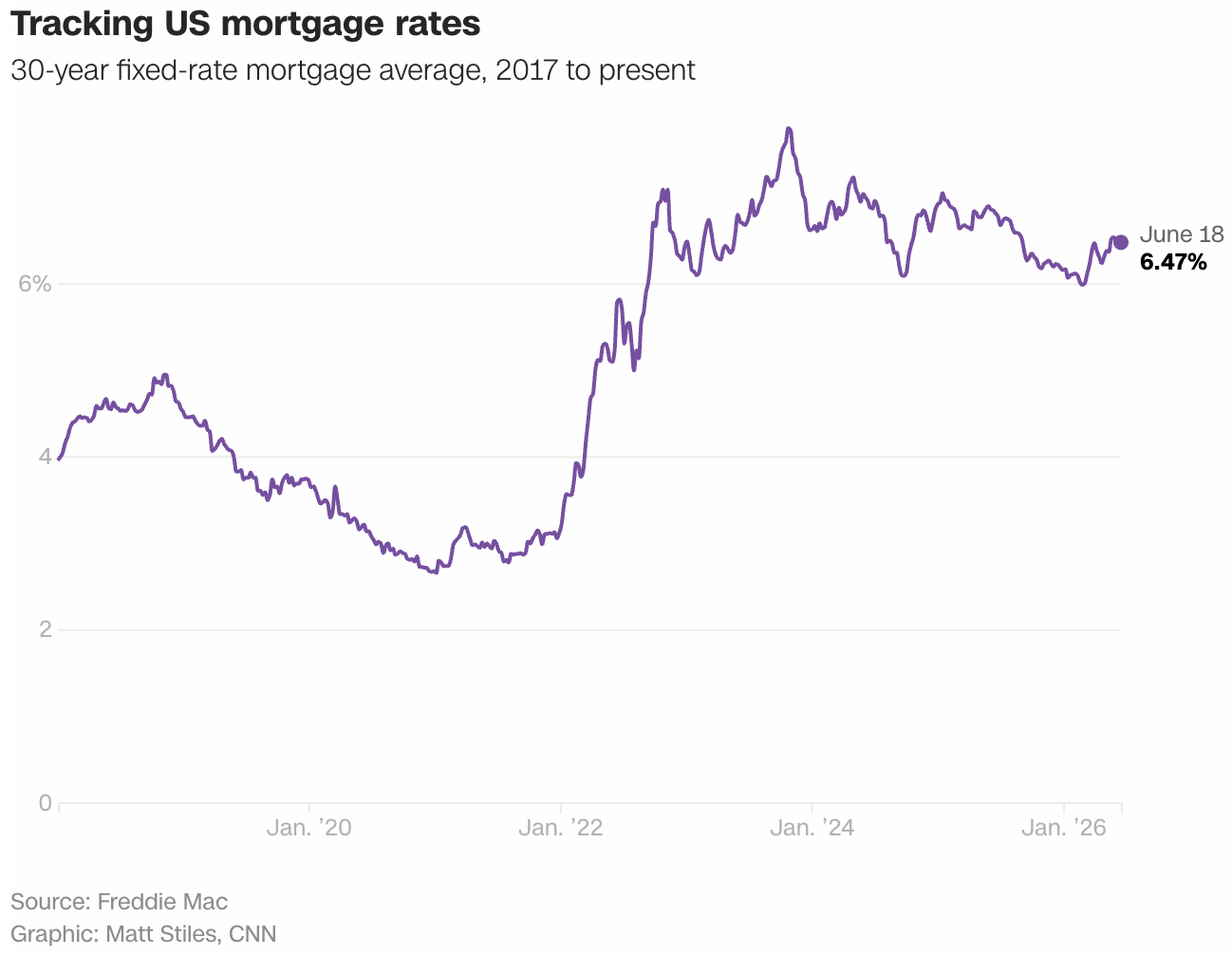
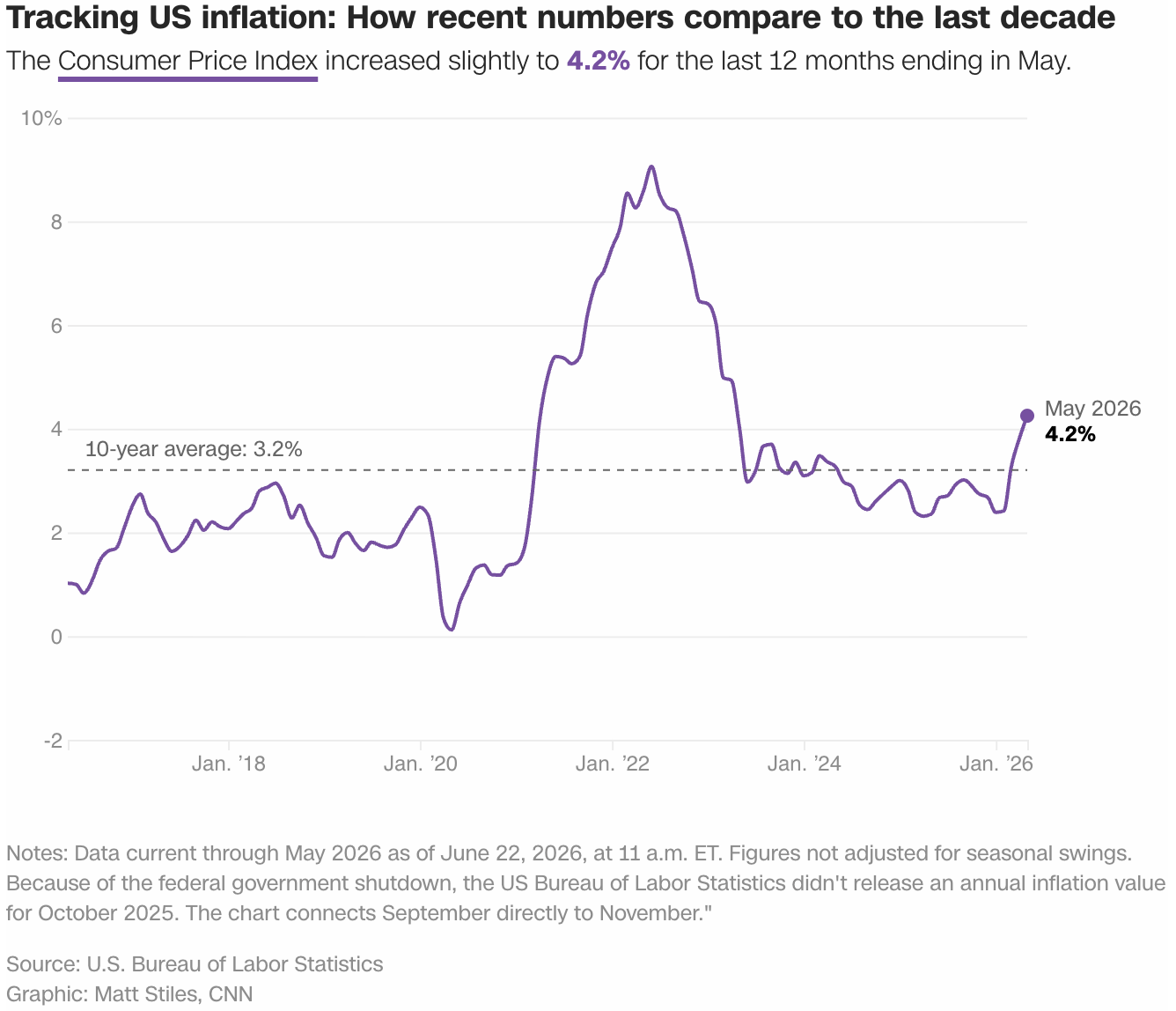
Mortgage rates eased slightly this week, with the average 30-year fixed rate falling to 6.47% from 6.52%, offering some relief to homebuyers. However, the decline may be temporary as the Federal Reserve signaled it could consider additional rate hikes following a recent inflation surge. U.S. inflation reached 4.2% in May, its highest level in three years, while stronger-than-expected employment data reinforced concerns that price pressures may persist
Despite elevated borrowing costs, housing demand remains resilient
Pending home sales rose 3.8% month-over-month and 4.8% year-over-year in May, suggesting that many buyers are adjusting to mortgage rates above 6% as the new normal
Analysts caution that if inflation remains elevated, mortgage rates could stay high for longer, limiting affordability improvements in the housing market
What the Iran war cost the Pentagon, the economy — and Trump (CNN, 8 minute read)
The economic impact of the 100+ day U.S.-Iran conflict has been significant, with estimates suggesting the war has cost the U.S. government roughly $40B, including $26B spent on munitions alone, while the Pentagon has reportedly requested $80B in supplemental funding. Energy markets were heavily affected, with U.S. gas prices rising from below $3 per gallon before the conflict to over $4, while diesel prices climbed from about $3.80 to more than $5 per gallon, adding an estimated $253 in extra energy costs per household and $27.1B in additional diesel expenses nationwide
Globally, the conflict removed approximately 1.15 billion barrels of oil supply from the market, forcing countries to draw on emergency reserves and alternative suppliers
The economic effects extended beyond energy: U.S. inflation rose above 4%, its highest level in three years, consumer confidence remained near historic lows, and mortgage rates stayed elevated around 6.5%
Despite the conflict, major stock indexes reached record highs, demonstrating continued investor confidence
IPO & EXITS
SpaceX stock down again, shaving off some IPO gains; confirms debt offering (Yahoo Finance, 2 minute read)
SpaceX’s post-IPO rally is showing signs of cooling. After surging as high as $225 per share and briefly overtaking Amazon and Microsoft to become the world’s fourth-most valuable public company, the stock has now fallen for three straight trading days, though it remains about 27% above its $135 IPO price. The pullback comes as investors weigh the company’s first-ever bond offering, reportedly worth up to $20B, which will be used primarily to refinance debt tied to SpaceX’s acquisition of xAI. The bigger concern may be what comes next
Analysts estimate that by early September, insiders could gain the ability to sell up to 44% of outstanding shares, increasing the public float by roughly 900% from current levels
While investor enthusiasm remains strong, new debt, additional share supply, and SpaceX’s $1.8T valuation are beginning to test the sustainability of its post-IPO momentum
SpaceX Acquires AI Coding Tool Cursor For $60B In Year’s Largest Startup M&A Deal (Crunchbase, 4 minute read)
SpaceX announced a $60B all-stock acquisition of Anysphere, the company behind AI coding platform Cursor, making it one of the largest venture-backed acquisitions ever and the biggest announced deal of 2026. The transaction represents a major win for Anysphere’s investors, including Andreessen Horowitz, Thrive Capital, Accel, and Coatue, after the company raised $3.4B in funding and was valued at approximately $30B as recently as November. The acquisition expands SpaceX’s presence in enterprise AI software, a fast-growing market fueled by AI-assisted coding tools
Cursor reportedly surpassed $1B in annualized revenue last year
Investors welcomed the move, sending SpaceX shares up roughly 16% following the announcement
The deal reflects a broader M&A rebound, with venture-backed acquisitions reaching $182.7B across 1,177 deals through mid-June, up from $106.7B across 1,132 deals a year earlier
8alpha.ai is an AI fintech transforming cash-generating businesses into scalable, AI-powered companies. We provide revenue-based financing and hands-on AI transformation, delivering no zeros with unlimited upside. We’re the architects building financial infrastructure for the next generation of investors and startups.
Become part of our revolution.
Happy reading,
8alpha.ai’s Research & Investment Team