The AI’s Hidden Price Tag
Welcome to AI8’s weekly newsletter, your ultimate source for curated insights and updates from the dynamic world of venture capital!
From billion-dollar rounds to market-defining shifts, we deliver the intelligence powering the global investment landscape, moving investors and innovators forward. At 8alpha.ai, we’re not waiting for the future of capital, we’re building it. Stay sharp, stay curious, and stay ahead.
STARTUPS
ROUNDS AND UNICORNS
The Week’s 10 Biggest Funding Rounds: AI Drives Another Spree Of Megadeals (Crunchbase, 5 minute read)
Baseten: Raised $1.5 billion in a Series F round at a $13 billion valuation to expand its AI inference platform. The round was co-led by Altimeter Capital, Conviction Partners, Spark Capital, Sands Capital, and Wellington Management
AppsFlyer: Secured more than $1 billion in Series E funding at a $2.7 billion valuation. Investors reportedly include Unity, Meta, Moloco, and Google
Groq: Raised $650 million to scale its AI inference cloud infrastructure. The funding was led by Infinitum and Disruptive
Ollin Biosciences: Closed a $330 million Series B round to advance therapies for vision-threatening diseases. TCG Crossover and Arch Venture Partners led the investment
General Intuition:Raised $320 million in Series A funding at a $2.3 billion valuation to develop foundational AI models. Khosla Ventures led the round, with participation from Jeff Bezos and General Catalyst
ECONOMIC SNAPSHOT
The Data-Center Boom Is Sparking a Third Wave of Inflation (The Wall Street Journal, 6 minute read)
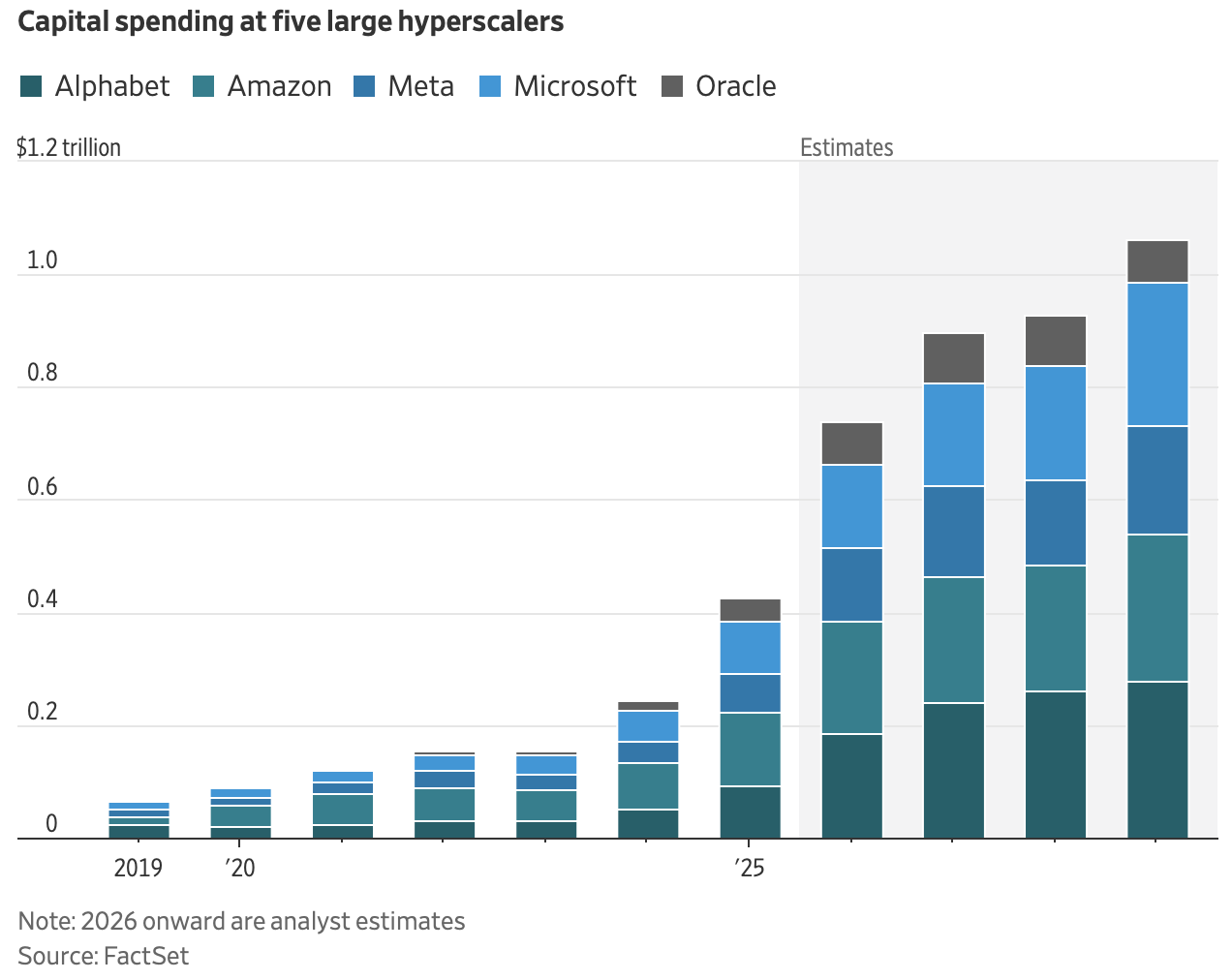
The AI infrastructure boom is emerging as a new source of inflation, even as trade tensions ease and energy prices decline. The five largest hyperscalers, Alphabet, Amazon, Meta, Microsoft, and Oracle, are expected to spend $741 billion on capital expenditures in 2026, a 75% increase from last year, while total AI infrastructure investment could reach $8 trillion by 2032. The surge in demand for data centers, chips, memory, storage, electricity, and construction is pushing up costs across the broader economy, contributing to higher prices for consumer electronics and power
Consumer prices for software and accessories are up 15%, wholesale electronic components have risen 27%, and data centers are expected to drive nearly half of U.S. electricity demand growth through 2030
Although economists expect AI to boost productivity and eventually reduce inflation, 81% of economists surveyed by the National Association for Business Economics believe the AI buildout will increase inflation over the next year
As a result, AI-driven investment is becoming a key near-term challenge for monetary policy
Apple’s Sweeping Price Increases Bring Home the Costs of the AI Era (Bloomberg, 6 minute read)
Apple has announced broad price increases across its hardware lineup, highlighting how the AI infrastructure boom is beginning to affect everyday consumer technology. Products across the Mac, iPad, and home device families saw price increases ranging from 17% to 54%, as soaring demand for AI chips, advanced memory, storage, and data center infrastructure drives up component costs across the industry. Rather than absorbing these higher costs, Apple chose to protect its profit margins by passing part of the increased expense on to consumers
The company did not raise iPhone prices, though future increases remain possible
The changes highlight how the AI investment boom is beginning to raise costs for everyday consumers, making personal technology more expensive across the industry
US economy grew at 2.1% in first quarter (Fox Business, 3 minute read)
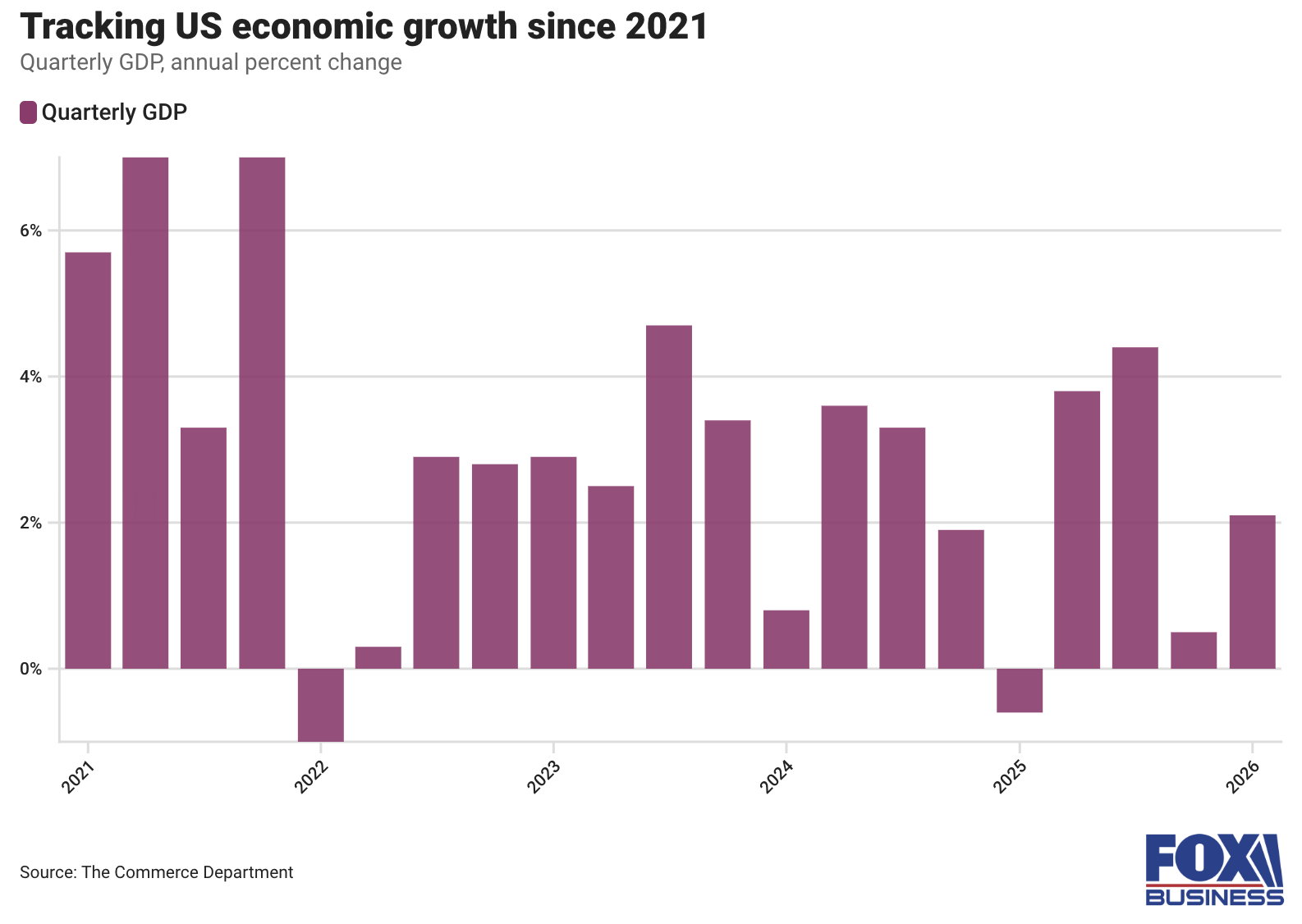
The U.S. economy grew at an annualized rate of 2.1% in the first quarter of 2026, outperforming economists' expectations of 1.6% and matching the overall pace of growth recorded in 2025. Growth was driven by business investment, exports, government spending, and consumer spending, with the information technology sector leading gains as companies increased investments in AI infrastructure, data centers, software, and computing equipment
However, economists noted that consumer spending has become increasingly reliant on savings and credit
At the same time, higher interest rates, slowing wage growth, and persistent inflation continue to pressure households and interest-rate-sensitive sectors such as housing
Looking ahead, analysts expect the U.S. economy to remain resilient but slow, forecasting GDP growth of around 1.9% in both 2026 and 2027, with AI-related investment continuing to be a key driver of economic activity
Kevin Warsh’s tough talk on inflation reassures investors (Financial Times, 4 minute read)
Federal Reserve Chair Kevin Warsh's hawkish stance on inflation has strengthened the Fed's credibility with investors, helping push 10-year market inflation expectations down from above 2.5% in mid-May to about 2.2%, their lowest level in more than a year. The decline reflects both easing oil prices following the Iran ceasefire and growing confidence that the Fed will prioritize price stability over political pressure to cut interest rates
Despite May inflation remaining elevated at 4.1% and core PCE rising to 3.4%, markets continue to expect at least one quarter-point rate hike this year
Some economists argue that Warsh's firm anti-inflation messaging may itself help contain inflation expectations, potentially reducing the need for multiple future rate increases
Supreme Court says Fed’s Cook can keep her job for now, but it upholds other Trump firings (AP, 5 minute read)
The U.S. Supreme Court significantly expanded presidential authority by ruling that presidents can remove the heads of most independent federal agencies without cause, overturning a 91-year-old precedent. However, in a 5-4 decision, the Court made an exception for the Federal Reserve, allowing Fed Governor Lisa Cook to remain in her position while challenging President Trump's attempt to remove her over alleged mortgage fraud, which she denies
The ruling preserves the Fed's independence for now, a closely watched outcome given its influence over interest rate policy and financial markets
Meanwhile, the broader decision strengthens executive control over agencies such as the Federal Trade Commission and National Labor Relations Board, potentially reshaping the balance of power between the White House and independent regulators
US banks would lose $700bn in economic crash, Fed stress tests find (Financial Times, 5 minute read)
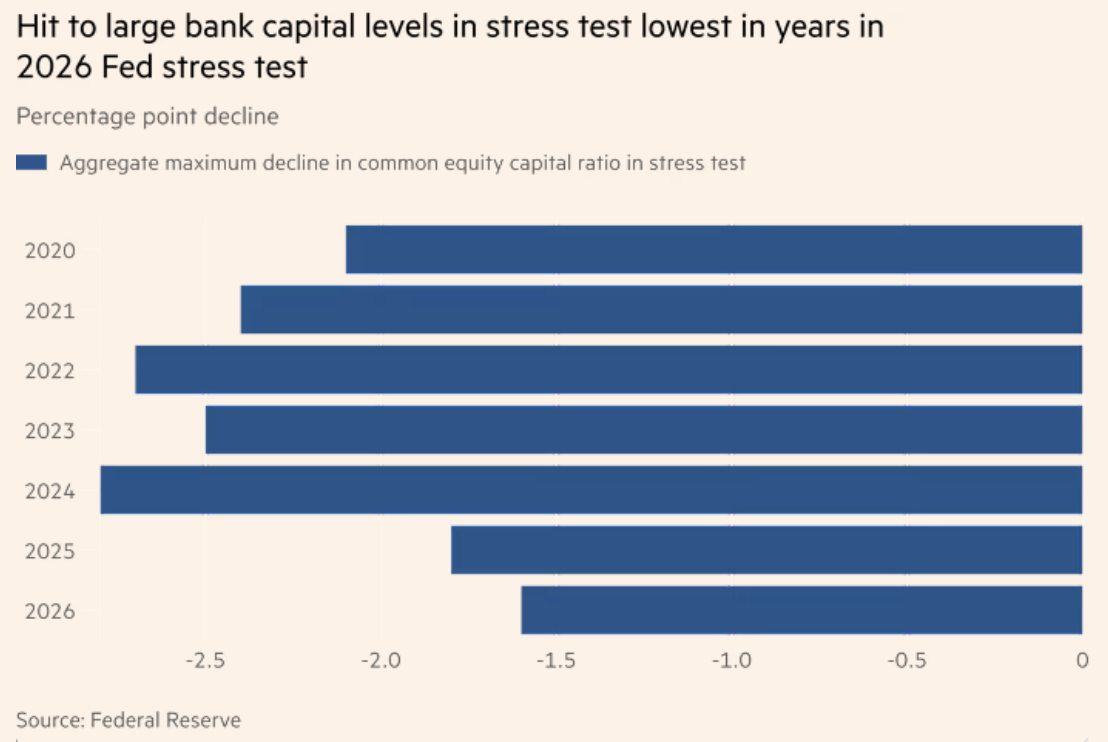
The Federal Reserve's 2026 stress tests found that the 32 largest U.S. banks would collectively lose more than $708 billion under a severe recession scenario, including 10% unemployment, a 30% decline in home prices, and significant losses in credit cards, commercial real estate, and corporate lending, while still remaining above minimum regulatory capital requirements. The tests showed banks' equity capital would decline by just 1.6 percentage points, the smallest drop in at least seven years, underscoring the resilience of the banking system
Following the results, several major banks, including JPMorgan, Goldman Sachs, Morgan Stanley, Citi, and Wells Fargo, announced higher dividends and expanded share buyback programs
The stress test's impact was muted, however, as the Fed is keeping capital requirements unchanged through 2027 while it reviews the testing framework and broader bank capital rules
IPO & EXITS
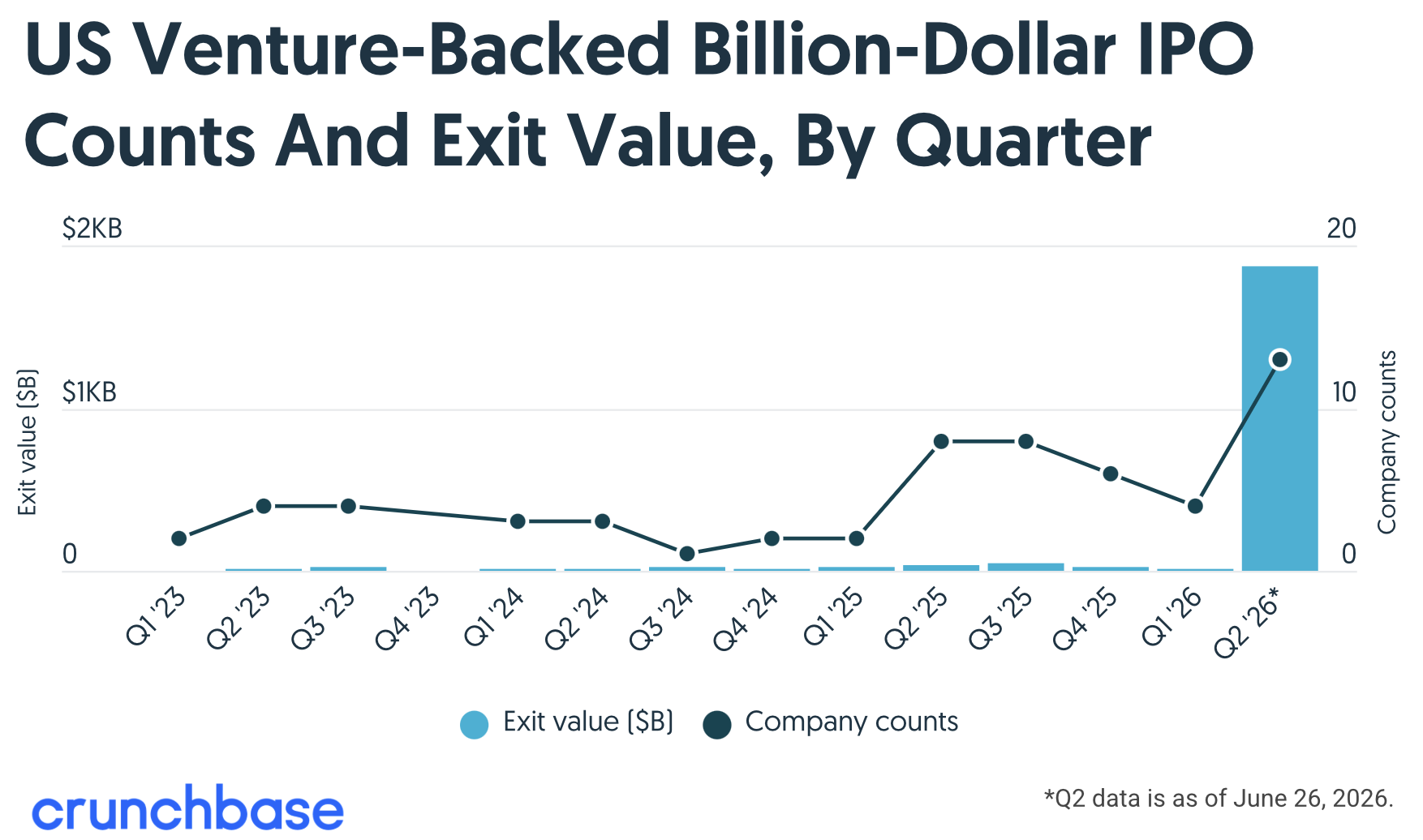
Crunchbase Data: Q2 Brought The Most Billion-Dollar Startup Exits Since 2021 (Crunchbase, 5 minute read)
Startup exits valued at $1 billion or more reached their highest level since the 2021 market peak during the second quarter of 2026, driven by a surge in megadeals rather than a higher number of transactions. The standout was SpaceX's record-breaking IPO, which raised $75 billion and achieved a $2.1 trillion market capitalization on its first trading day, followed by its $60 billion acquisition of AI coding startup Cursor, the largest private startup acquisition ever
Other notable exits included Cerebras Systems' $5.55 billion IPO, which valued the company at about $38 billion, and Quantinuum's $1.7 billion IPO, debuting with a $15.6 billion market capitalization
Looking ahead, confidential IPO filings from Anthropic and OpenAI suggest the trend toward larger AI-driven exits is likely to continue
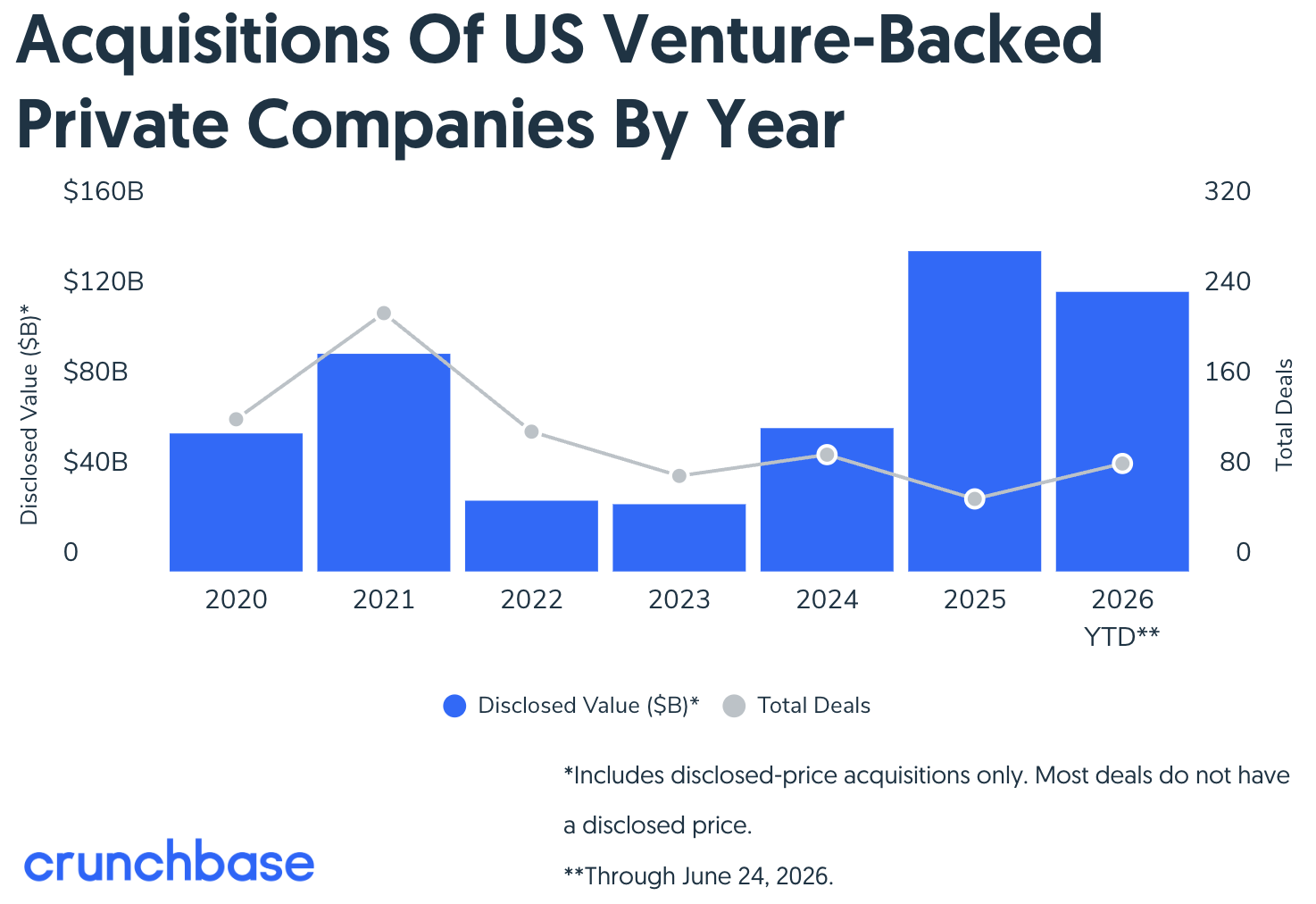
Cursor Deal Puts US On Track For Record Startup M&A Year (Crunchbase, 4 minute read)
Startup M&A activity is on pace for a record year in 2026, with U.S. acquirers spending at least $119.8 billion on venture-backed companies. Nearly half of that total ($60 billion) comes from SpaceX's acquisition of AI coding startup Cursor (Anysphere), the largest startup acquisition ever and almost double Google's $32 billion purchase of Wiz. Beyond AI, biotech has been the most active sector, accounting for half of the 10 largest deals, led by Eli Lilly's acquisition of Kelonia Therapeutics for up to $7 billion
Other major deals include Capital One's $5.15 billion acquisition of Brex, Qualcomm's $4 billion purchase of Modular, and separate $3.6 billion AI software acquisitions by Salesforce and Autodesk
The surge in dealmaking reflects strong confidence in AI and biotech, putting 2026 on track to become a record year for startup acquisitions
OpenAI Considers Delaying IPO To 2027 After SpaceX's Rocky Debut, Report Says (Forbes, 6 minute read)
OpenAI is reportedly considering delaying its IPO from 2026 to 2027 after advisers warned that weak market conditions and the sharp decline in SpaceX's shares following its record IPO could limit investor demand. CEO Sam Altman is reportedly unwilling to accept a valuation below $1 trillion, despite OpenAI's current $852 billion valuation, $13 billion in annual revenue, and $21 billion net loss, alongside plans to invest $600 billion in compute and AI infrastructure through 2030
As a result, the company is exploring new revenue streams, including advertising and e-commerce partnerships, while scaling back less profitable initiatives
The potential delay reflects broader investor caution over whether AI companies can justify their lofty valuations despite continued long-term optimism for the sector
Baidu chip IPO channels extreme AI frenzy (Reuters, 4 minute read)
China's AI chip boom is fueling soaring valuations, with Baidu's chip unit Kunlunxin reportedly targeting a $50 billion valuation in its planned Hong Kong IPO, up from just $3 billion in a funding round six months earlier. The dramatic increase reflects strong demand for domestic AI chips amid U.S. export restrictions and China's push for semiconductor self-sufficiency, with local manufacturers now accounting for 41% of China's AI accelerator server market
Analysts expect Kunlunxin's revenue to surpass 14 billion yuan ($2 billion) by 2027, more than tripling from last year
Kunlunxin's valuation now exceeds 80% of Baidu's market value, even as Baidu shares have fallen 20% this year
The surge adds to growing concerns that the global AI boom is entering bubble territory
8alpha.ai is an AI fintech transforming cash-generating businesses into scalable, AI-powered companies. We provide revenue-based financing and hands-on AI transformation, delivering no zeros with unlimited upside. We’re the architects building financial infrastructure for the next generation of investors and startups.
Become part of our revolution.
Happy reading,
8alpha.ai’s Research & Investment Team