More Capital, Tighter Gate
Welcome to AI8’s weekly newsletter, your ultimate source for curated insights and updates from the dynamic world of venture capital!
From billion-dollar rounds to market-defining shifts, we deliver the intelligence powering the global investment landscape, moving investors and innovators forward. At 8alpha.ai, we’re not waiting for the future of capital, we’re building it. Stay sharp, stay curious, and stay ahead.
STARTUPS
ROUNDS AND UNICORNS
The Week’s 10 Biggest Funding Rounds: Transportation And Biotech Take The Lead (Crunchbase, 5 minute read)
Slate Auto (Electric Vehicles): A $650M Series C round led by TWG Global will support scaling production of lower-cost, customizable electric pickup trucks, with initial deliveries planned for later this year
Beeline Medicines (Biotech): Emerging from stealth, the company secured $300M in Series A funding from Bain Capital to advance precision therapies for autoimmune and inflammatory diseases, including five programs from Bristol Myers Squibb
Glydways (Autonomous Transportation):Backed by a $170M Series C led by Suzuki Motor, ACS Group, and Khosla Ventures, the company is preparing to launch autonomous transit pod pilots across three cities
Factory (AI Software Development): Khosla Ventures led a $150M Series C that values the startup at $1.5B, as it works to introduce autonomy into software engineering workflows
Terremoto Biosciences (Biotech): The company raised $108M in Series C funding from investors including RA Capital to further develop small molecule treatments for cancer and rare diseases
These 3 Charts Show How Venture Capital Has Concentrated At The Top In 2026 (Crunchbase, 4 minute read)
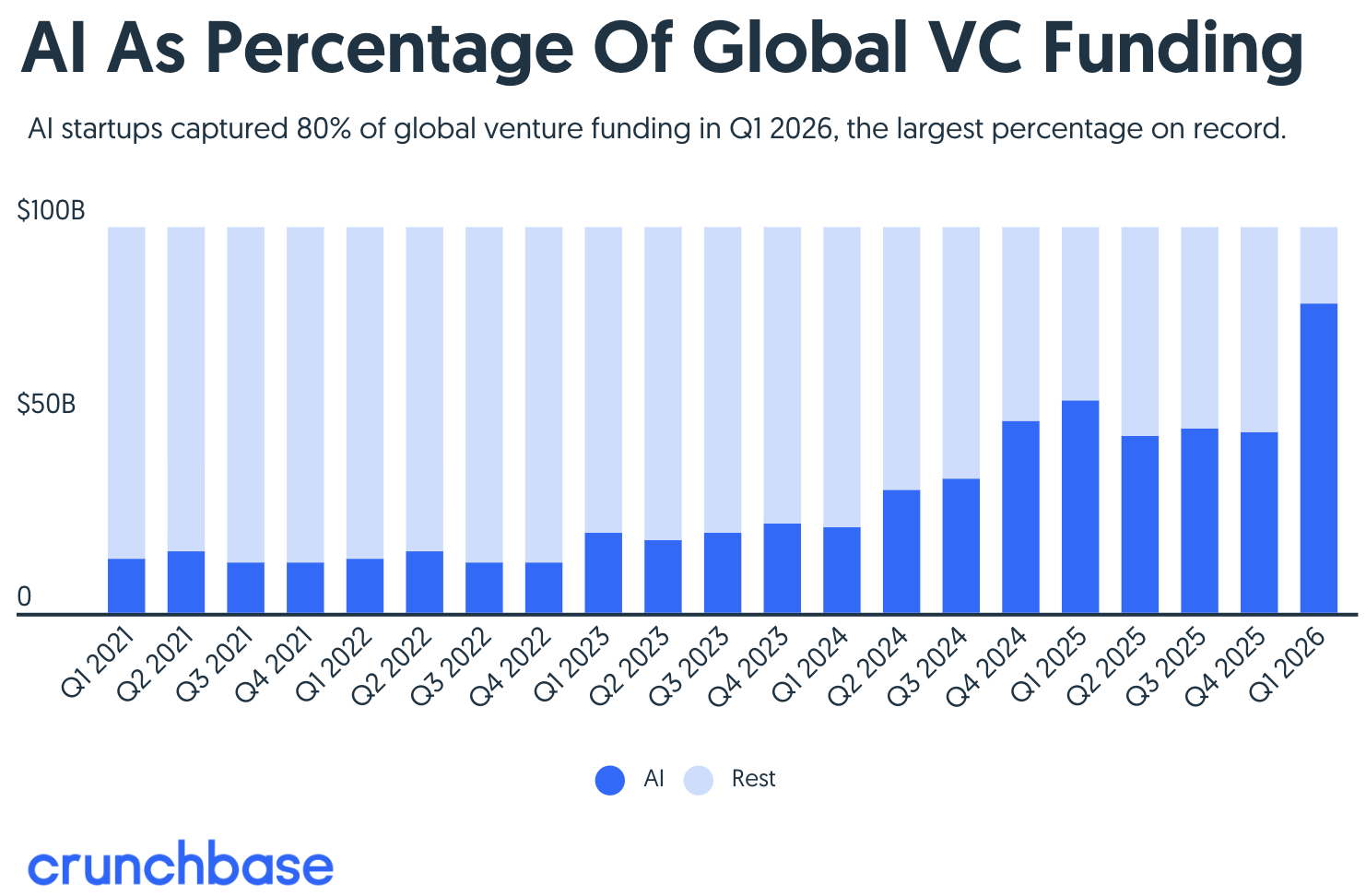
Q1 2026 set a record for venture funding, but the surge was driven by a few massive deals rather than broader activity. Investment has become highly concentrated, with AI capturing 80% of global venture funding, led by a handful of U.S.-based companies. Just four companies—OpenAI, Anthropic, xAI, and Waymo—accounted for nearly 65% of total funding
At the same time, deal count continues to decline globally, extending a trend since 2021
In North America, funding surged 190% YoY while deal volume fell 26%, with similar patterns in Europe and Latin America
Only Asia saw a modest 5% increase in deal count, reinforcing a shift toward capital concentration in fewer, larger late-stage bets
The AI gold rush is pulling private wealth into riskier, earlier bets (TechCrunch, 5 minute read)
Family offices and private wealth investors are increasingly bypassing traditional VC funds to invest directly in startups, particularly in AI, as more value is created before IPOs. This shift is driven by a changing market structure, where companies stay private longer and access to top deals is no longer limited to venture firms. The trend is accelerating: in February alone, family offices made 41 direct startup investments, nearly all in AI, and 83% now view AI as a top strategic priority, with more than half already having exposure
Some are going further by incubating companies themselves, backing them with multi-million dollar seed capital and taking operational roles
High-profile examples include Jeff Bezos’ $6.2B robotics startup at a ~$30B valuation and Arena’s $230M investment in AI chip startup Positron
This marks a shift in VC investing: from diversified portfolios to fewer, high-conviction bets with larger stakes, deeper involvement, and higher risk to gain early exposure to AI
ECONOMIC SNAPSHOT
Businesses race to apply for tariff refunds (NPR, 4 minute read)
Businesses have begun applying for tariff refunds after the Supreme Court struck down most of Trump’s tariffs, with the U.S. government expected to return up to $166 billion. In the initial phase, about $127 billion is tied to importers already enrolled for electronic payments, with refunds expected within 60–90 days. This first wave mainly covers more recent, still-unfinalized tariff payments, with older claims to follow
While this marks a major win for importers, many of whom paid tariffs upfront months or even a year ago, the impact on consumers is less clear
Tariff costs were distributed across the supply chain, meaning manufacturers, importers, retailers, and shoppers all absorbed portions
As a result, refunds will go mainly to importers, with any benefit to consumers coming indirectly through lower prices or discounts, not direct payments
Messy War, Happy Stock Markets (The New York Times, 6 minute read)
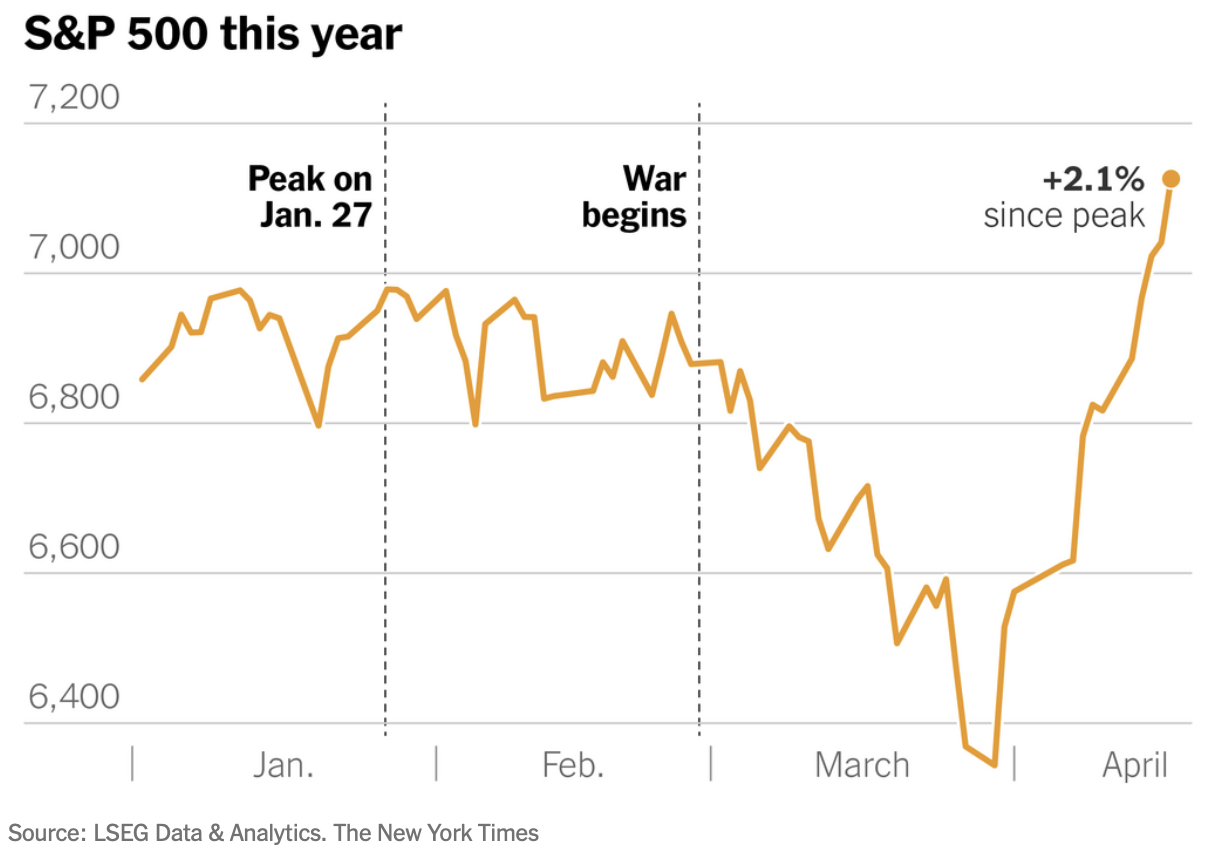
Despite the Iran war increasing risks of inflation, slower growth, and recession, global stock markets remain near record highs, with the S&P 500 surpassing pre-war levels (since Feb. 28) and extending its rally. This highlights a growing disconnect between economic stress and market performance. Markets are focusing on corporate earnings rather than short-term disruption, with S&P 500 companies expected to post double-digit earnings growth for a sixth straight quarter
Large tech firms, particularly those benefiting from AI, continue to drive index performance, outweighing weakness in consumer-facing companies, some of which have seen double-digit stock declines
Investor behavior is also playing a role. Markets have repeatedly rebounded after geopolitical shocks, leading to a “buy the dip” mindset
As a result, equities are being driven more by expectations of long-term profitability than by near-term economic risks
What Warsh should do at the Fed (Financial Times, 5 minute read)
Donald Trump’s nomination of Kevin Warsh as Fed chair comes at a critical moment, with the central bank facing three key challenges: near-term economic uncertainty (including the Iran war), persistent inflation above the 2% target, and longer-term questions about policy tools like quantitative easing. Warsh is expected to reassess the Fed’s purpose, strategy, and structure, including clarifying its dual mandate, strengthening independence, and improving communication
Proposed changes include replacing “dot plots” with scenario analysis and expanding engagement with markets and experts to better guide expectations
On policy, elevated inflation and economic resilience make near-term rate cuts unlikely, despite political pressure
In the near term, elevated inflation and steady economic conditions may limit the case for rate cuts, while the Fed continues to balance its goals of price stability and employment
UAE in talks with U.S. for possible financial lifeline, WSJ says (Fortune, 3 minute read)
The United Arab Emirates (UAE) has begun discussions with the U.S. about a potential financial backstop, including a currency swap line with the Federal Reserve, as concerns grow over the economic impact of the Iran war. The UAE is a major oil exporter and one of the Middle East’s key financial and trade hubs, making it particularly exposed to disruptions in global energy flows. The war has affected shipments through the Strait of Hormuz, which carries roughly 20% of global oil supply, threatening a critical source of dollar inflows
The talks highlight rising risks to the UAE’s economy, including potential capital flight, pressure on foreign reserves, and strain on its role as an international financial center
Despite initially avoiding the worst economic fallout, the country has faced over 2,800 missile and drone attacks since February 28, along with damage to energy infrastructure, underscoring the growing economic and security pressures
IPO & EXITS
Revolut CEO Storonsky Says Digital Bank’s IPO Is Two Years Out (Bloomberg, 4 minute read)
Revolut plans to go public no earlier than 2028, as CEO Nik Storonsky focuses on building scale and credibility, noting that public companies are generally seen as more trusted. This pushes back expectations for what had been one of Europe’s most anticipated IPOs. In the meantime, the company will continue using secondary share sales every 1–2 years to provide liquidity for investors and employees while remaining private
Its most recent secondary deal in November 2025 valued Revolut at $75 billion, up from $45 billion in 2024, reflecting rapid growth
Revolut is also accelerating international expansion, particularly in the U.S., where it has applied for a banking license
Approval could take 4 to 12 months, enabling direct access to Federal Reserve systems and new products like lending and credit cards
AI chipmaker Cerebras files to go public after scrapping IPO plans last year (CNBC, 6 minute read)
Cerebras, an AI chipmaker, has filed to go public on Nasdaq under the ticker CBRS, reporting a strong financial turnaround with $510M in revenue and $87.9M in net income in 2025, compared to a $485M loss in 2024, with revenue growing ~76% year-over-year. The company has significant future demand, with $24.6B in contracted revenue and a major $20B+ deal with OpenAI to supply up to 750 megawatts of computing power through 2028, with potential expansion to 2 gigawatts by 2030
OpenAI has also provided a $1B loan at 6% interest and holds warrants tied to future purchases
Cerebras is shifting from selling chips to offering AI compute as a cloud service, competing with major players like Nvidia, Amazon, and Google
Backed by a $23B valuation in 2026, the IPO comes amid renewed investor demand for large AI companies
Employees at mega-IPO candidates are opting out of tender offers in a ‘champagne problem’ (PitchBook, 6 minute read)
Employees at top private companies like OpenAI, Anthropic, and SpaceX are increasingly holding onto their shares instead of selling in tender offers, even as investor demand surges. Tender activity reached $18.4B in 2025, but supply is tightening as employees expect higher valuations at IPO. For example, OpenAI saw $10.3B in demand but only $6.6B in shares sold, leaving $4B unmet, while Anthropic employees held shares at a $350B valuation
These companies have seen rapid growth. Anthropic’s revenue exceeded $30B annually, and OpenAI’s valuation rose from $157B (2024) to $852B
This reflects a shift in pre-IPO dynamics: at top-tier companies, employees are less pressured to sell due to strong compensation and high conviction in future value
As a result, liquidity is becoming more constrained and concentrated, with the top five private companies accounting for 55.6% of secondary trading value
Private market secondaries are booming amid an IPO slowdown (JP Morgan, 4 minute read)
Global private market secondaries reached a record $226 billion in 2025, up 41% year-over-year, driven by growing demand for liquidity in an increasingly illiquid private market. The slowdown in IPOs has created a major exit bottleneck, with roughly 30,000 companies and $3.7 trillion in unrealized value still waiting for exits, pushing investors to sell stakes through secondary markets instead
Secondaries have become a key liquidity tool for both LPs and GPs, especially as private market assets are expected to exceed $18 trillion by 2027
This trend reflects a broader shift: rather than waiting for IPOs or acquisitions, investors are increasingly trading ownership within private markets
However, the market carries risks: secondary deals are often opaque, with limited disclosure and challenging valuations
WHAT A TIME TO BE ALIVE
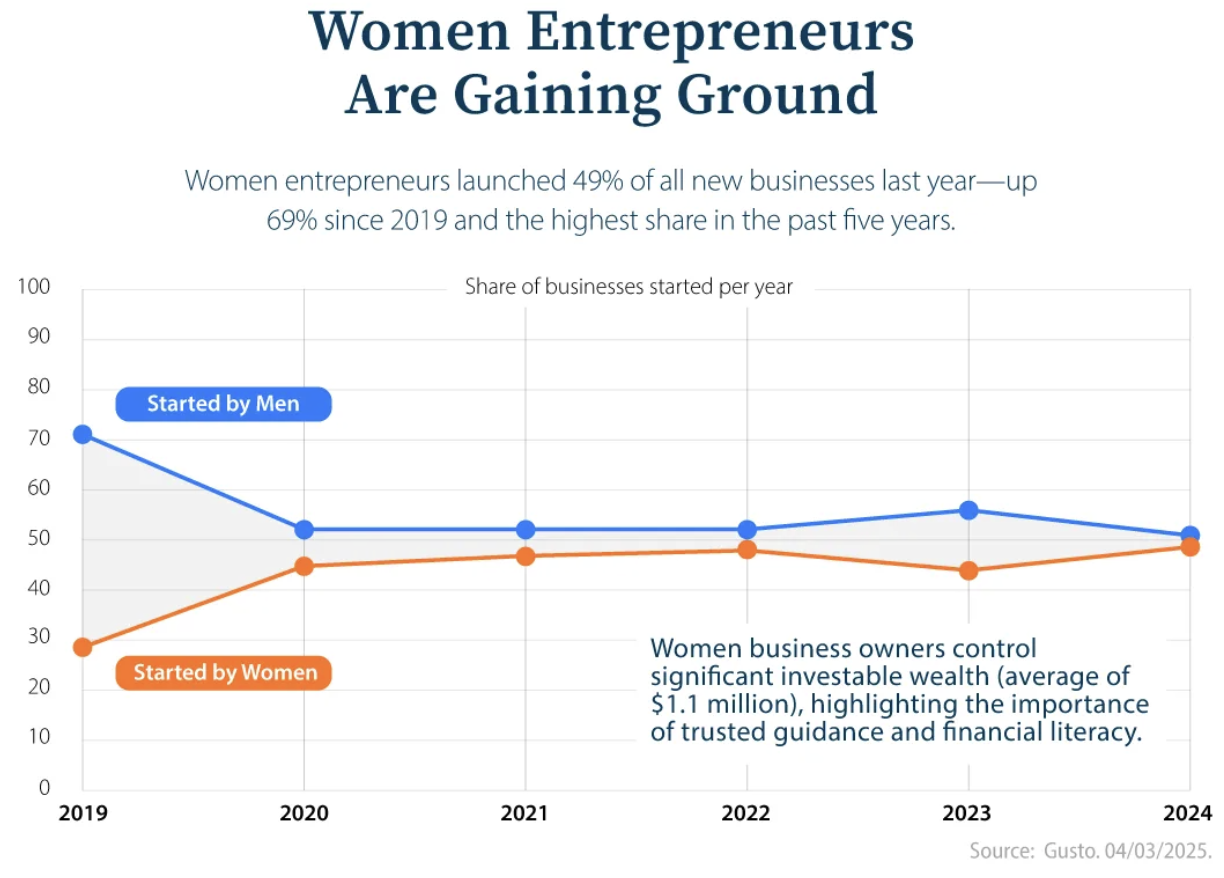
5 Ways Women Are Reshaping Investing (Visual Capitalist, 6 minute read)
Women are playing a growing role in investing, driven by rising entrepreneurship, income, and wealth. They now launch 49% of new U.S. businesses (up 69% since 2019) and control increasing levels of capital, with average assets of ~$1.1M among women business owners. Their influence is set to expand significantly: women’s share of U.S. wealth is projected to grow from 31% ($10T) in 2018 to 38% ($34T) by 2030, with nearly 25% of affluent households ($250K+ assets) led by married female breadwinners
At the same time, earnings are rising, with women earning 84 cents per dollar in 2022 vs. 61 cents in 1960, increasing their investment capacity
As their financial role grows, women are reshaping expectations around investing by seeking more frequent advisor engagement, greater transparency, and stronger personal relationships
8alpha.ai is an AI fintech transforming cash-generating businesses into scalable, AI-powered companies. We provide revenue-based financing and hands-on AI transformation, delivering no zeros with unlimited upside. We’re the architects building financial infrastructure for the next generation of investors and startups.
Become part of our revolution.
Happy reading,
8alpha.ai’s Research & Investment Team