Are We Building the Technology That Could End Us?
Welcome to AI8’s weekly newsletter, your ultimate source for curated insights and updates from the dynamic world of venture capital!
From billion-dollar rounds to market-defining shifts, we deliver the intelligence powering the global investment landscape, moving investors and innovators forward. At 8alpha.ai, we’re not waiting for the future of capital, we’re building it. Stay sharp, stay curious, and stay ahead.
STARTUPS
ROUNDS AND UNICORNS
The Week’s 10 Biggest Funding Rounds: Large Rounds For AI Infrastructure, Space Tech And Investment Management Lead (Crunchbase, 5 minute read)
Temporal Technologies (AI Infrastructure): Bellevue, Washington-based Temporal Technologies, developer of an open source platform for AI agents and enterprise systems, secured $550 million in Series E funding led by Lightspeed, Wellington Management, Goldman Sachs Alternatives, and Tiger Global, valuing the company at $12.55 billion
Impulse Space (Space Tech): Redondo Beach, California-based Impulse Space, which builds vehicles for moving payloads across and between orbits, secured $308 million in Series D extension funding, bringing the combined round total to $808 million
Ridgeline (Investment Management): Incline Village, Nevada-based Ridgeline, an AI-enabled investment management platform, picked up $250 million in a Series E led by founder and chairman Dave Duffield, valuing the company at $1.45 billion
Cornelis Networks (Networking): Wayne, Pennsylvania-based Cornelis Networks, which develops networking technology for AI and high-performance computing workloads, closed $205 million in new funding backed by IAG Capital Partners
Factory (AI Software Development): San Francisco-based Factory, a provider of AI tools for enterprise software development, announced $200 million in funding at a $5 billion valuation, backed by a long list of venture firms and individual investors
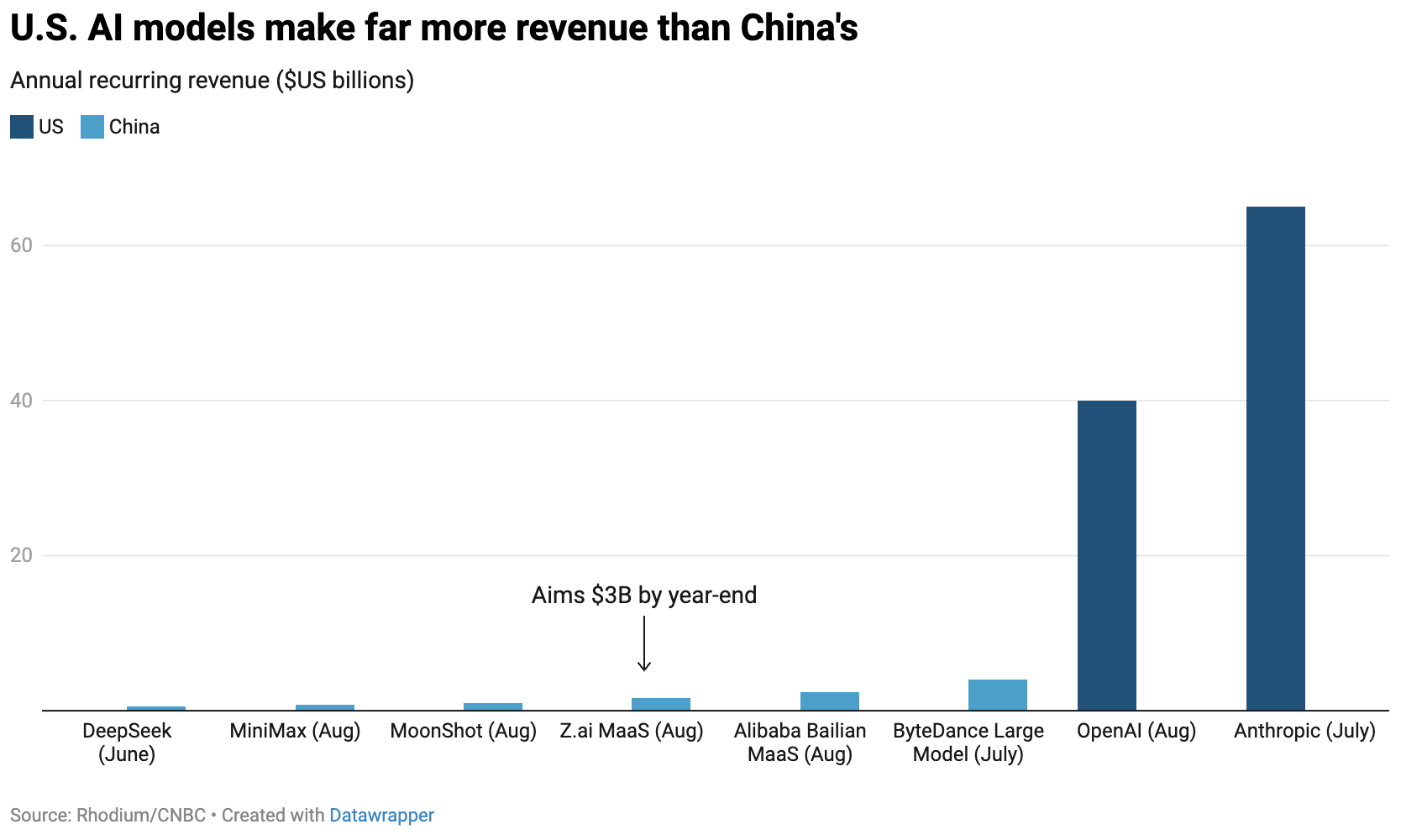
OpenAI and Anthropic are making 10 times more revenue than all Chinese AI models combined, research group Rhodium says (CNBC, 6 minute read)
Chinese AI companies' combined revenue remains far below their US counterparts despite rapid adoption, with Rhodium Group estimating all Chinese AI models generate only about 10% of OpenAI and Anthropic's revenue combined. DeepSeek's annual recurring revenue (ARR) stood at just $500 million, followed by MiniMax at $800 million and Moonshot at $1 billion, while even ByteDance ($4 billion) and Alibaba ($2.4 billion) fell far short of OpenAI's $40 billion and Anthropic's $65 billion. Despite the revenue gap, valuations for Chinese startups look stretched relative to revenue, with Moonshot and DeepSeek trading at estimated 50x and 163x revenue multiples, compared to 34x for OpenAI and 21x for Anthropic. Anthropic is reportedly expected to list in the US next month, while Moonshot has confidentially filed for a Hong Kong IPO and DeepSeek is also said to be preparing a listing
Z.ai raised its year-end ARR forecast to $3 billion, up from a previous $2.4 billion estimate
Rhodium found more than 60% of equity investment in Chinese AI chips and servers came from state-affiliated sources
Chinese AI labs are exploring ways to capture more revenue from third parties running their open-source models independently
Family offices are clamoring for AI investments (TechCrunch, 5 minute read)
Family offices are increasingly bypassing traditional venture fund structures to chase fast, high-conviction AI bets, often buying existing shares directly in the secondary market rather than committing to blind-pool funds, according to advisors interviewed for this piece. Family offices collectively oversaw $5.5 trillion in wealth as of 2024, projected to reach $9.5 trillion by 2030, and alternative investments now make up 42% of the average family office portfolio, per UBS. Direct deal activity, which peaked in 2021 at 17,460 deals worth roughly $1.05 trillion before falling 53% by late 2023 amid rising rates, is now rebounding, this time with fewer, larger checks concentrated in AI names like Anthropic and OpenAI
A J.P. Morgan Private Bank report found 65% of global family offices plan to prioritize AI investments despite valuation concerns
Secondary-market deals are seen as comparatively "de-risked" since target companies often already have revenue and customer traction
Advisors warn that if the AI boom turns into a bubble, the fallout could spread well beyond AI-focused stocks
ECONOMIC SNAPSHOT
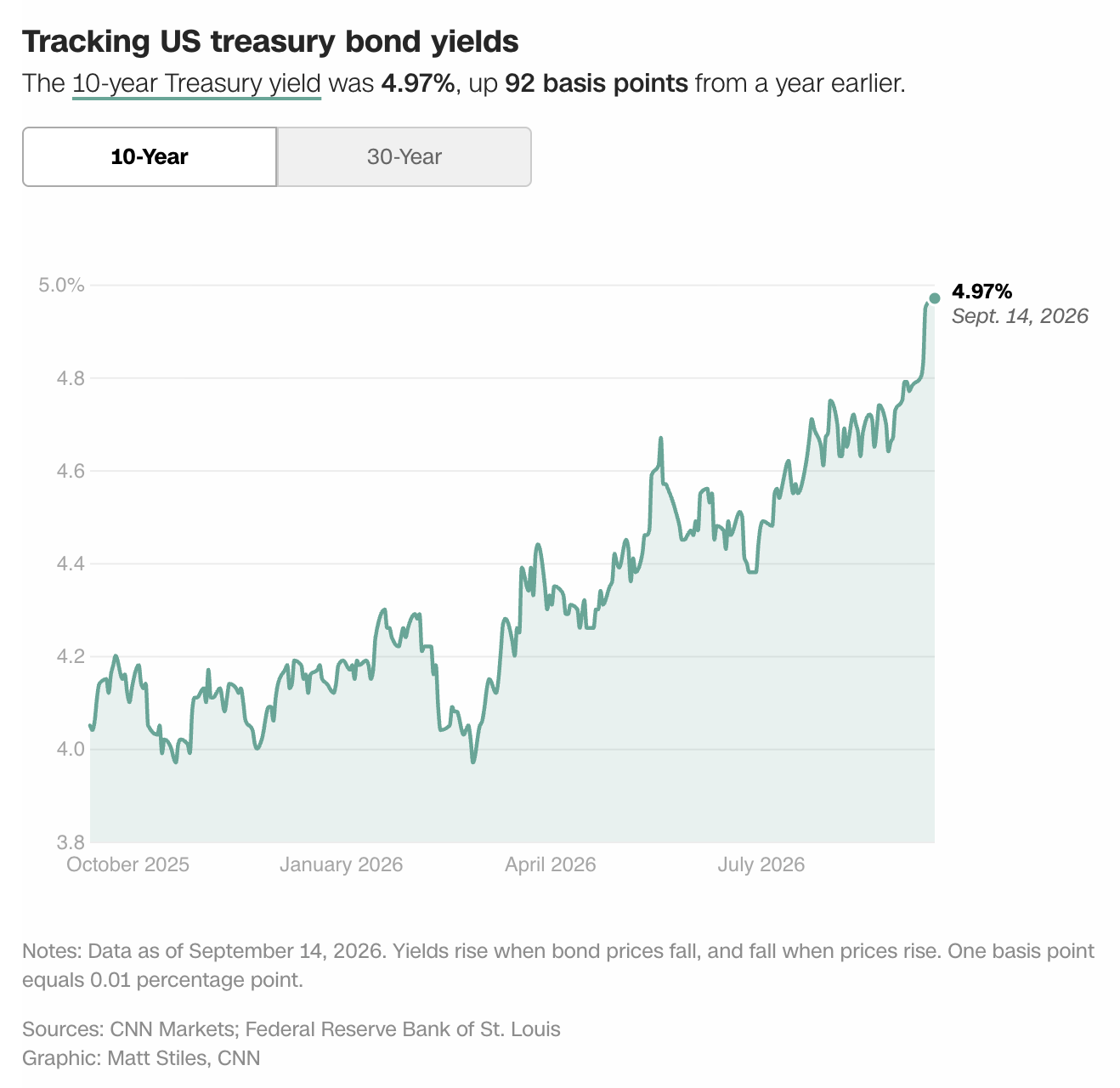
10-year Treasury yield hits 5%, critical threshold for US economy and markets (CNN, 4 minute read)
The 10-year Treasury yield hit 5% on Monday for the first time since 2007, before pulling back slightly to its highest level since October 2023. Yields have climbed steadily this year, reversing sharply after the Iran war began, reaching 4.5% in May and 5% on Monday, driven by soaring energy prices, expected rate hikes, and mounting government debt concerns. Higher yields have already pushed the average 30-year mortgage rate to 6.76%, up from 6.15% at the start of the year, while global yields in Germany, France, and the UK have also hit multi-decade highs. Despite the sell-off, the S&P 500 remains up more than 10% this year, though analysts warn a yield spike combined with weaker earnings could pose greater risk to stocks
Capital Economics' John Higgins said 5% is seen by some as a potential threshold for financial market stress, though he isn't convinced it's a "magic number"
Analysts describe the shift as a move toward "normal for longer" interest rates, ending the ultra-low-rate era that followed the 2008 financial crisis
The European Central Bank raised rates last week for the second time this year, citing inflation pressure from energy prices
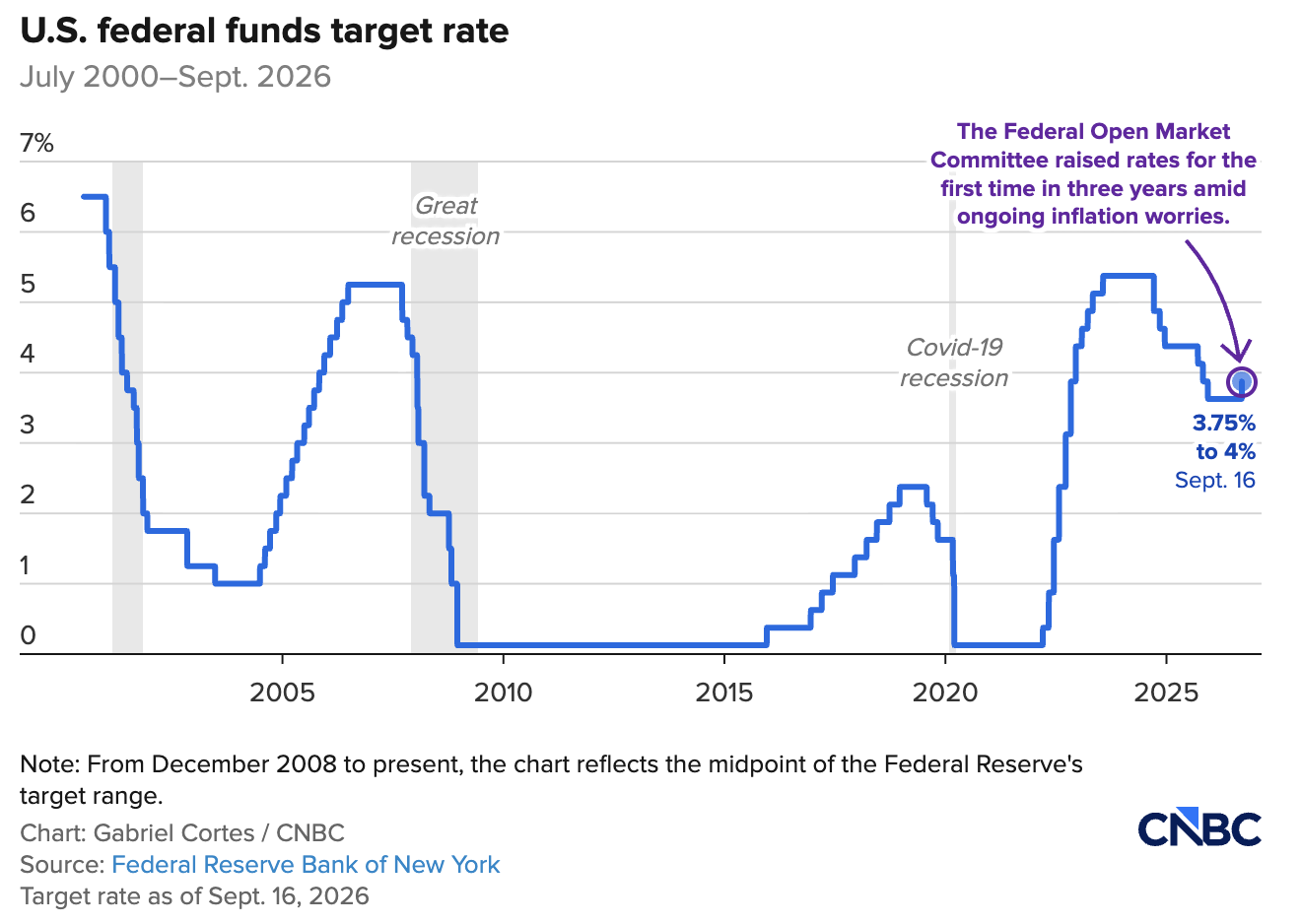
Fed approves interest rate hike, signals one more to come this year (CNBC, 6 minute read)
The Federal Reserve raised its key interest rate by a quarter point to 3.75%-4% in a unanimous vote, its first hike in more than three years, citing persistently elevated inflation driven by rising oil prices and Middle East tensions. Fed Chair Kevin Warsh said inflation has been"too high ... for too long," pointing to a strong labor market alongside above-target inflation. Updated projections showed 16 of 18 officials expect at least one more hike this year, while the Fed raised its inflation forecasts, projecting headline PCE at 3.7% and core PCE at 3.4%, with the 2% target not expected until 2029. The committee lowered its unemployment forecast to 4.1%, and officials flagged concerns that prolonged energy costs and AI-related investment could keep inflation elevated. Treasury yields fell following the decision, while the S&P 500 rose
The Fed's decision follows a July meeting in which three members dissented in favor of a hike instead of a hold
The 30-year fixed mortgage rate has climbed to 7.19%, up about 38 basis points since Warsh's late-August Jackson Hole remarks
Officials are split on 2027 policy, with eight favoring another hike, six expecting rates to hold, and four anticipating cuts
OpenAI boss and Elon Musk back calls to put brakes onrs being built near them
IPO & EXITS
A Hard Year For Software IPOs (Crunchbase, 4 minute read)
US venture-backed tech companies have raised nearly $90 billion in domestic public offerings this year, the second-highest annual total on record, but the total is overwhelmingly concentrated in just two companies: SpaceX, which alone accounted for 83% of proceeds, and Cerebras Systems at 6%. The remaining 21 venture-backed tech companies that went public this year collectively raised less than $10 billion. Energy startups led the smaller cohort, making up about a quarter of this year's offerings, including geothermal company Fervo Energy and nuclear-focused firms X-energy, Hadron Energy, and Standard Nuclear, while defense, aerospace, and quantum computing also saw notable debuts from companies like Quantinuum, HawkEye 360, and York Space Systems. Enterprise software, historically a major source of venture-backed IPOs, was largely absent this year, as AI reshapes the sector and pushes SaaS unicorns to delay public listings
Consumer-facing e-bike and scooter platform Lime finally went public this year, though at a valuation below its previous peak
A potential Anthropic IPO could be even larger than SpaceX's, further deepening the market's concentration among a handful of giant offerings
The upcoming IPO pipeline, dominated by Anthropic and OpenAI, suggests the winner-take-almost-all pattern in tech IPO proceeds is likely to continue
Anthropic IPO Date: What Investors Need to Know Before It Prices (The Motley Fool via Yahoo Finance, 4 minute read)
Anthropic, which confidentially filed its Form S-1 on June 1, is reportedly targeting a $2 trillion valuation for its planned IPO, more than double its $965 billion May valuation and potentially the largest IPO ever. Its annualized revenue run rate jumped from roughly $9 billion at the end of 2025 to more than $65 billion by July, driven by enterprise adoption of Claude and cloud partnerships with Amazon and Google, both equity stakeholders. Anthropic claims "adjusted" profitability in Q2 2026, though it's likely still unprofitable under GAAP once depreciation, interest, and revenue-sharing costs are factored in. Growing AI safety concerns, echoed by CEO Dario Amodei and rival OpenAI's delayed IPO, could complicate the timeline, especially since $2 trillion would value Anthropic at 31 times its revenue run rate
Nvidia has reportedly considered a $10 billion investment in Anthropic's IPO to strengthen its software and supply chain ties
Rising interest rates could compress high AI valuations and draw more attention to Anthropic's debt and losses
Investors should closely scrutinize Anthropic's eventual S-1 filing before assuming strong post-IPO performance
OpenAI Exposure Adds a Twist to $50 Billion IPO (Gurufocus via Yahoo Finance, 2 minute read)
SoftBank's push to list SB Energy at a roughly $50 billion valuation is facing added scrutiny amid uncertainty over OpenAI's own delayed IPO, given how heavily SB Energy's growth story depends on OpenAI as a key tenant. SB Energy is expected to seek $5 billion to $7 billion in its IPO within weeks, backed by a $439 billion contracted backlog tied to 8.8 gigawatts of future data center capacity, even though it has yet to bring a single facility online. Roughly $357 billion of that backlog isn't expected to be recognized until 2034 or later, while the company generated just $138.7 million in revenue and posted a $551.6 million operating loss in the first half of this year. Nvidia has provided a $105 billion guarantee for an 8-gigawatt Ohio campus, and both Nvidia and OpenAI are expected to hold stakes in the newly public company
SB Energy estimates it needs more than $170 billion in capital spending to complete its project pipeline
Analysts say the company may need roughly $7 billion in additional equity beyond IPO proceeds, plus significant debt, to maintain its typical 10% equity stake in projects
Without a completed OpenAI IPO to serve as a valuation benchmark, investors may scrutinize SB Energy's customer concentration and execution risk more closely
8alpha.ai is an AI fintech transforming cash-generating businesses into scalable, AI-powered companies. We provide revenue-based financing and hands-on AI transformation, delivering no zeros with unlimited upside. We’re the architects building financial infrastructure for the next generation of investors and startups.
Become part of our revolution.
Happy reading,
8alpha.ai’s Research & Investment Team