Space Race Meets Debt Race
Welcome to AI8’s weekly newsletter, your ultimate source for curated insights and updates from the dynamic world of venture capital!
From billion-dollar rounds to market-defining shifts, we deliver the intelligence powering the global investment landscape, moving investors and innovators forward. At 8alpha.ai, we’re not waiting for the future of capital, we’re building it. Stay sharp, stay curious, and stay ahead.
STARTUPS
ROUNDS AND UNICORNS
The Week’s 10 Biggest Funding Rounds: The Boring Co., Cognition And Motive Lead A Massive Week (Crunchbase, 5 minute read)
The Boring Co. (Transportation and Infrastructure): Musk's Bastrop, Texas-based tunneling company raised a $3 billion Series D led by the United Arab Emirates, with participation from Andreessen Horowitz, Sequoia Capital, and Valor Equity Partners, valuing the company at $23 billion and bringing total funding to nearly $3.9 billion
Cognition (Artificial Intelligence): San Francisco-based Cognition, known for its autonomous coding agent Devin, raised a $2 billion Series E led by Accel, Andreessen Horowitz, Avenir, Founders Fund, and General Catalyst, reaching a $48 billion valuation and nearly $3.9 billion in total funding
Motive (Fleet Management and Transportation): San Francisco-based Motive, formerly KeepTruckin, raised $1.3 billion in private equity funding led by General Catalyst, bringing total funding to just over $2 billion for its AI-driven fleet management platform
Stoke Space (Aerospace): Kent, Washington-based Stoke Space raised a $1 billion Series E co-led by Point72 Ventures and Spark Capital, with Y Combinator also participating, valuing the reusable rocket developer at $10 billion and bringing total funding to roughly $2.4 billion
Suniva (Solar Energy): Norcross, Georgia-based Suniva raised $835 million from Electron Capital Partners, OIC, and Rubric Capital Management to expand domestic solar cell production, bringing total funding to nearly $1.2 billion
Which AI companies are governments betting on? (PitchBook, 5 minute read)
Governments worldwide are increasingly taking equity stakes in AI companies, with PitchBook data showing 148 separate governmental entities, including defense agencies, national research councils, and state AI funds, on the cap tables of major AI startups. Luxembourg became the latest to join this trend last Tuesday, backing French LLM company Mistral AI's $3.5 billion Series D. Investors span a wide range of institutions, including the EU's €80 billion Horizon 2020 program, France's Bpifrance, and In-Q-Tel, the venture arm of US intelligence agencies, backing companies as varied as defense startup Anduril and speech-recognition firm Verbit
Luxembourg's backing of Mistral AI marks the latest example of European governments investing directly in AI startups
Government investors range from defense agencies to national research councils to newly created state AI funds
The mix of government-backed AI companies spans defense, enterprise AI models, and speech recognition technology
Climate tech VC fundraising heads for worst year in a decade (PitchBook, 5 minute read)
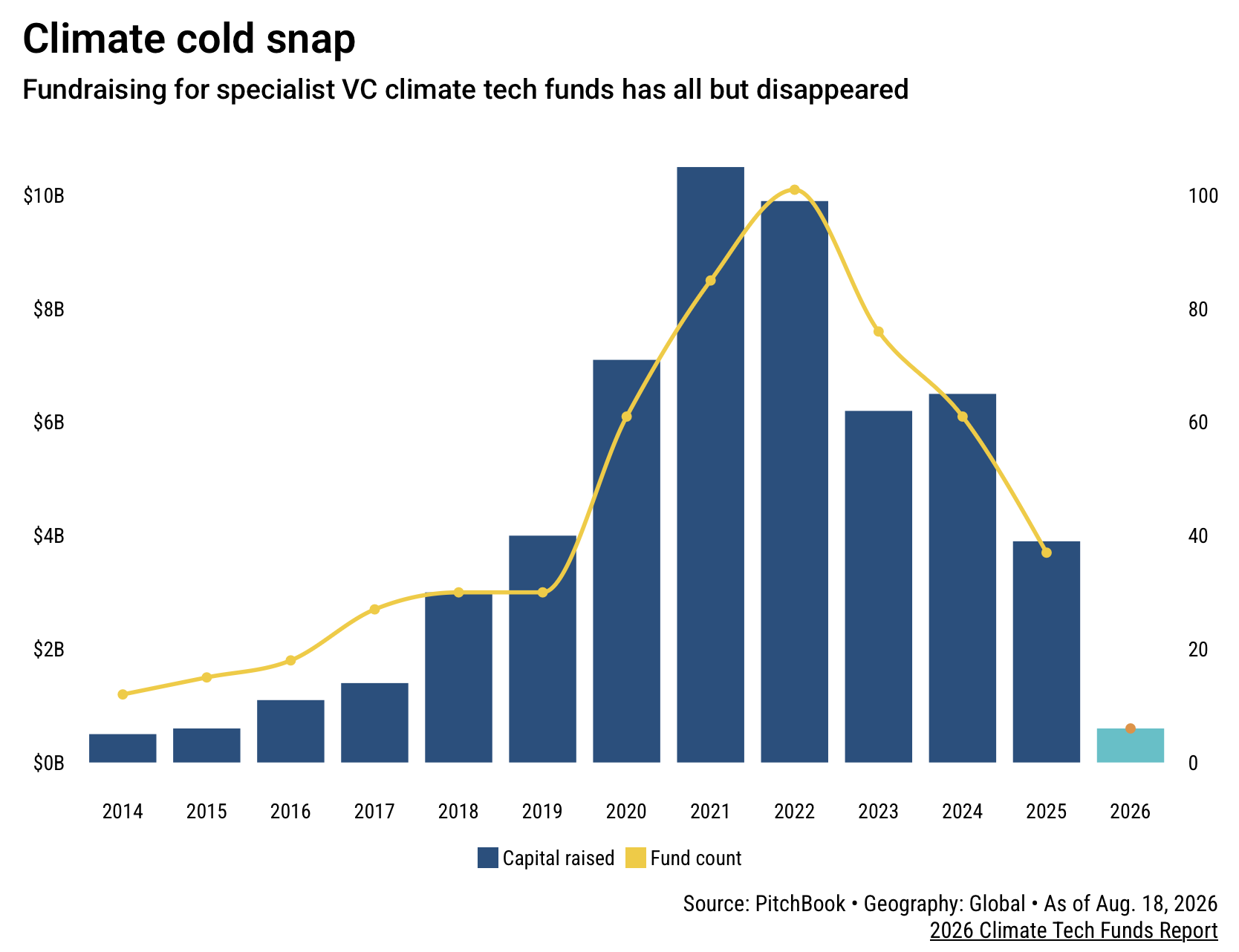
Climate tech VC fundraising has collapsed to its worst level this decade, with just six climate-specialist funds closed as of August 18 and full-year capital projected to fall below $1 billion for the first time since 2015, down from over $10 billion five years ago, per PitchBook. The 2021 surge, driven by climate commitments, Biden's election, and cost breakthroughs in batteries and renewables, has reversed amid broader VC contraction and Trump-era funding cuts. Europe has partially offset the decline, with Denmark's Kompas II and the UK's 2150 Urban Tech Sustainability Fund II accounting for roughly 79% of this year's capital raised. Still, analysts point to potential tailwinds, including rising AI-driven energy demand and growing interest in energy sovereignty following the Iran war
Capital raised for climate-specialist VC funds is on track to fall below $1 billion for the first time since 2015
AI's growing energy needs are increasing demand for energy generation, storage, and grid technologies
European funds accounted for about 79% of this year's climate tech VC capital raised, led by Denmark and the UK
ECONOMIC SNAPSHOT
America can’t grow its way out of its debt problem (CNN, 5 minute read)
With US debt surpassing $40 trillion, the Trump administration argues the country can grow its way out of the burden, but economists say the math doesn't add up. The key metric, GDP growth versus the 10-year Treasury yield, currently favors debt outpacing the economy, with yields near 5% against roughly 2% growth, while the primary deficit sits at 3% of GDP, far above sustainable levels. Stabilizing the debt would require 6% annual GDP growth for the rest of Trump's term, or 3-4% for a decade, a pace unseen since the 1990s, while the economy grew just 2.1% and 1.5% in the first two quarters this year. Economists say reaching that growth would also require ending the Iran war, avoiding new spending, and immigration reform, all politically unlikely, while faster growth itself would likely fuel more inflation and rate hikes
Rising Iran war tensions have pushed oil above $100 a barrel and diesel to record highs
The 10-year Treasury yield is nearing 5%, its highest level since 2007
Higher Treasury yields are expected to keep pushing up mortgage and auto loan rates
Mortgage rates climb: Average rate on a 30-year home loan hits the highest level in over 14 months (AP, 4 minute read)
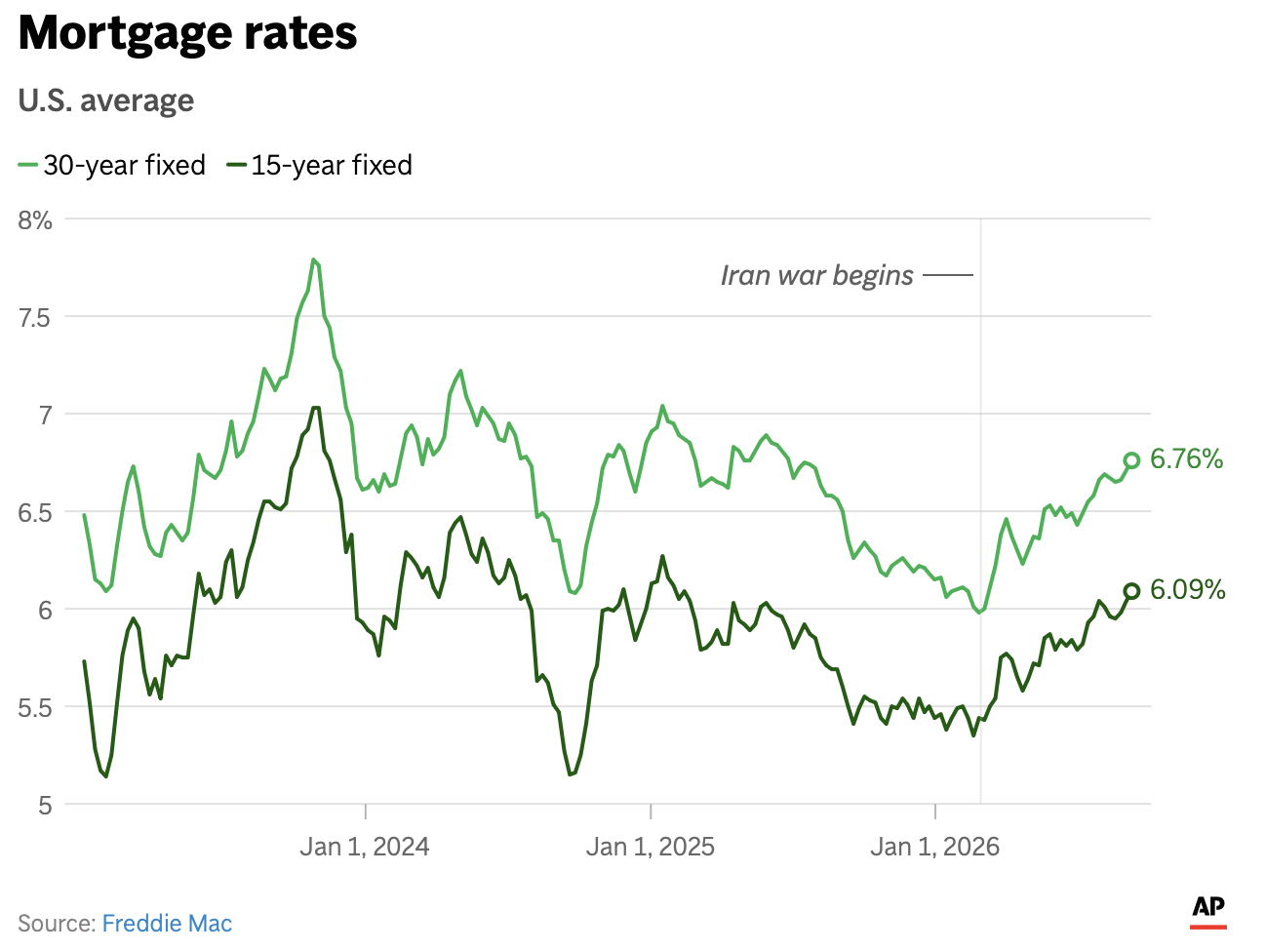
The average 30-year fixed mortgage rate rose for the third straight week to 6.76%, up from 6.71% and its highest level since June 2025. A year ago, the average stood at 6.35%. The 15-year fixed rate, often used for refinancing, also climbed to 6.09% from 6.04%, up from 5.5% a year earlier. Higher rates raise monthly costs for borrowers and can lead buyers to delay home purchases, contributing to largely stagnant home sales this year. Mortgage rates generally track the 10-year Treasury yield, which has been rising alongside oil prices due to the US war with Iran, fueling inflation concerns
Higher mortgage rates can add hundreds of dollars a month to borrowing costs
The current 30-year rate is just below its June 2025 peak of 6.77%
Mortgage rates are influenced by inflation, Fed policy, and bond market investor expectations
Inflation ticked up in August, setting the stage for the Fed to hike interest rates (NBC, 5 minute read)
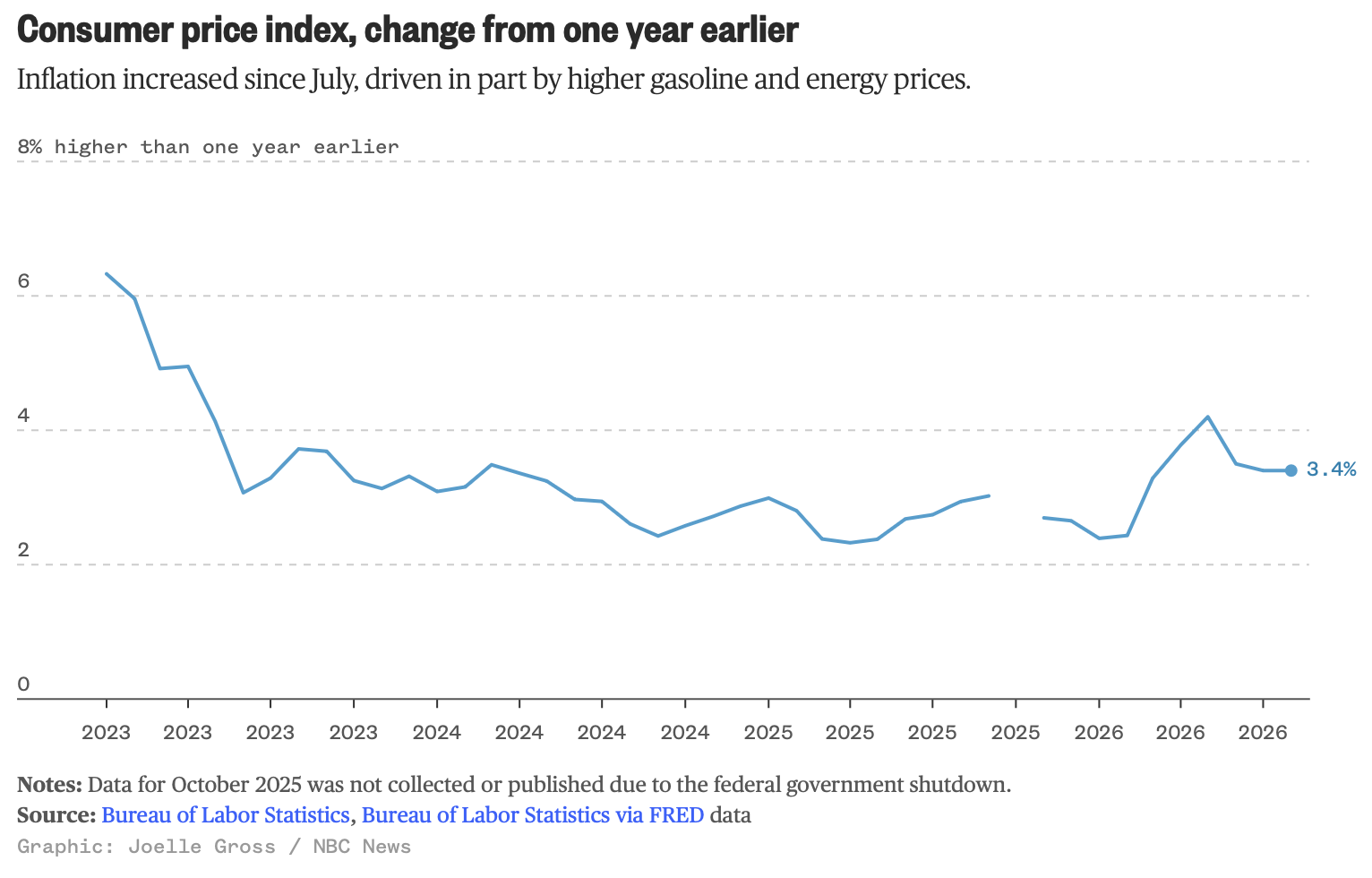
US consumer prices rose 0.4% in August, an annual rate of 3.4%, with core inflation coming in higher than expected and prompting economists to see a Fed rate hike this week as increasingly likely. Gasoline prices rose 3.9%, accounting for over a third of the overall increase, even before crude oil surged further to around $100 a barrel by Friday, while diesel hit a record $6 per gallon. Airfare rose 2.7% and computer software/accessories prices jumped 25.4% year-over-year, their largest annual increase on record, tied partly to AI-driven demand for memory and storage that also pushed Apple and other electronics makers to raise prices. Market odds of a Fed rate hike rose from under 70% to nearly 90%, while real average hourly earnings fell 0.1% from July to August, adding pressure on consumers already facing 30-year mortgage rates above 7%
Shelter costs rose 0.3% and overall food prices rose 0.1%, with the food index up 2.7% over the past year
Vehicle insurance and medical care prices declined, while apparel prices were roughly flat
Despite inflation concerns, the S&P 500 rose nearly 1% and the Nasdaq gained 1.3% following the report
Anthropic Drops Stark AI Forecast for U.S. Economy (Yahoo Finance, 2 minute read)
Anthropic has released an interactive model examining how AI could reshape US growth, employment, and wages by 2030 under three adoption scenarios. In the moderate scenario, AI's impact resembles the internet's, lifting GDP just 1.6% above baseline. In the middle scenario, where AI completes about half of knowledge-based work, GDP could reach $36 trillion, though the modest 2.1% average wage gain hides a divide: knowledge-worker pay falls 0.3% while other workers see 5.9% gains, and labor's share of output drops from 60% to 56.1%. In the most aggressive scenario, growth accelerates to 15% annually and GDP reaches $44.4 trillion, but knowledge-worker wages fall more than 10%, their unemployment surpasses recession-era levels, and capital's share of GDP surges to 55%
Across scenarios, AI-driven growth may increasingly benefit capital owners over workers
The findings could favor capital-return and dividend-focused investment strategies, including funds like SCHD, VYM, and DVY
The economy could double in size every 4.5 years under the most aggressive AI adoption scenario
Trump Declares the Moon Belongs to the U.S. Here Are 5 Space Stocks to Watch (24/7 Wall St. via Yahoo Finance, 5 minute read)
Growing US government spending on space defense and lunar programs is repricing publicly traded space contractors, with backlogs hitting records across the sector. The FY2027 budget assigns $71.2 billion to the Space Force, up $39.4 billion from FY2026, plus $17.9 billion for Golden Dome missile defense. Lockheed Martin's backlog reached $230 billion after winning a $35 billion THAAD contract, with shares up 11.68% year to date. Intuitive Machines quadrupled Q2 revenue to $206 million as national security work grew to 30% of revenue, while Redwire's revenue jumped 89.6% and Rocket Lab's rose 62% with backlog at $2.36 billion. SpaceX rounded out the group with $7.81 billion in Q2 revenue and Starlink subscribers doubling to 12 million, as Elon Musk reiterated plans to land humans on the moon by 2028
The 1967 Outer Space Treaty prohibits nations from claiming celestial bodies, so rhetoric doesn't change ownership but can still shift procurement timelines
Key upcoming signals include NASA's next lunar task-order awards, Rocket Lab's first Neutron rocket static fire, and additional Golden Dome contract tranches
Intuitive Machines guided full-year 2026 revenue to $900 million–$1 billion
IPO & EXITS
SpaceX Fell 3.9% on Its Third Lockup Release Since the IPO. I'd Wait to Buy the Stock (The Motley Fool via Yahoo Finance, 5 minute read)
SpaceX shares fell 3.9% to $147.55 last Wednesday as its third scheduled lockup release freed up to 319 million shares, mirroring a similar decline after the August 20 release. Despite recent unlocks, only about 17% of SpaceX's shares can currently trade, with another 3.1 billion shares scheduled to become sellable by early December, including a 1.3 billion-share release tied to Q3 earnings. CEO Elon Musk's stake of more than 6 billion shares remains locked until June 2027. The stock, valued around $2 trillion at over 60 times annualized revenue, still looks too expensive despite Q2 revenue of $7.8 billion nearly doubling year-over-year
SpaceX's weight in the Nasdaq-100 is expected to rise at the September 21 rebalancing, which JPMorgan estimates could drive about $15.5 billion in index-fund buying
SpaceX's largest 2026 lockup release, up to 1.3 billion shares, lands after Q3 earnings are reported
Wave of AI-Driven IPOs Expected to Accompany Anthropic’s Listing (Bloomberg via Yahoo Finance, 2 minute read)
With Labor Day behind it, the market is entering its traditional year-end IPO push, led by Anthropic, which is seeking to match or exceed SpaceX's record $86 billion-plus June listing while reportedly targeting a $2 trillion valuation. Other companies preparing for public markets include AI cloud computing firm Nscale, power supplier Aggreko, and consumer health tech maker Oura Health, spanning sectors like data centers, power cooling, and consumer health that analysts say could draw strong investor interest. Despite headwinds including rising oil prices, ongoing conflicts in the Middle East and Ukraine, and the potential for higher interest rates, strategists say companies aren't specifically timing their listings around Anthropic's IPO, since timing in this market remains inherently uncertain. OpenAI is also expected to pursue one of the largest-ever listings this year or next
Renaissance Capital's Matt Kennedy doesn't see a bubble forming, noting investors gave SpaceX its valuation based on earnings expected years in the future
Kennedy said Anthropic could use similar reasoning to justify its reported $2 trillion valuation target
Some companies are choosing to wait for more favorable market conditions, while others view the current environment as good enough to proceed
Anthropic IPO launch shifts toward mid-October, sources say (Reuters, 5 minute read)
Anthropic is now expected to begin marketing its IPO in mid-October at the earliest, with the listing completing just days before November's US midterm elections, according to people familiar with the matter. The company's prospectus, originally anticipated as early as next week, is now not expected until late September, pushing back what could be a $2 trillion listing, among the largest IPOs ever attempted. As part of the process, Anthropic is finalizing a $15 billion revolving credit facility before meeting with analysts, though the window before its prospectus becomes public is expected to be shorter than usual since analysts already know the company well. Morgan Stanley, Goldman Sachs, JPMorgan, and Citi are among the banks working on the offering, which follows SpaceX's record $1.77 trillion valuation IPO in June and could arrive alongside a potential OpenAI listing
Schedule changes are common as companies navigate market conditions and regulatory reviews
Bloomberg previously reported Anthropic was negotiating to expand its credit facility to $15 billion
Secondaries H1 2026 Update (Ropes & Gray, 5 minute read)
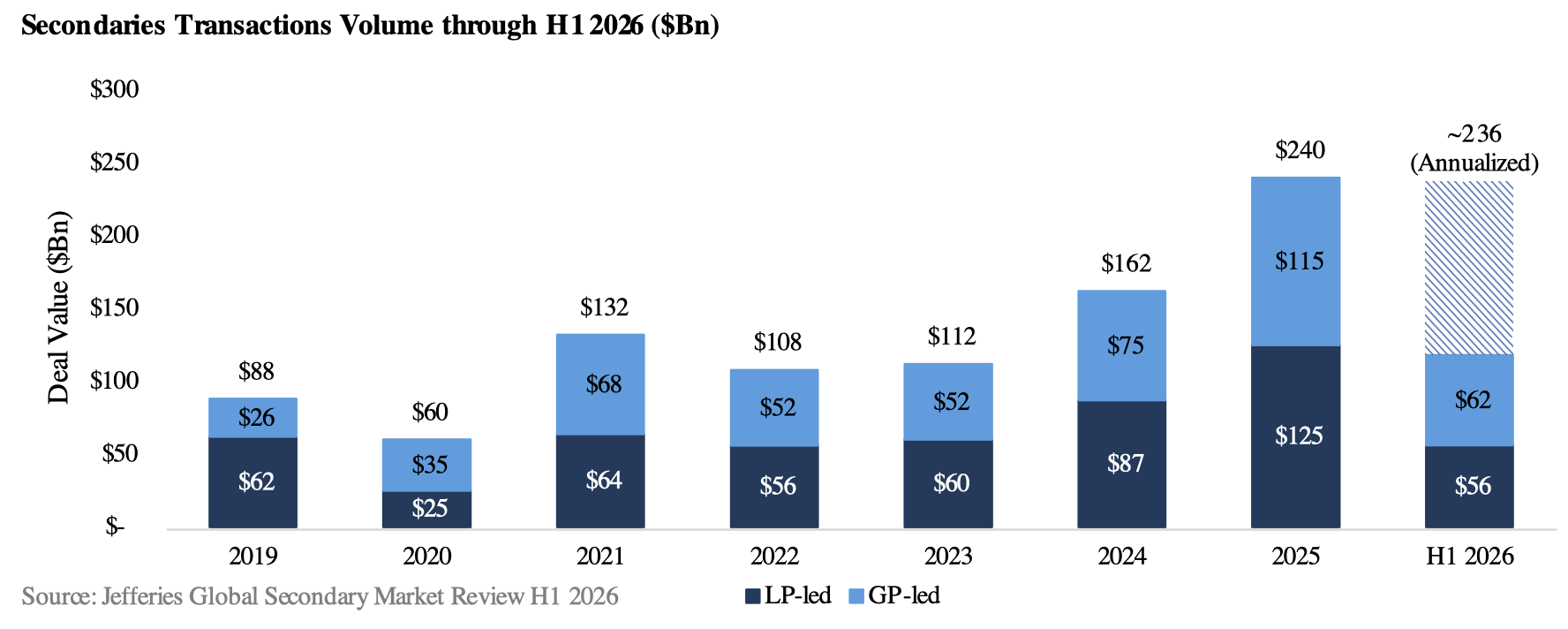
The secondaries market posted strong volume in H1 2026, reaching $118 billion (up 15% year-over-year) and putting the full year on pace to exceed $200 billion, driven by LP liquidity needs, growing GP adoption of continuation vehicles, and an expanding buyer base. Distribution yields held near 10%, well below the historical average of roughly 25%. Dedicated secondaries capital fell to $290 billion from $327 billion at the end of 2025, signaling shrinking dry powder as deployment accelerates. GP-led buyout transactions fell to 66% of the market from 70% in 2025, as continuation vehicles tied to credit and AI-linked venture investments grew faster than the broader market, while GPs rotated toward more durable sectors like business services, healthcare, and industrials amid wavering AI valuation confidence
European GP-led volume reached about $15 billion, or 24% of the global market, projected to approach $35 billion for full-year 2026
About one-third of LP-led deals now include deferred consideration, typically settling within 12 months
Total available capital, including evergreen vehicles and leverage, remains around $328 billion despite the contraction
8alpha.ai is an AI fintech transforming cash-generating businesses into scalable, AI-powered companies. We provide revenue-based financing and hands-on AI transformation, delivering no zeros with unlimited upside. We’re the architects building financial infrastructure for the next generation of investors and startups.
Become part of our revolution.
Happy reading,
8alpha.ai’s Research & Investment Team