AI Keeps Climbing, So Does the Debt Clock
Welcome to AI8’s weekly newsletter, your ultimate source for curated insights and updates from the dynamic world of venture capital!
From billion-dollar rounds to market-defining shifts, we deliver the intelligence powering the global investment landscape, moving investors and innovators forward. At 8alpha.ai, we’re not waiting for the future of capital, we’re building it. Stay sharp, stay curious, and stay ahead.
STARTUPS
ROUNDS AND UNICORNS
The Week’s 10 Biggest Funding Rounds: Crusoe And Fluidstack Lead Multibillion-Dollar AI Infrastructure Haul (Crunchbase, 5 minute read)
Crusoe (AI Infrastructure): Denver-based Crusoe raised $3 billion in a Series F co-led by Atreides Management and Valor Equity Partners, with Mubadala Capital also participating, valuing the AI cloud and data center provider at $30 billion — triple its valuation from less than a year ago
Fluidstack (AI Infrastructure): New York-based Fluidstack raised $1.5 billion led by Jane Street Capital, bringing total funding to $2.6 billion and valuing the GPU and data center infrastructure provider at $18 billion
Gimlet Labs (AI Infrastructure): San Francisco-based Gimlet Labs raised a $300 million Series B led by Andreessen Horowitz, with Sapphire Ventures, Menlo Ventures, Arm Holdings, and Microsoft's M12 participating, valuing its AI inference cloud company at $3 billion
Upwind Security (Cybersecurity): San Francisco-based Upwind Security raised $300 million co-led by Bessemer Venture Partners and TCV, valuing the cloud security and threat-detection platform at $3.8 billion
David (Food and Nutrition): New York-based high-protein food company David raised a $250 million Series B co-led by Greenoaks and Valor Equity Partners, valuing the company at $2.25 billion as it expands beyond its signature protein bars
Global Venture Funding Jumps 122% In August As Streak Of Billion-Dollar Deals Continues (Crunchbase, 4 minute read)
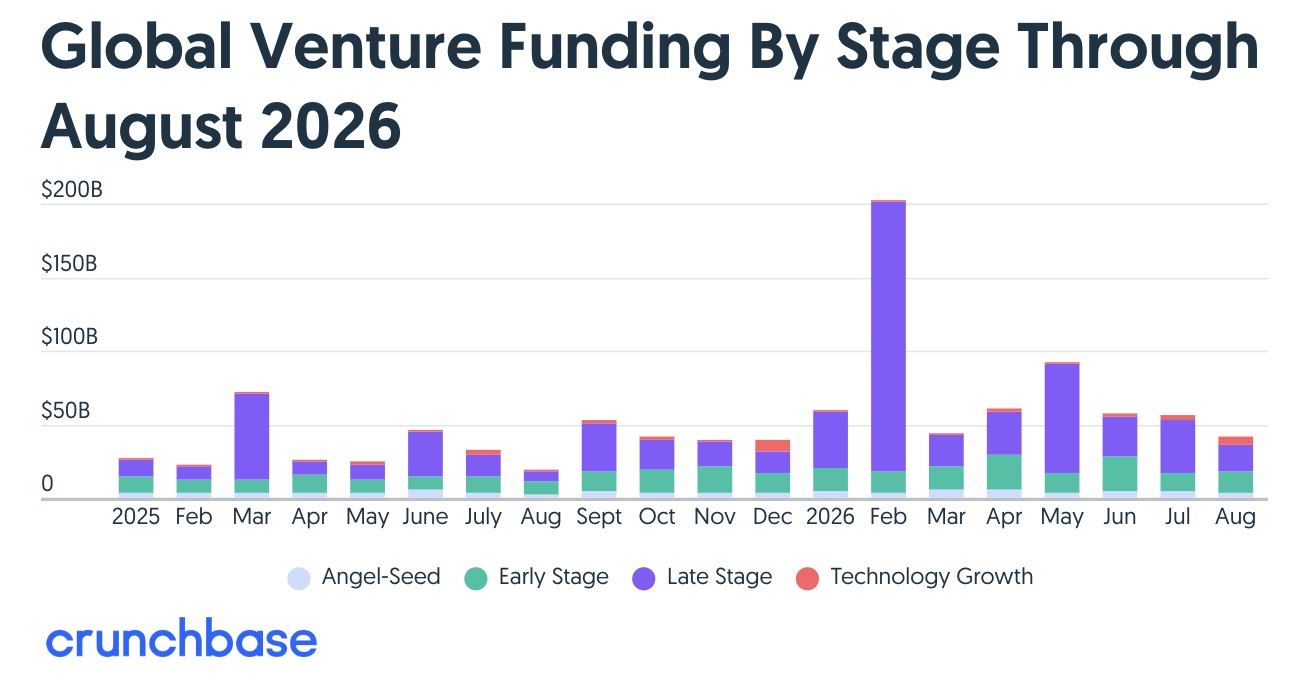
Venture investors poured $42 billion into just over 1,500 startups worldwide in August, down 25% from July's $56 billion but up 122% compared to last August. Seven companies raised billion-dollar rounds during the month, tied for the year's second-highest monthly count after July's 13. Databricks led with a $5 billion raise at a $190 billion valuation, while other billion-dollar rounds spanned defense tech, AI, satellites, nuclear energy, and home batteries. On the exit side, Chinese humanoid robotics company Unitree Robotics went public at a roughly $9 billion valuation and surged 460% on its Shanghai Stock Exchange debut, while Nvidia's planned $12.9 billion acquisition of Hugging Face marked the month's largest M&A deal, followed by Bending Spoons' approximately $1.3 billion bid for Airtable
Databricks added $56 billion to its valuation in just six months, while River AI raised $1.1 billion across its seed and Series A rounds this year alone
Five of August's seven billion-dollar funding recipients had last raised capital less than 12 months earlier
ECONOMIC SNAPSHOT
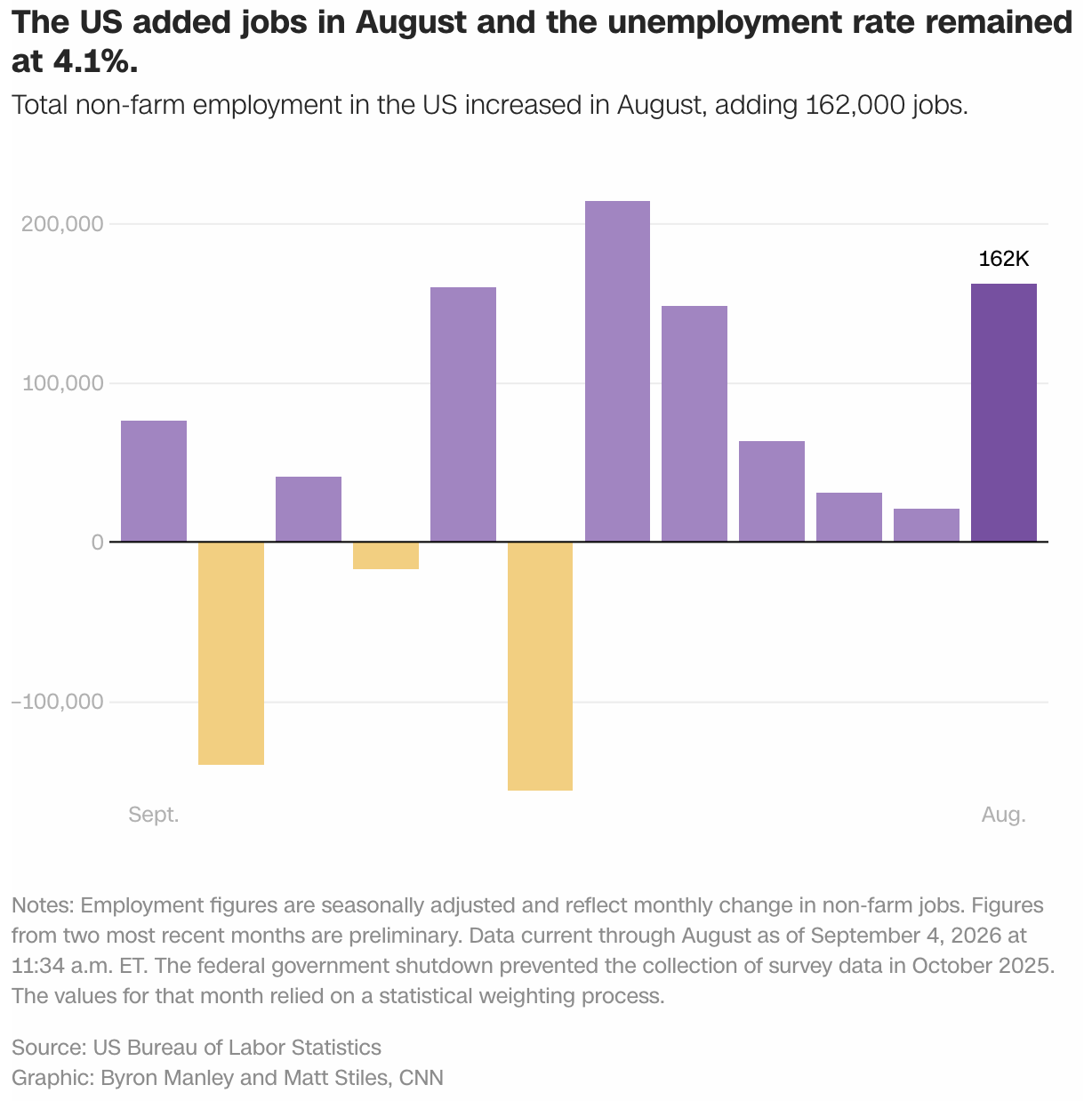
The US economy added 162,000 jobs in August, more than double expectations (CNN, 4 minute read)
The US added 162,000 jobs in August, more than double economists' expectations of 65,000, marking the strongest gain since March, while unemployment held steady at 4.1%. July's figure was revised sharply upward from a 23,000-job loss to a 21,000-job gain, easing concerns about a rapidly slowing labor market. Growth was broad-based, with leisure and hospitality adding 62,000 jobs after two months of losses, and construction and manufacturing each growing for a second straight month, likely reflecting AI infrastructure buildout. However, wage growth slowed to 3.1% annually, a five-year low, marking the fourth straight month wages have trailed inflation, while information and financial services, sectors exposed to AI adoption, both shed jobs
Healthcare and social assistance added 28,400 jobs, while local government education reversed a large July loss with a 41,900-job gain
Economists at Pantheon Macroeconomics cautioned the rebound may reflect payback from weak prior months rather than sustained acceleration
Treasury yields rose following the report, reflecting increased expectations the Fed could raise rates at its mid-September meeting
The US debt crisis just got uglier: Number to know (Yahoo Finance, 2 minute read)
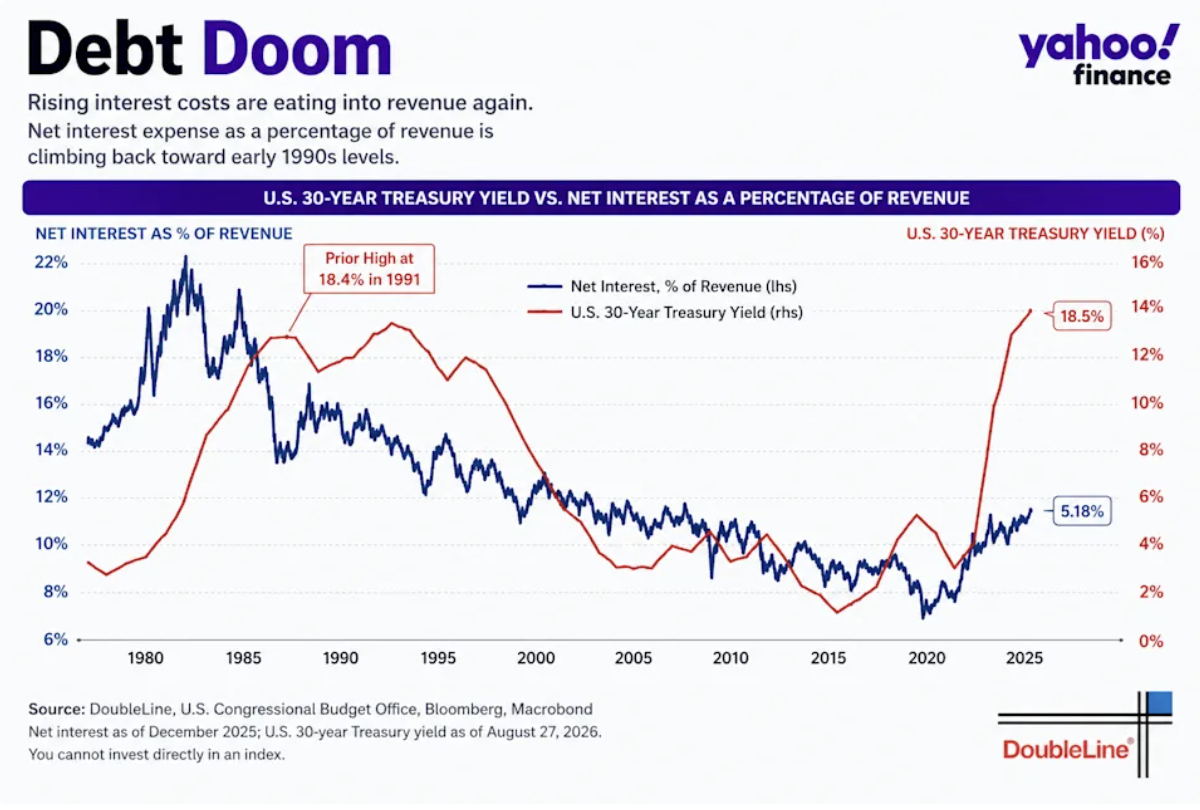
US annual interest expense on the roughly $40 trillion national debt has climbed to a record 18.5% of federal revenue, surpassing the previous 1991 high of 18.4%. The metric has more than quadrupled over four years, with interest costs now totaling a record $1.25 trillion. Rising Treasury yields have driven the increase, and analysts warn the growing burden could crowd out spending on defense and social programs while limiting flexibility for future recessions. Still, Fed Watch Advisors' Ben Emons noted the US is borrowing at a weighted-average rate near 3.5%, well below the 7% threshold where real stress would begin
Since 1970, federal debt has grown faster than nominal GDP, rising about $760 billion annually compared to GDP's $470 billion average annual growth
Nearly one in five dollars collected by the government now goes toward servicing existing debt
World’s biggest sovereign wealth fund plans to cut U.S. Treasury holdings (CNBC, 3 minute read)
Norway's $2.3 trillion sovereign wealth fund, NBIM, has proposed cutting government bonds from 70% to 50% of its bond portfolio, primarily reducing US Treasury holdings from 34.1% to 21.9% while boosting Japanese bonds and US corporate debt. The move comes as Treasury yields sit at decade-highs amid concern over US debt, which recently topped $40 trillion. Economist Mohamed El-Erian said the shift signals that traditional Treasury buyers like Japan, China, and Gulf countries are becoming less reliable. NBIM has posted record profits from AI and tech investments, though CEO Nicolai Tangen warns those returns aren't sustainable, citing a stress test showing an AI correction could wipe out 35% of the fund's value
NBIM plans to increase nongovernment US fixed income holdings, including mortgage-backed securities, from 16.2% to 27.6%
The fund wants to weight government bond holdings by market value rather than GDP, citing high debt levels across developed economies
NBIM swung to a $40 billion loss in Q1 2025 during a tech-driven market downturn
The Federal Reserve's Initial September Inflation Forecast Has Arrived, and It Contains a Glaring Red Flag for Wall Street (The Motley Fool via Yahoo Finance, 5 minute read)
Despite record highs across the Dow, S&P 500, and Nasdaq in 2026, persistently elevated inflation remains a key risk, according to the Cleveland Fed's latest forecast. Headline CPI has been declining since peaking at 4.2% in May amid an oil-price spike tied to the Iran war, with further easing to 3.3% projected by September. However, core PCE, which excludes food and energy, is forecast to reaccelerate from 3.3% to 3.49% over the same period, suggesting inflation has spread beyond energy into the broader economy. The diverging trends suggest the Fed may need to raise rates sooner than expected, pressuring Wall Street's four-year bull run, especially given debt-financed AI data center spending
Core PCE peaked near a three-year high of 3.5% in May before easing to 3.3% in June and July
Rising core inflation alongside falling headline inflation suggests price pressures may prove more persistent than initially expected
IPO & EXITS
The IPO Window Is Closing. Here Are 8 Startups To Watch (Crunchbase, 4 minute read)
Eight well-funded startups have been flagged as likely IPO candidates in the coming months, following a record first half of 2026 that saw 58 companies go public at $1 billion or above and $110.8 billion raised collectively, driven largely by SpaceX's historic $86 billion Nasdaq debut. Anthropic, the world's most valuable venture-backed startup, could debut as soon as September or October and raise up to $100 billion, though predictive estimates put its listing on a six-to-12-month timeline. Other candidates include smart-ring maker Oura, productivity software firm Notion, crypto exchange Kraken, AI chipmaker SambaNova, green-steel producer Stegra, payments giant Stripe, and medical AI platform OpenEvidence
Anthropic has raised $125 billion from private investors since its 2021 founding, while OpenAI is considered a likely but more distant candidate, possibly delaying into 2027
SambaNova raised $1 billion in a Series F this summer at an $11 billion valuation, following Cerebras Systems' $6.4 billion IPO in May
Stripe has raised $10.4 billion since 2010 but has repeatedly delayed going public, relying instead on employee tender offers for liquidity
Anthropic Has Already Raised $130 Billion Ahead of Its IPO. Here's What Potential Investors Need to Know (The Motley Fool, via Yahoo Finance, 4 minute read)
Anthropic, which confidentially filed its Form S-1 a few weeks ago, is expected to release its IPO prospectus after Labor Day and could go public in late September or October seeking to raise up to $100 billion, surpassing SpaceX's record $86 billion raise, with a potential market cap of $2 trillion. The AI company has already raised more than $130 billion privately, including a $65 billion round this spring valuing it at $965 billion. Its revenue run rate reportedly hit $65 billion in July, six times higher than a year earlier, fueling major infrastructure deals including 5-gigawatt agreements with Amazon and with Google/Broadcom, plus compute deals with Nscale ($45 billion) and Lambda ($35 billion)
Anthropic also has a GPU capacity deal with SpaceX as part of its infrastructure buildout
2026 has already seen the two largest IPOs ever, from SpaceX and SK Hynix's $26.5 billion Nasdaq cross-listing
The IPO would give Anthropic an additional capital source to fund expansion amid strong investor appetite for AI stocks
Oura files to go public (TechCrunch, 5 minute read)
Smart ring maker Oura has filed to go public, with SEC filings showing revenue jumped from $697 million to $1.2 billion over the nine months ended June 30, following full-year totals of roughly $500 million in 2024 and $1 billion in 2025. The Finland-based company sold 3.6 million rings and now has about 5 million paid members, with an 85% average retention rate. Oura reportedly seeks a $16 billion valuation and plans to raise $3 billion in the offering, up from roughly $11 billion last October. The company also touts its data advantage, citing nearly 42 billion hours of physiological data powering its AI models, even as it faces a lawsuit alleging its sleep-tracking claims are misleading
Oura's rings sell for $350 to $400 and track metrics including heart rate, stress, and sleep patterns via an accompanying app
The company aims to expand beyond fitness tracking into partnerships with health plans, employers, and care providers
Oura disputes the lawsuit's claims and says it will defend itself in the appropriate legal forum
Shein’s unhappy IPO (Financial Times, 4 minute read)
Shein's Hong Kong IPO priced shares at $6.19, raising $1.7 billion and valuing the company at just over $26 billion, a roughly 75% discount to its nearly $100 billion 2022 private valuation. Demand was lukewarm by Hong Kong standards, with cornerstone commitments covering only about 22% of the offering versus the typical 30-50%, and shares fell as much as 10% on debut before recovering to just below the IPO price. Strikingly, Shein may owe as much as $3.5 billion in cash and shares to earlier investors under anti-dilution clauses tied to prior funding rounds, meaning roughly twice the amount raised could flow back to existing shareholders. Analysts also note the stock wasn't cheap, priced at twice PDD Holdings' 2026 earnings multiple, while slower revenue growth and regulatory scrutiny weighed on investor confidence
Cornerstone investors committed just $383 million, thin for a jumbo Hong Kong listing, with most demand coming from existing shareholders rather than new long-only investors
Analysts say heavy underwriter reassurances about strong demand may have raised more skepticism than confidence among seasoned investors
The piece concludes Shein isn't necessarily a failed company, but that its hot private valuation simply didn't survive public market scrutiny
8alpha.ai is an AI fintech transforming cash-generating businesses into scalable, AI-powered companies. We provide revenue-based financing and hands-on AI transformation, delivering no zeros with unlimited upside. We’re the architects building financial infrastructure for the next generation of investors and startups.
Become part of our revolution.
Happy reading,
8alpha.ai’s Research & Investment Team