AI at Mega-Scale
Welcome to AI8’s weekly newsletter, your ultimate source for curated insights and updates from the dynamic world of venture capital!
From billion-dollar rounds to market-defining shifts, we deliver the intelligence powering the global investment landscape, moving investors and innovators forward. At 8alpha.ai, we’re not waiting for the future of capital, we’re building it. Stay sharp, stay curious, and stay ahead.
STARTUPS
ROUNDS AND UNICORNS
The Week’s 10 Biggest Funding Rounds: Largest Financings Went To Defense, Wearables, Energy And Security (Crunchbase, 5 minute read)
Saronic (Autonomous Defense / Maritime AI):Raised $1.75B Series D, bringing total funding to ~$2.6B at a $9.25B valuation (more than 2x since 2025). Backed by Kleiner Perkins, the company is scaling autonomous naval systems, reflecting rising defense tech investment and geopolitical demand
Whoop (Health & Wearables): Raised $575M Series G at a $10.1B valuation. The company combines hardware with a subscription model focused on real-time physiological data, signaling continued investor interest in recurring-revenue consumer health platforms
Valar Atomics (Nuclear / Energy): Raised $450M ($340M equity + $110M debt) at a $2B valuation. The funding highlights growing momentum in next-gen nuclear as a solution to long-term energy demand, especially driven by AI and data center growth
EnerVenue (Battery / Energy Storage): Raised $300M Series B extension, led by Full Vision Capital. The company focuses on grid-scale storage, a critical infrastructure layer as renewable energy adoption and AI-driven power demand accelerate
Tenex.AI (Cybersecurity / AI): Raised $250M Series B, led by Crosspoint Capital, with plans to hire 250+ employees. The company aims to boost productivity through AI-powered security operations, reflecting strong demand for automation in enterprise cybersecurity
This Is A Momentous Year For Early-Stage Unicorns (Crunchbase, 4 minute read)
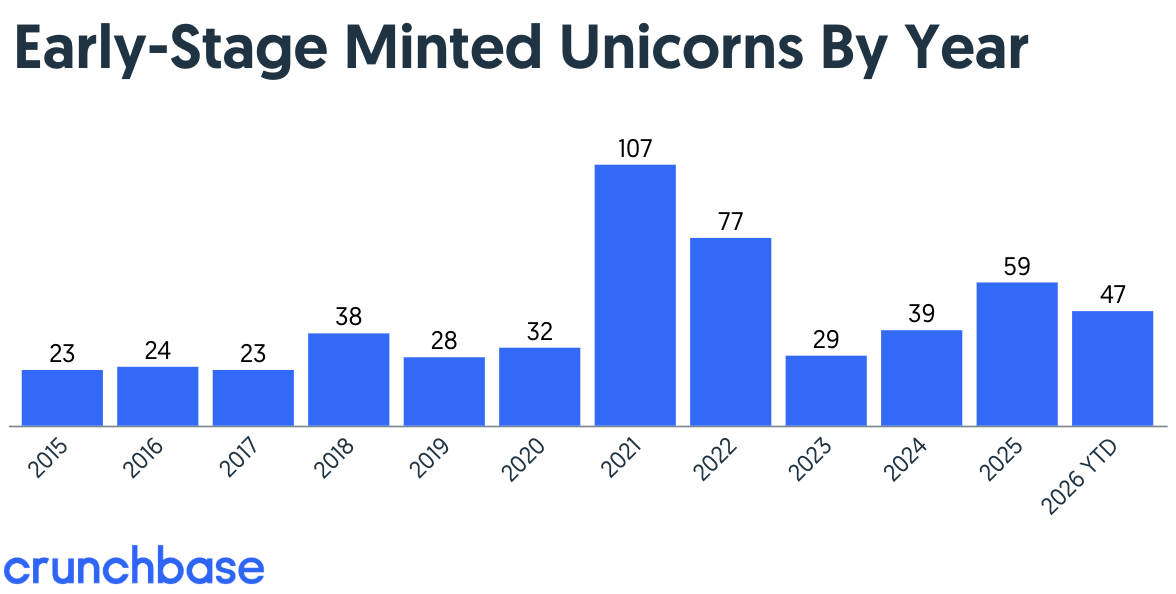
Early-stage unicorn creation is accelerating rapidly, with 47 new seed and early-stage unicorns in Q1 2026, putting the year on track for a record, after 59 in 2025 (+50% YoY). This surge is overwhelmingly driven by AI, which captured ~80% of global venture funding, with standout companies like Thinking Machines Lab ($12B initial valuation, targeting $50B) and Reflection AI ($8B, $25B target) achieving unprecedented valuations at early stages
Many of these companies are scaling at record pace, some founded as recently as 2025 or even 2026, and quickly moving into later-stage rounds
While the pace suggests a peak-like environment, with parallels to past market tops, it also reflects strong conviction in AI’s long-term potential despite recent public market volatility
Q1 2026 Shatters Venture Funding Records As AI Boom Pushes Startup Investment To $300B (Crunchbase, 5 minute read)
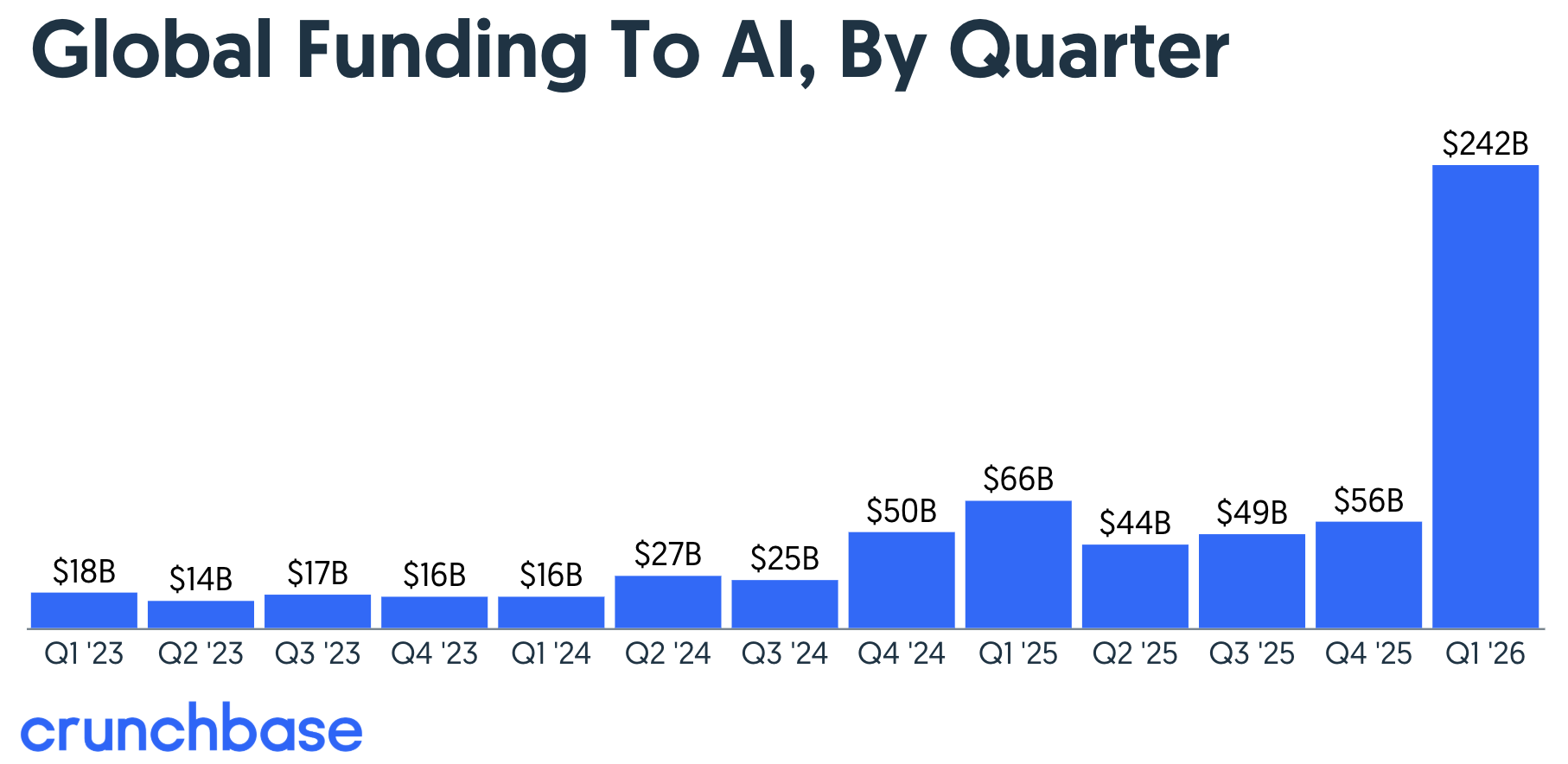
Q1 2026 marked a record-breaking quarter for venture capital, with $300B invested across ~6,000 startups (+150% QoQ and YoY), nearly 70% of all 2025 funding. The surge was overwhelmingly driven by AI, which captured $242B (~80%), with mega-rounds from OpenAI ($122B), Anthropic ($30B), xAI ($20B), and Waymo ($16B) alone accounting for $188B (65% of total funding)
Growth was led by late-stage funding ($246.6B, +205% YoY)
Early-stage ($41.3B, +41% YoY) and seed ($12B, +31% YoY, but -30% deal count) also increased, driven by larger rounds
Despite record private funding, IPO activity remained muted, with just 21 $1B+ exits globally
Meanwhile, M&A reached $56.6B, highlighting a disconnect between private valuations and public markets and increasing pressure for IPO markets to reopen
Startup funding shatters all records in Q1 (TechCrunch, 3 minute read)
Global startup funding hit a record $297B in Q1 2026 (+2.5x QoQ), surpassing any full year prior to 2019, with activity heavily concentrated in AI. Four mega-rounds—OpenAI ($122B, $852B valuation), Anthropic ($30B, $380B), xAI ($20B), and Waymo ($16B)—accounted for $188B (~63%) of total funding, underscoring extreme capital concentration at the top
While these outsized deals skew totals, momentum extends beyond them, with early-stage AI startups raising larger rounds at higher valuations than ever before
This signals sustained investor demand and a broader repricing of AI across all stages
ECONOMIC SNAPSHOT
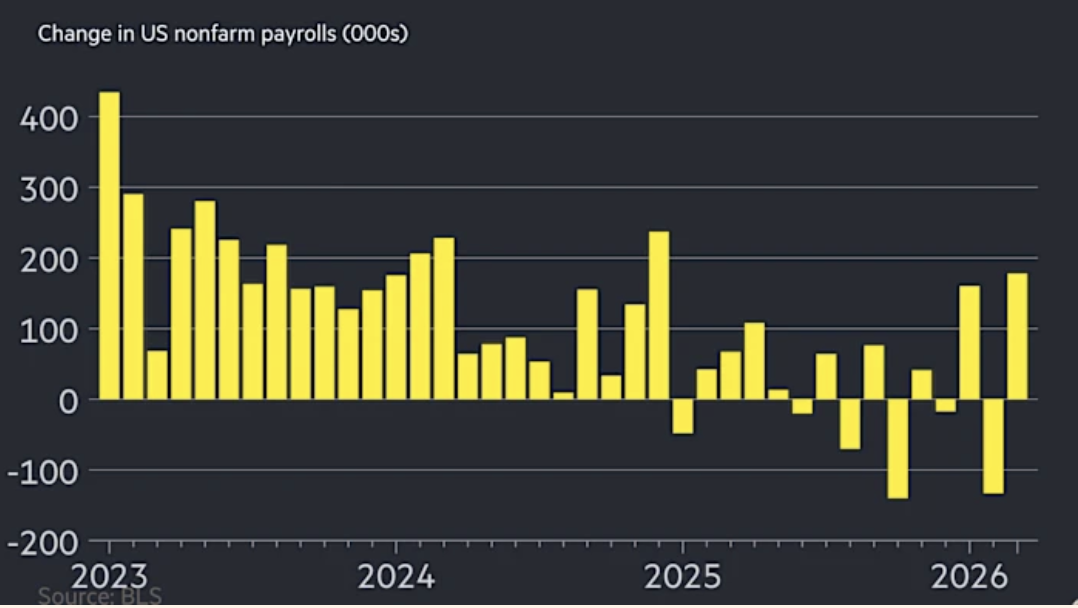
US economy beats expectations to add 178,000 jobs in March (Financial Times, 4 minute read)
The US labor market rebounded strongly in March, adding 178,000 jobs, far exceeding expectations of 65,000, after a revised loss of 133,000 jobs in February (from an initial -92,000). Growth was driven by education, healthcare, and manufacturing, while the unemployment rate edged down from 4.4% to 4.3%
The stronger-than-expected data pushed the 2-year Treasury yield up to 3.85% (+0.05pp)
It also reinforced expectations that the Federal Reserve will keep rates steady in the 3.5%–3.75% range as it assesses the inflation impact of rising energy prices tied to the Iran conflict
What falling wage growth says about where the U.S. economy is heading (NBC News, 4 minute read)
U.S. wage growth is slowing, with average hourly earnings rising 3.4% YoY, the weakest since 2021, while rising energy costs are pushing inflation higher and threatening affordability. Gas prices have jumped $1+ to ~$4.09/gallon, diesel to ~$5.50, and jet fuel is up 104%, driving higher costs across transportation, retail, and airlines
Although wages are still outpacing inflation (3.4% vs. 2.4%), economists warn this may reverse as inflation could reach ~4%, squeezing consumers
Higher interest rates, already pushing mortgages to ~6.45%, and broader cost pressures are increasing concerns about declining purchasing power and worsening affordability
Private credit sector stresses could be catastrophic, but not just yet (Reuters, 5 minute read)
Private credit is showing increasing signs of stress, with rising redemption requests, shrinking returns, and concerns over AI-driven disruption, particularly in software-backed loans, impacting a market estimated at $3.5T globally and $500B+ held by BDCs. Publicly traded BDCs are now trading at ~20% discounts to NAV, while major firms like Apollo, Blackstone, and KKR have begun limiting withdrawals, signaling liquidity pressure
Risk exposure is significant, with 25–35% of portfolios potentially vulnerable to AI disruption, and default rates expected to rise as credit conditions tighten
While some investors view this as a cyclical recalibration rather than a systemic crisis, the biggest concern lies in indirect exposure, particularly through insurers
Private credit makes up ~35% of U.S. insurer portfolios and over $1T in assets, increasing the risk of a slower, less visible impact on pensions and retail investors
Trump backs away from seizing Iran's oil: 'Unfortunately, the American people would like to see us come home' (Yahoo Finance, 2 minute read)
Amid escalating threats and rhetoric toward Iran, President Trump signaled a partial step back from plans to seize Iranian oil, despite repeatedly saying he would like to “take the oil” for economic gain. He acknowledged limited public support, noting such a move would likely require a complex ground operation targeting key infrastructure like Kharg Island, which handles ~90% of Iran’s oil exports
This shift lowers the immediate risk of direct disruption to global oil supply, even as tensions remain high and military threats continue
President Trump’s comments came amid escalating threats to target Iran’s bridges and electric grid as early as Tuesday night if Iran does not reopen the Strait of Hormuz
Markets are closely watching the situation, as any escalation involving Iranian oil infrastructure, or the Strait of Hormuz, through which ~20% of global oil flows, could drive further volatility and inflation in energy prices
IPO & EXITS
Big Banks Seeking a Piece of SpaceX’s I.P.O. Must Subscribe to Elon Musk’s Grok (The New York Times, 5 minute read)
Elon Musk is taking an unconventional approach to the upcoming SpaceX IPO (expected to raise $50B+ at a $1T+ valuation) by requiring banks, law firms, and advisers to purchase subscriptions to his AI chatbot, Grok, with some firms committing tens of millions of dollars and integrating it into their systems. The move underscores Musk’s strong leverage over Wall Street, as major banks compete for roles in what could be one of the largest IPOs ever, generating $500M+ in advisory fees
The strategy also aims to boost Grok’s enterprise traction ahead of the listing, especially as it lags competitors like ChatGPT and Gemini
It also reinforces Musk’s broader ecosystem, which includes xAI (~$1B revenue) and Starlink, SpaceX’s core business, generating ~$8B in revenue (2024)
SpaceX IPO is Musk’s biggest financial moonshot (Financial Times, 5 minute read)
SpaceX’s IPO is being positioned as a transformative bet on the future space economy, spanning communications (Starlink), launch infrastructure, and AI integration via xAI. While Starlink is already generating significant cash flow (estimated $7.5B EBITDA, potentially scaling to $95B by 2040 on $150B revenue), the valuation relies heavily on ambitious long-term narratives, including space-based data infrastructure and broader industrial expansion
The deal reflects financial opportunism, with SpaceX funding xAI’s costly AI push. It also creates a complex story for investors to evaluate
Despite questions around fundamentals and execution, the IPO is expected to attract massive demand
This is driven by FOMO and potential inclusion in major indices. It could become one of the most anticipated listings ever
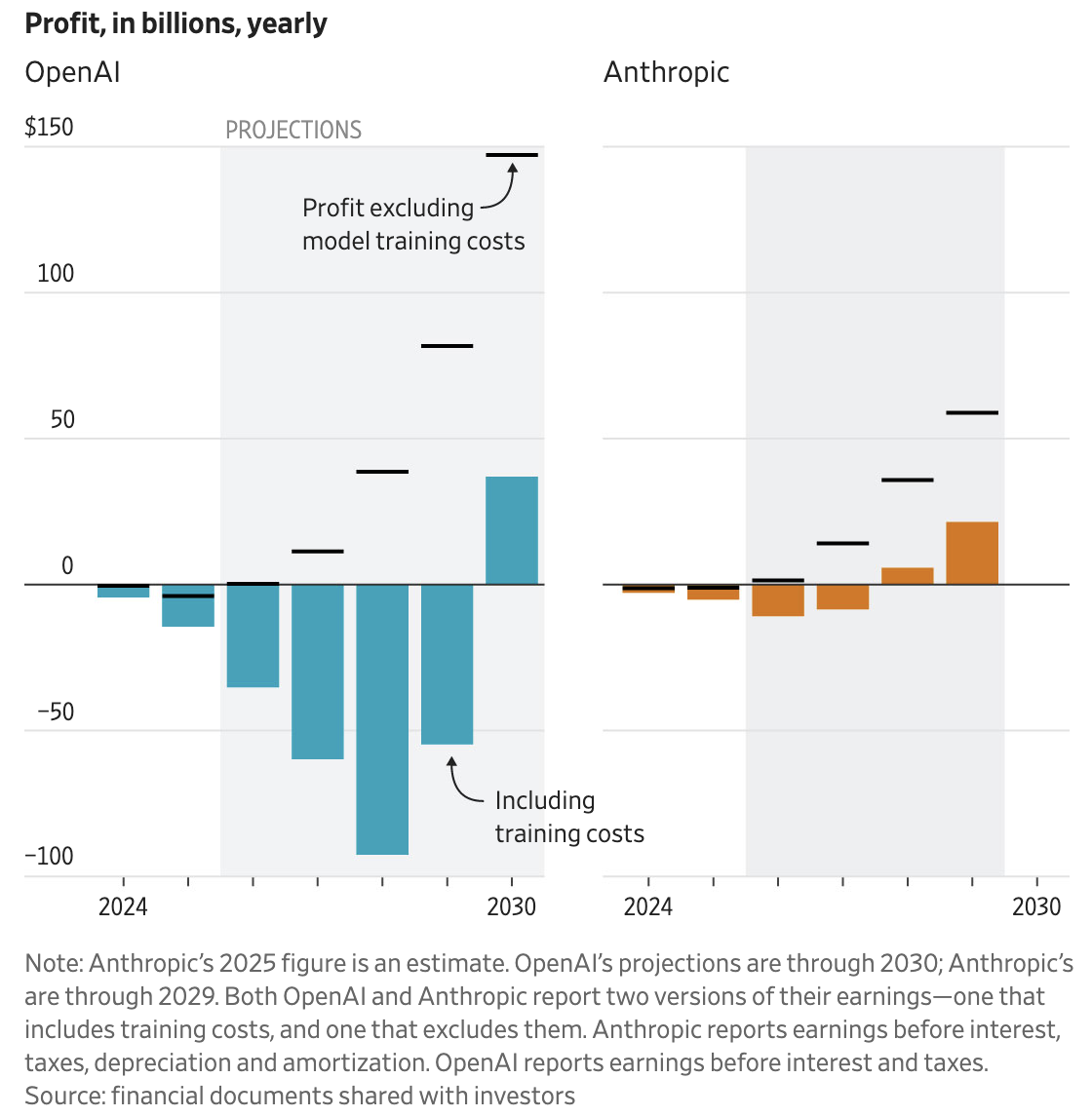
An Inside Look at OpenAI and Anthropic’s Finances Ahead of Their IPOs (The Wall Street Journal, 5 minute read)
OpenAI and Anthropic are racing toward potential IPOs, but their biggest challenge is the massive cost of building AI. OpenAI alone expects to spend ~$121B on compute by 2028, with projected losses of ~$85B that year, and does not expect to break even until the 2030s, while Anthropic faces similar, though smaller, cost pressures
Despite this, both companies are growing rapidly, with revenues expected to more than double YoY, driven largely by enterprise adoption
However, costs remain extreme, with inference expenses consuming 50%+ of revenue
Both firms rely on continued fundraising and future IPOs to sustain operations, highlighting the capital-intensive nature of the AI arms race
WHAT A TIME TO BE ALIVE
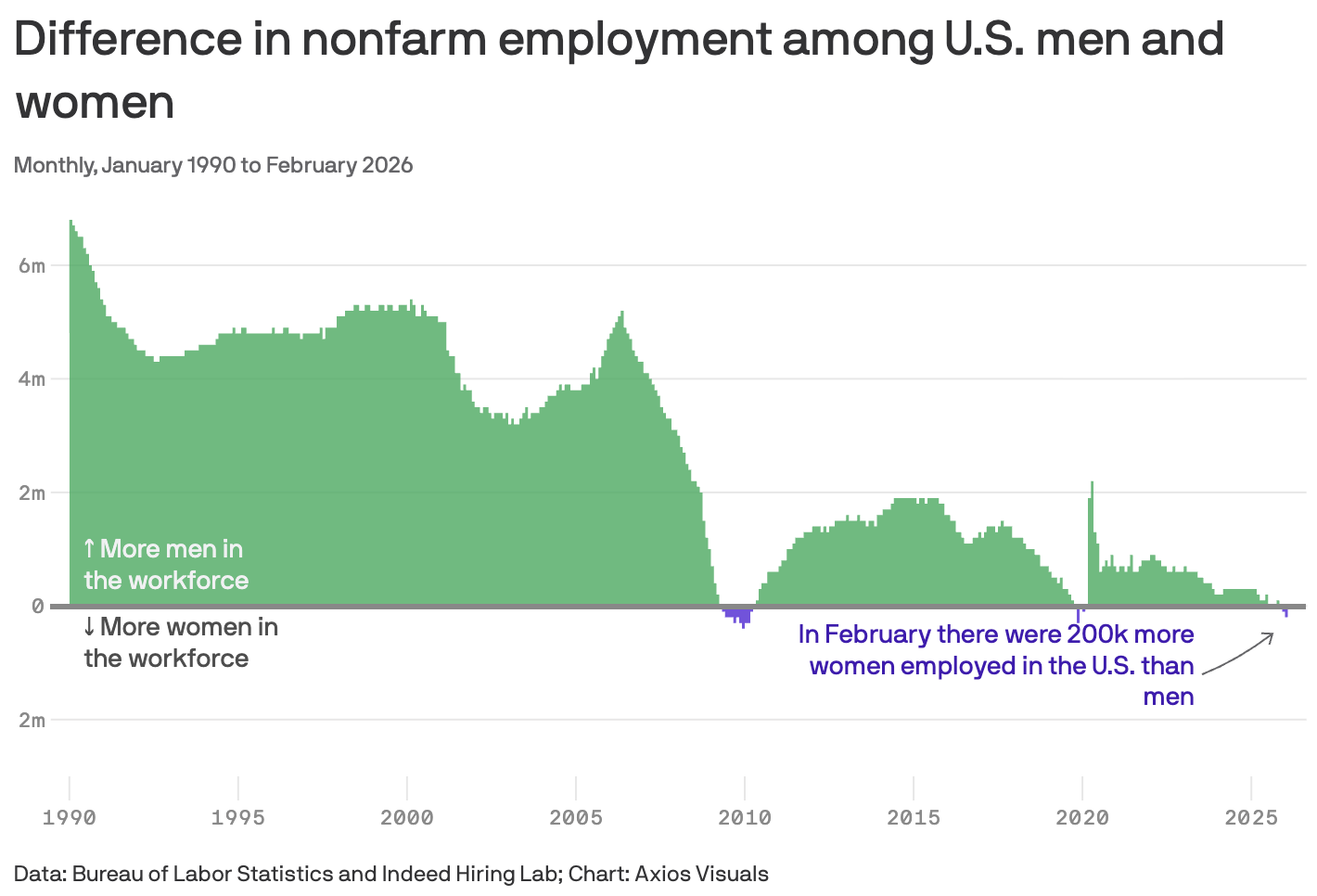
It's a woman's economy now (Axios, 4 minute read)
Women now slightly outnumber men in the U.S. workforce for only the third time in history, driven largely by structural shifts rather than pure empowerment. Growth in female-dominated sectors like healthcare, education, and hospitality, combined with declines in male-heavy industries like manufacturing, has shifted employment, while male employment fell by ~142,000 jobs between 2025–2026
This shift has trade-offs: female-dominated jobs tend to pay less, and women still earn about ~82 cents per dollar on average
At the same time, men’s workforce participation is declining, and many are not moving into fast-growing sectors like healthcare due to structural and cultural barriers
California Suspends Enforcement of Law Requiring VCs to Report Diversity Data (Wired, 6 minute read)
California has suspended enforcement of its 2023 venture diversity law just before the April 1, 2026 reporting deadline, which would have required VC firms to disclose demographic data on founders and funding allocation. The rule included annual reporting requirements, anonymized founder surveys, and potential daily fines for noncompliance, aiming to address longstanding disparities where women and minorities receive a disproportionately small share of venture funding
However, industry backlash highlighted rollout issues like delays, unclear processes, and concerns about data accuracy and legal risks
The state will now restart rule making, which could take up to 12 months, reflecting broader tensions around DEI policies and growing regulatory uncertainty
8alpha.ai is an AI fintech transforming cash-generating businesses into scalable, AI-powered companies. We provide revenue-based financing and hands-on AI transformation, delivering no zeros with unlimited upside. We’re the architects building financial infrastructure for the next generation of investors and startups.
Become part of our revolution.
Happy reading,
8alpha.ai’s Research & Investment Team