AI Priced on Promise?
Welcome to AI8’s weekly newsletter, your ultimate source for curated insights and updates from the dynamic world of venture capital!
From billion-dollar rounds to market-defining shifts, we deliver the intelligence powering the global investment landscape, moving investors and innovators forward. At 8alpha.ai, we’re not waiting for the future of capital, we’re building it. Stay sharp, stay curious, and stay ahead.
STARTUPS
ROUNDS AND UNICORNS
The Week’s 10 Biggest Funding Rounds: Space Tech, AI Infrastructure Lead Fundraises (Crunchbase, 5 minute read)
Sierra Space ($550M, space tech): The Louisville, Colorado–based company developing satellites, spacecraft, and space subsystems secured $550 million in equity funding led by LuminArx Capital Management, valuing the 5-year-old firm at $8 billion
Ayar Labs ($500M, AI infrastructure): Developer of co-packaged optical interconnects used in AI data centers, the San Jose startup raised a $500 million Series E led by Neuberger Berman, bringing its valuation to $3.75 billion
Vast ($500M, space tech): The Long Beach startup building next-generation commercial space stations announced $500 million in new financing, including $300 million in Series A equity and $200 million in debt, with Balerion Space Ventures leading the round
Findhelp ($250M, healthcare platform): Austin-based Findhelp, which operates a platform connecting individuals with health and social care resources, raised $250 million from TPG’s The Rise Fund to expand its network across healthcare systems and public programs
Science Corp. ($230M, neuro technology): Focused on brain-computer interface technology, the Alameda biotech startup closed a $230 million Series C backed by Lightspeed Venture Partners, Khosla Ventures, Y Combinator, IQT, and Quiet Capital
Over $50B Went To Boom-Era Software Companies That Haven’t Raised In 4+ Years (Crunchbase, 3 minute read)
Many startups raised large amounts of capital during the 2020–2022 venture boom, but companies that go more than four years without a new funding round often face declining chances of securing major financing or achieving a significant exit. This issue is becoming more visible now that four years have passed since U.S. venture investment hit its peak. More than 150 U.S. software and software-related startups that each raised at least $100M have not raised new funding in over four years, despite remaining private and not being acquired
Collectively, these companies raised over $51B in total funding during the boom
Some notable examples include Carta ($1.2B raised), OpenSea ($427M), and Calendly ($350M)
While some may still be operating with the capital raised during the boom, others may be quietly downsizing or sustaining operations with small teams while waiting for improved market conditions
Massive AI Deals Drive $189B Startup Funding Record In February While Public Software Stocks Reel (Crunchbase, 3 minute read)
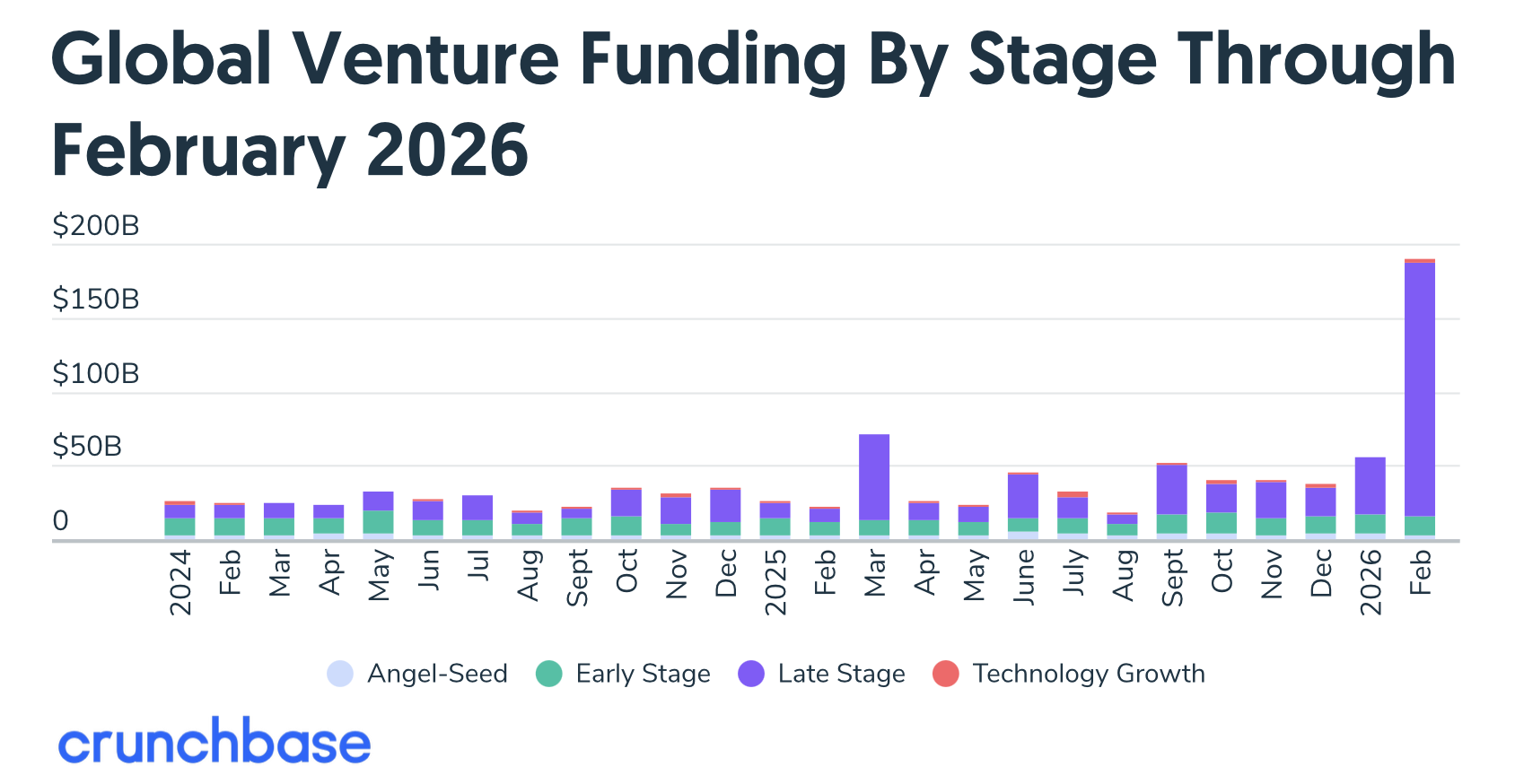
Global venture funding reached a record $189B in February, up ~780% year-over-year from $21.5B in February 2025. However, capital was highly concentrated: 83% ($156B) went to just three companies: OpenAI ($110B), Anthropic ($30B), and Waymo ($16B). AI dominated the funding surge, with $171B (about 90%) of global venture investment going to AI-related startups. Overall, venture capital is becoming more concentrated in large AI deals even as public market volatility continues to limit exit opportunities
The U.S. captured the vast majority of capital, with $174B (92% of global funding) raised by U.S.-based startups
Several other billion-dollar rounds also occurred, including four companies raising $1B+: Rapidus, Wayve, World Labs, and Cerebras Systems
Despite the surge in late-stage capital, early funding was mixed: seed funding fell 11% to $2.6B, while early-stage funding rose 47% to $13.1B
Robinhood’s startup fund stumbles in NYSE debut (TechCrunch, 3 minute read)
Robinhood launched Robinhood Ventures Fund I, a vehicle aimed at giving retail investors exposure to private startups such as Databricks, Stripe, Mercor, Oura, Ramp, Airwallex, Revolut, and Boom. The fund initially targeted $1B, but raised $658.4M (up to $705.7M with underwriters). Shares were initially priced at $25, but fell to $21 on the first day, a 16% drop
The weaker reception contrasts with Destiny Tech100, a similar fund investing in companies like SpaceX and OpenAI, whose shares now trade 33% above their underlying asset value
Analysts suggest Robinhood’s fund attracted less enthusiasm because it lacks exposure to high-demand startups like OpenAI, Anthropic, and SpaceX
Robinhood plans to expand the portfolio to 15–20 late-stage companies, but gaining access to these coveted startups’ cap tables remains difficult
AI’s giants: Mostly priced on promise (PitchBook, 3 minute read)
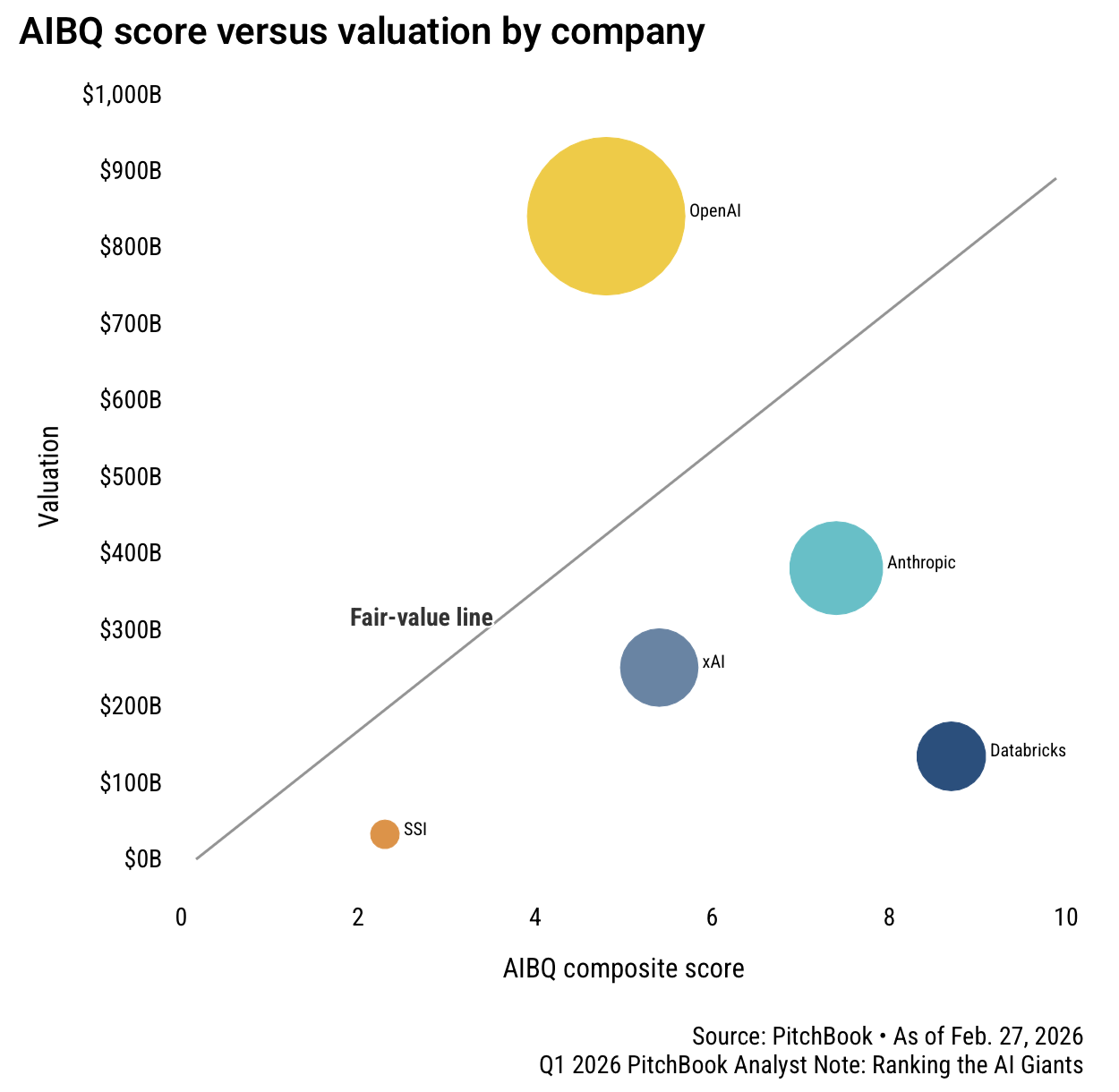
A PitchBook analysis shows that valuation does not necessarily reflect business quality among leading AI companies, many of which have raised massive funding based on future potential. The top five AI companies have collectively raised about $202B in primary capital, yet their operational strength varies widely. Databricks, valued at $134B, scored the highest on PitchBook’s AI Business Quality index at 8.7, supported by strong enterprise revenue, multi-cloud infrastructure, and positive free cash flow in 2025
By contrast, OpenAI, despite raising $110B in funding and reaching an $840B valuation, scored 4.8, partly because 85% of its 800–900M weekly users are on free tiers and profitability may not come until 2029
Anthropic scored 7.4 with 140%+ net revenue retention, while xAI scored 5.4 due to early-stage revenue
Safe Superintelligence, valued at $32B with no product or revenue, scored the lowest at 2.3, underscoring how much AI investment is currently driven by expectations rather than proven fundamentals

ECONOMIC SNAPSHOT
The US economy lost 92,000 jobs in February and the unemployment rate rose to 4.4% (CNN, 4 minute read)
U.S. employers cut 92,000 jobs in February, far below expectations of a 60,000 gain, while the unemployment rate edged up to 4.4% from 4.3%, according to the Bureau of Labor Statistics. Job losses were concentrated in health care (-28,000, largely due to a 31,000-worker strike), leisure and hospitality (-27,000), and construction (-11,000). January job gains were also revised down to 126,000, and December was revised to a loss of 17,000 jobs
The data highlights a fragile labor market that has lost jobs in five of the past nine months and 19,000 jobs since May, amid uncertainty tied to tariffs, geopolitical tensions, and AI-related layoffs
Still, some indicators remain resilient: wage growth rose 0.4% in February (3.8% annually) and layoffs remain relatively low, suggesting the labor market is slowing but not yet in sharp decline
Weak Jobs Data Underscores Fed’s Dilemma as War Stokes Inflation Risk (The New York Times, 4 minute read)
Rising inflation risks, particularly from higher energy prices tied to the Middle East conflict and earlier tariffs, are complicating the Federal Reserve’s policy outlook. While February payrolls fell by 92,000 and unemployment rose to 4.4%, Fed officials are more concerned about inflation remaining above the 2% target for nearly five years, with policymakers warning that inflation above 3% for a prolonged period becomes increasingly dangerous
The Fed is expected to hold rates at 3.5%–3.75% at its March 17–18 meeting, extending the pause after three cuts late last year
However, if inflation rises while the labor market weakens, policymakers may face a trade-off between supporting growth and controlling prices
Upcoming CPI and PCE reports will be key for determining whether rate cuts later in 2026 remain likely
Why an Iran war inflation shock could wreck global economic recovery (The Guardian, 5 minute read)
An escalation of the Iran conflict could trigger a global inflation shock, mainly through rising energy prices. The IMF estimates that a sustained 10% increase in energy prices would raise global inflation by about 0.4 percentage points and reduce global growth by 0.1–0.2%, while disruptions around the Strait of Hormuz, through which about 20% of global oil supply passes, could significantly tighten energy markets
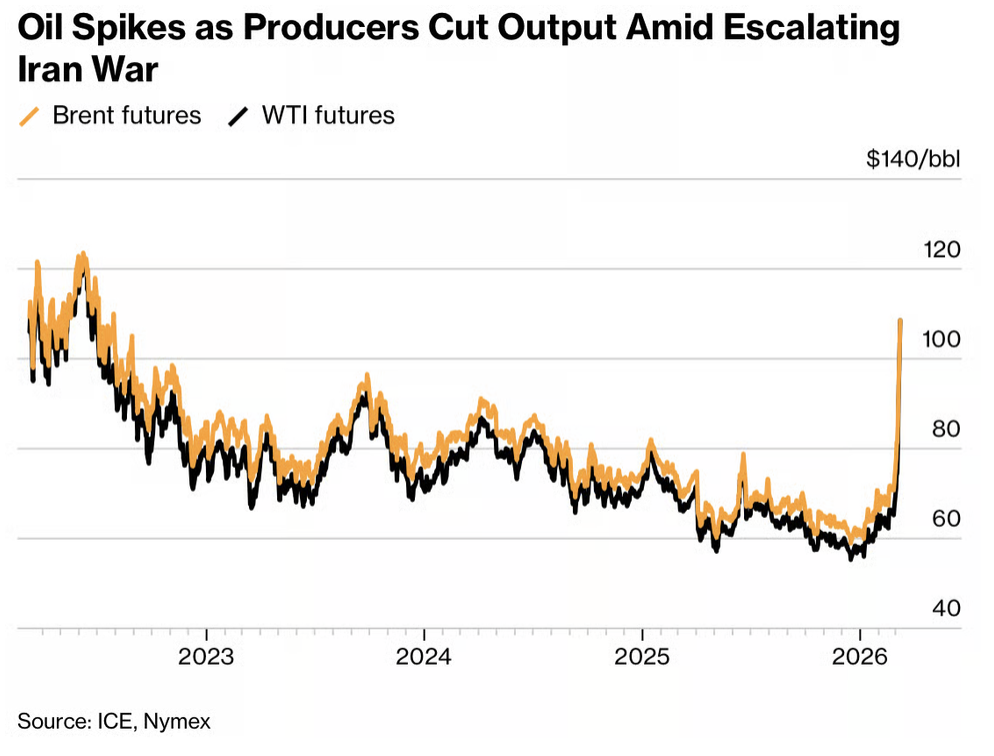
Oil prices have already surged, with Brent crude rising about 17% since the conflict began, pushing U.S. gasoline prices up roughly 15 cents per gallon
If supply disruptions worsen, economists estimate oil could reach around $108 per barrel
This could raise inflation in the UK and eurozone by 0.5–0.6 percentage points and slow growth, with UK GDP forecasts falling from 1.1% to about 0.9% and eurozone growth from 1.2% to around 1%
Stocks Sink as Yields Spike After Oil Hit $100: Markets Wrap (Bloomberg, 4 minute read)
Global markets fell as the Middle East conflict pushed oil above $100 per barrel for the first time since 2022, raising fears of an inflation shock. Brent crude jumped 15% to about $107, while S&P 500 futures dropped 1.3%, the 10-year Treasury yield rose to 4.19%, and the U.S. dollar climbed 0.6% to its highest level since January
The surge in energy prices is raising concerns about inflation and potential stagflation, particularly in Europe
Traders are now pricing in about 50 basis points of European Central Bank rate hikes this year and over a 50% chance of a Bank of England increase
Analysts warn that sustained oil prices above $100 could slow economic growth while keeping interest rates higher for longer
IPO & EXITS
AI Chipmaker Cerebras Taps Morgan Stanley for IPO Return (Bloomberg, 3 minute read)
Cerebras Systems, an AI chip startup, is preparing a renewed IPO that could raise about $2B as soon as April, with Morgan Stanley leading the offering alongside Citigroup and Barclays. The company previously withdrew its IPO filing in October after nearly a year in process but has now submitted fresh paperwork and begun meeting with analysts and potential investors
The company, valued at about $23B after a $1B funding round in February led by Tiger Global, aims to compete with Nvidia in the rapidly growing AI chip market
Its IPO effort comes amid surging investment in AI infrastructure, and momentum has increased after OpenAI launched a model running on Cerebras chips
The company had also resolved earlier U.S. national security review concerns tied to its relationship with Abu Dhabi AI firm G42
To justify a $1.5 trillion market cap after its IPO, SpaceX would need to earn more than Berkshire Hathaway. Here’s why that’s so unlikely (Fortune via Yahoo Finance, 4 minute read)
Reports suggest Elon Musk may take SpaceX public this summer, potentially raising about $50B at a $1.5T valuation, which would make it the largest IPO ever. The listing follows the merger of SpaceX and xAI, though financial details remain limited. Musk has said SpaceX generated about $15B in revenue and $8B in EBITDA last year, while reports indicate a $2.4B loss in the first nine months of 2025, implying little or no GAAP profitability
The valuation depends heavily on future growth in space and AI
SpaceX plans to build 10,000 reusable Starlink rockets costing about $35M each (~$350B total), while xAI reportedly burned $8B in 2025 building AI data centers
Analysts estimate SpaceX would need roughly $80B in annual net earnings within five years to justify a $1.5T valuation
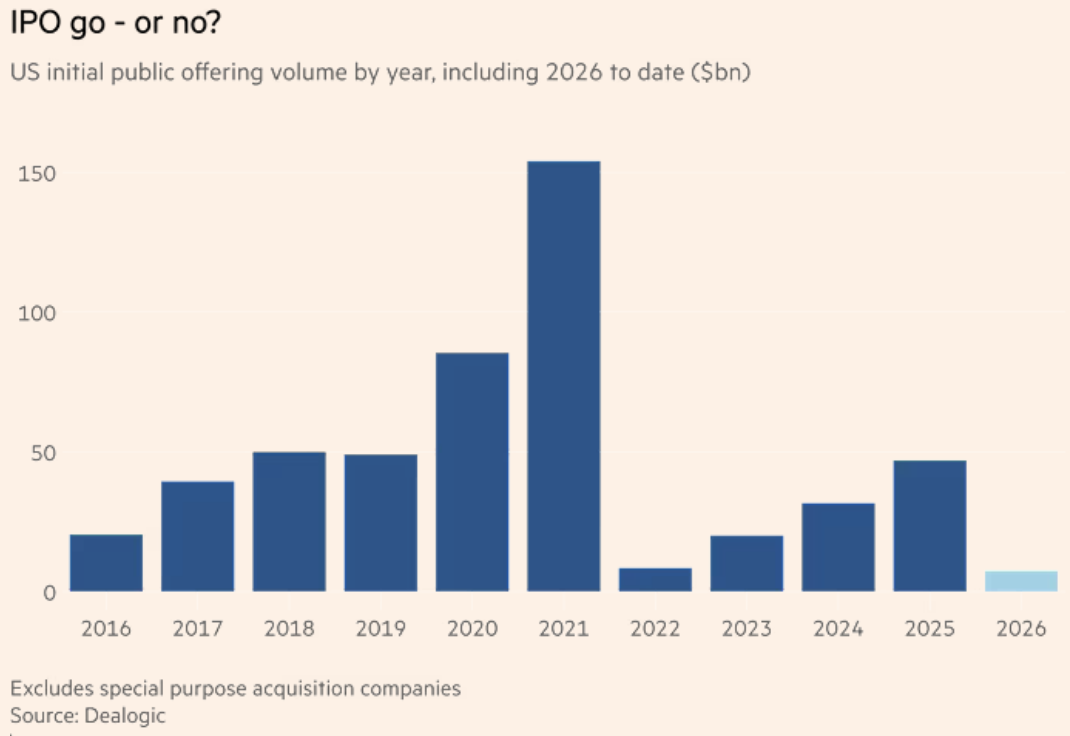
Banker’s bumper year for IPOs isn’t quite going to plan (Financial Times, 3 minute read)
The IPO market began 2026 with strong momentum after global IPO volumes rose 33% in 2025 to $155B, the highest since the $434B record in 2021, and U.S. listings started the year at their fastest pace since that boom. However, rising market volatility (VIX around 23) and geopolitical tensions are slowing activity, prompting companies such as Loveholidays and PayPay to delay planned offerings
Another risk is the potential impact of mega IPOs absorbing investor capital
A 3% float of SpaceX at a $1.5T valuation could raise about $45B, nearly double Alibaba’s $25B IPO record in 2014 and close to the total raised by all 186 U.S. IPOs last year
WHAT A TIME TO BE ALIVE
Venture dollars to female founders doubled to a record $73 billion last year—but Anthropic and Scale AI skewed the data (Fortune, 4 minute read)
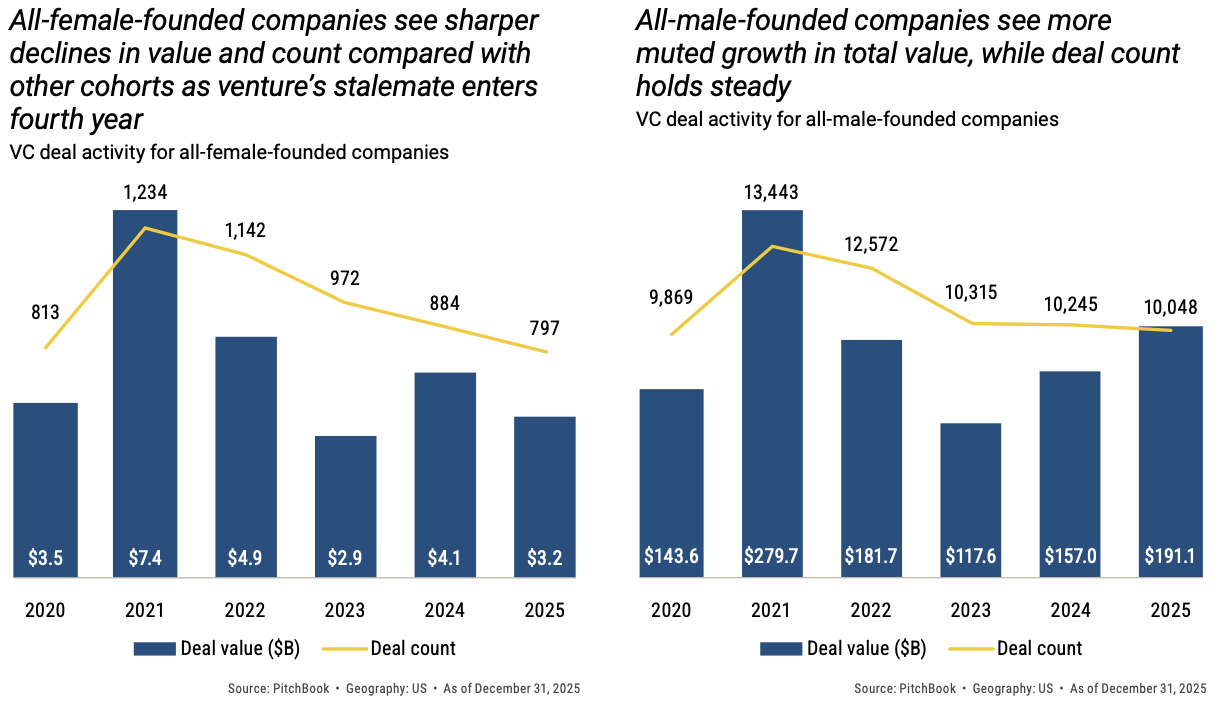
Funding for female-founded startups reached a record $73.6B in 2025, nearly double the $44.7B raised in 2023, but the gains were highly concentrated in a few AI companies. Two-thirds of venture dollars for female founders went to AI, with Anthropic and Scale AI alone raising over $30B and accounting for more than 40% of AI funding in the category. Despite higher funding totals, deal count for female-founded startups fell for the fourth straight year
All-female founding teams remain especially underfunded, receiving only about 2% of total U.S. VC capital
Meanwhile, most VC decision-makers are still male, representing 82% at firms with $50M+ in assets under management
US All In: Female Founders in the VC Ecosystem (PitchBook, 15 minute read)
Female-founded startups in the U.S. raised a record $73.6B in venture funding in 2025, even as deal count declined, highlighting a shift toward fewer but larger rounds. Much of the capital was concentrated in AI, which captured about two-thirds of all VC dollars invested in female-founded companies, with Scale AI and Anthropic alone raising more than $30B
Despite record funding, all-female founding teams saw larger declines in deal value and count, while mixed-gender teams captured most megadeals
Valuations rose sharply, over 50% overall and about 25% for all-female teams
Exit value also more than doubled, with female founders accounting for 24.9% of U.S. exits, though VC decision-making remains largely male-dominated
8alpha.ai is an AI fintech transforming cash-generating businesses into scalable, AI-powered companies. We provide revenue-based financing and hands-on AI transformation, delivering no zeros with unlimited upside. We’re the architects building financial infrastructure for the next generation of investors and startups.
Become part of our revolution.
Happy reading,
8alpha.ai’s Research & Investment Team