Welcome to AI8’s weekly newsletter, your ultimate source for curated insights and updates from the dynamic world of venture capital!
From billion-dollar rounds to market-defining shifts, we deliver the intelligence powering the global investment landscape, moving investors and innovators forward. At 8alpha.ai, we’re not waiting for the future of capital, we’re building it. Stay sharp, stay curious, and stay ahead.
STARTUPS
ROUNDS AND UNICORNS
The Week’s 10 Biggest Funding Rounds: Agentic AI And Infrastructure Are Still On A Roll (Crunchbase, 5 minute read)
Mirendil (AI for R&D): San Francisco-based Mirendil, a developer of agentic AI technology for research and development, secured $1 billion in Series A funding led by Kleiner Perkins and Clearlake Capital
Mercor (Human-Led AI Training): San Francisco-based Mercor, a platform that connects AI developers with human experts for model training and evaluation, raised $750 million in Series D funding at a $20 billion valuation, less than four years after its founding
Torus (AI Infrastructure): Salt Lake City-based Torus, a manufacturer of distributed power and compute infrastructure, announced $500 million in growth financing led by Magnetar Capital and introduced Foundry, a modular AI infrastructure product for inference compute
Path Robotics (AI for Manufacturing):Columbus-based Path Robotics, a developer of physical AI for robotics and manufacturing with initial expertise in welding, picked up $300 million in Series E financing led by Georgian at a $2.45 billion valuation
LangChain (Agentic AI): San Francisco-based LangChain, developer of a platform to run, improve, and govern AI agents, closed $300 million in Series C funding led by CapitalG at a $3 billion valuation
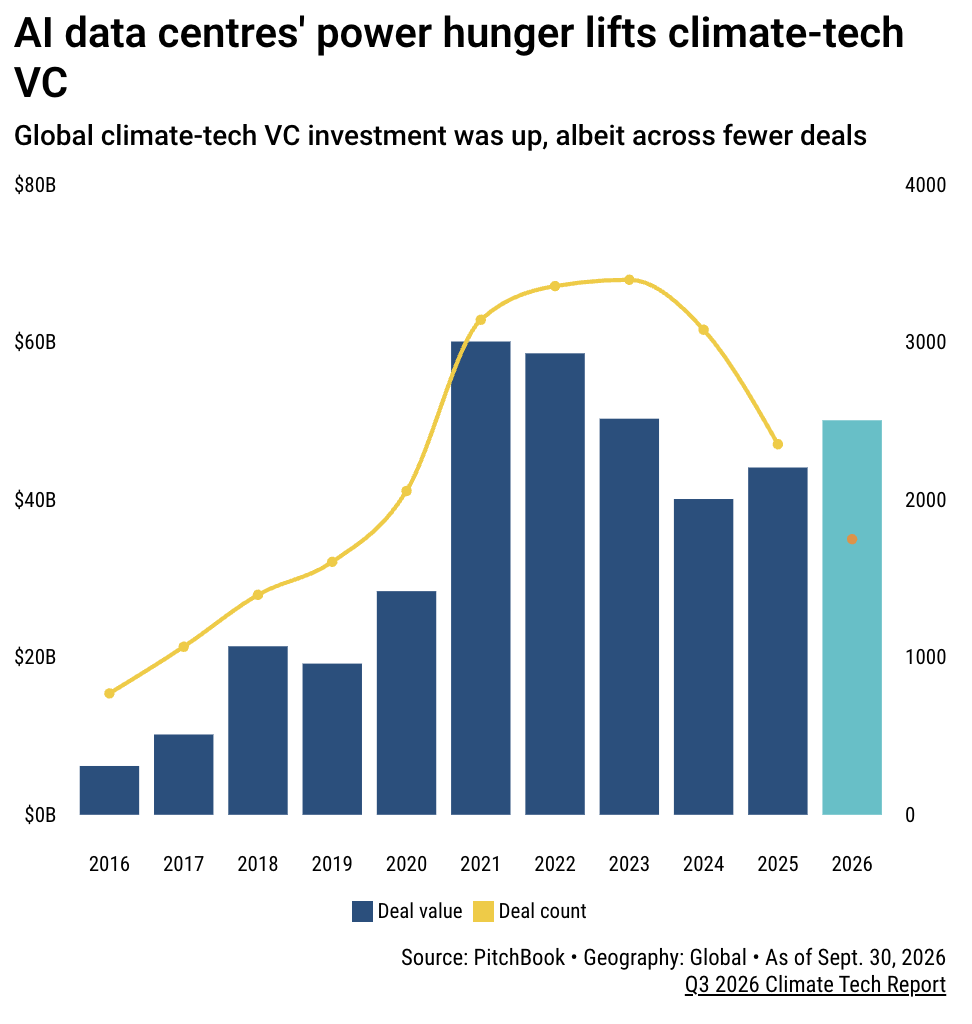
AI-driven data centre demand fuels record quarter for climate tech VC (PitchBook, 4 minute read)
Global climate tech VC deal value hit a record $22.5 billion in Q3, up roughly 62% from Q2, even as deal count slipped about 7%, with data center-related investments driving much of the surge as capital concentrates on AI-driven energy demand. Funding in 2026 has already surpassed each of the previous two full years, putting the year on track to challenge 2021’s peak. Three data center-linked segments led: built environment captured the most, at $7.3 billion across 57 deals (32.3% of the quarter), followed by dispatchable energy at $6.1 billion across 50 deals (27.2%) and grid infrastructure at $4.3 billion across 89 deals (18.9%). Six megadeals of $1 billion or more made up just under half of Q3’s value, led by low-carbon data center developers Crusoe at $3.9 billion and Firmus at $2 billion (before it later pulled its IPO), with Valar Atomics, Form Energy, Base Power, and Commonwealth Fusion Systems each raising about $1 billion
North America accounted for $26.3 billion of global deal value so far in 2026, versus $13.1 billion for Europe, and both regions have already topped 2025’s full-year total
Form Energy combined a $750 million Series G with a $270 million credit facility
ECONOMIC SNAPSHOT
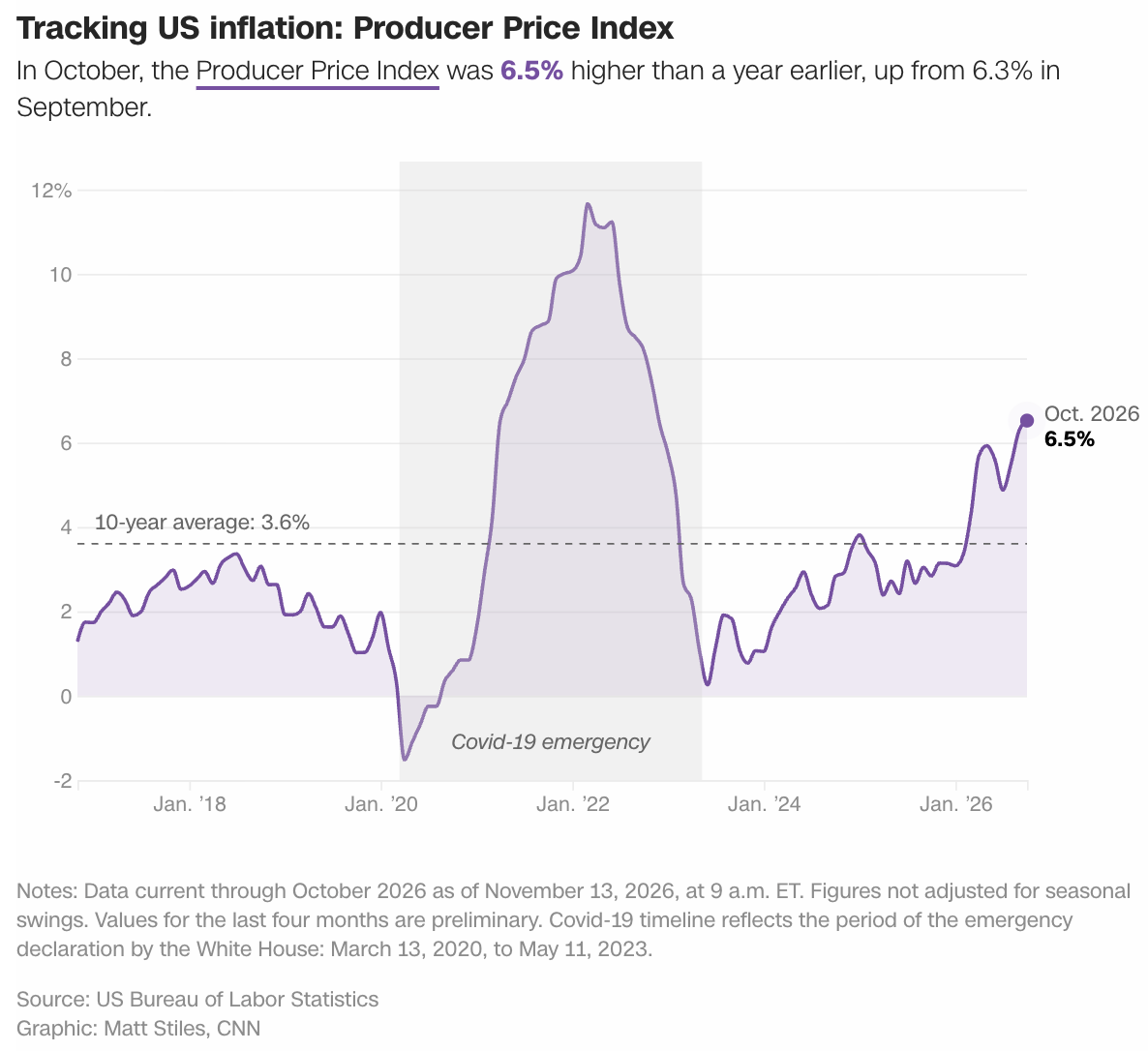
Wholesale inflation rose in October to highest annual rate in nearly four years (CNN, 3 minute read)
Wholesale inflation accelerated in October to its highest rate in nearly four years, with the Producer Price Index up 0.3% from September and 6.5% over 12 months, the highest annual rate since November 2022, per the BLS. Core PPI rose 0.3% monthly and 5% annually. The Iran war’s energy shock is still feeding through supply chains, and food prices climbed 1.3% in October, the fastest monthly rise since July 2022, led by produce, with wholesale fresh and dry vegetables up 26.7% and trucking freight costs up nearly 25% from a year ago. Guggenheim’s Matt Bush expects these costs to reach consumers in six to eight months, with businesses likely to pass them on in early 2027 annual price resets
Electronic components and accessories are up 31.7% from a year ago, the highest annual rate on record, a sign of AI investment adding inflationary pressure
The Fed is expected to hike in early December, with markets pricing a quarter-point increase while Governor Christopher Waller said a half-point could be necessary
Nationwide’s Ben Ayers said lingering fuel-price effects could warrant further tightening into 2027
U.S. debt now equals the whole economy — and tax cuts since 2001 added over $10 trillion (Fortune, 6 minute read)
Democrats, set to take over Congress with robust majorities, face a national debt now equal to the size of the US economy, a 100% debt-to-GDP ratio that drew little attention in an election dominated by cost-of-living concerns. Tax cuts since 2001 have added over $10 trillion to the debt, per a Center for American Progress analysis of CBO data, and without them the debt-to-GDP ratio would be falling. Tax cuts are also less benign now than in the past, because debt is higher and interest rates are steeper, so each new dollar of borrowing costs far more. Trump’s 2025 legislation, which made most of his 2017 cuts permanent, was only the sixth-largest tax cut as a share of GDP at 1.2%, yet the CBO estimated it would add $3.4 trillion over 10 years and push debt to 116% of GDP by the end of 2034. Democrats will have to weigh this math as they pursue an affordability agenda that minimizes new borrowing
Reagan’s 1981 cuts were the largest in history, reducing annual revenue by an average 2.9% of GDP, and the national debt tripled during his presidency
Debt stays stable only if the government runs a primary surplus and growth exceeds the interest rate, and US deficits are now growing faster than the economy
The last time the US took in more revenue than it spent was in 2000, which Bush cited to justify his 2001 tax cuts
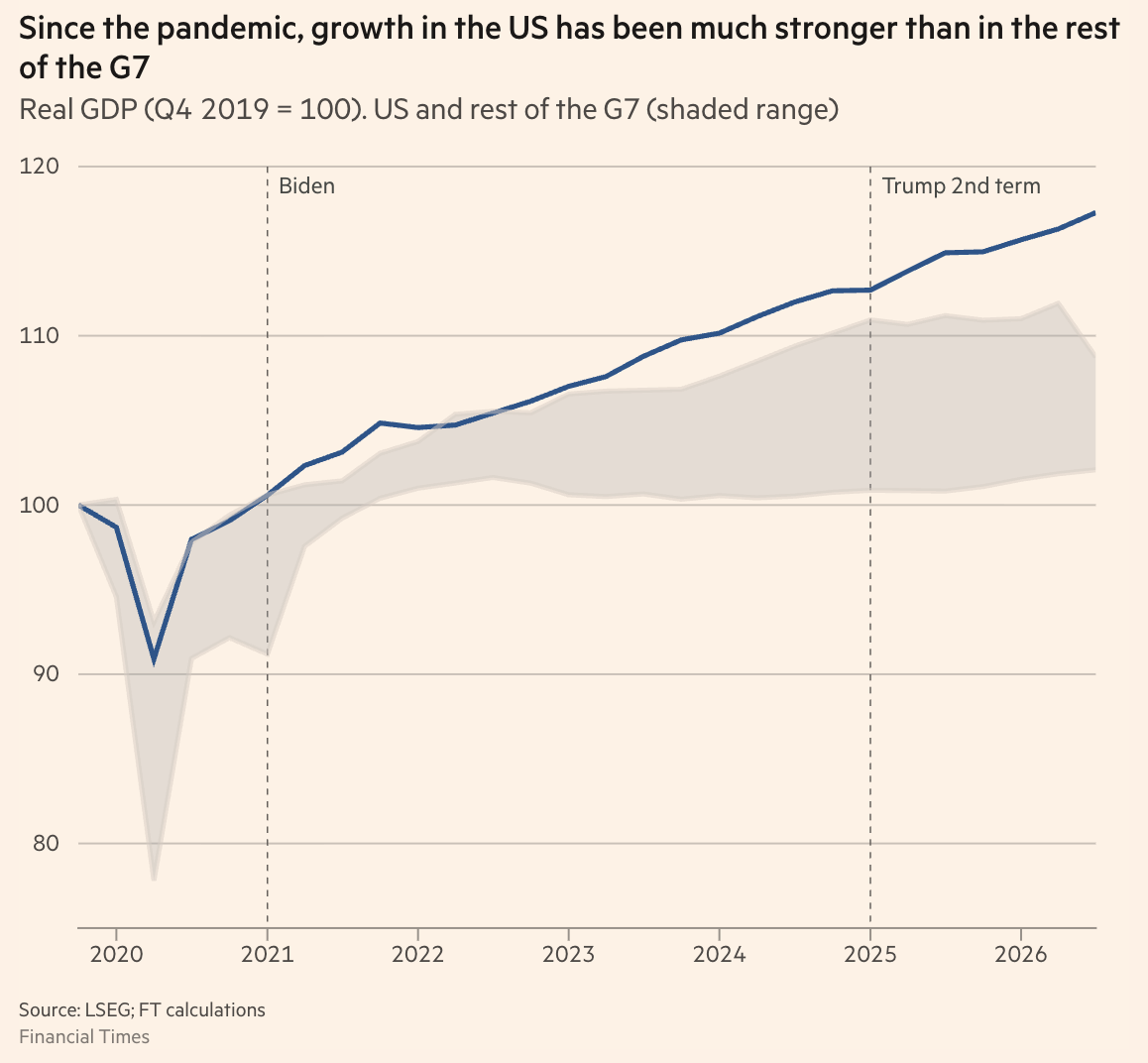
Surging US economy defies worries over turbulent Trump (Financial Times, 7 minute read)
The US is in an investment boom, with Q3 GDP growing at a 3.4% annualized rate, led by a 12.7% annualized rise in non-residential fixed investment that has held up through nearly two years of policy uncertainty. AI is the main driver, with one economist describing it as one of the largest investment booms“going all the way back to the railroads,” though market volatility has followed: Alphabet lost $500 billion in market value in a single day after its cash flow turned more negative, with $50 billion spent over three months on AI. The question now is whether the surge can continue through the Fed’s tightening. RSM’s Joe Brusuelas expects hyperscalers like Amazon and Meta to “roll right through” further rate increases but not other parts of the AI ecosystem, while Fed Chair Kevin Warsh says capex is broadening beyond AI
Foreign direct investment rose $266 billion last year to $5.86 trillion, so tariff fears of a US investment pullback haven’t materialized
The economy has added 72,000 manufacturing jobs in 2026 after years of decline, though the total is still below January 2025
AI to stay dominant force behind US business investment in 2027, Goldman says (Reuters, 5 minute read)
Goldman Sachs forecasts annualized spending on AI-related hardware and intellectual property will climb to $1.4 trillion by the end of 2027, nearly 4% of the US economy, after exceeding $900 billion by the end of 2026, and says AI will remain the dominant driver of business investment growth in 2027. It expects Democrats’ midterm wins to pose only limited risks to AI investment, despite concerns about tighter regulation of data-center development and about rising borrowing costs and investor scrutiny curbing debt-funded spending. Overall, it forecasts US business investment growth of 8% on a quarterly basis in 2027, nearly double the 4.2% consensus
Goldman estimates AI investment will add 5.3 percentage points to 2027 capex growth and 0.6 points to US GDP growth, but excluding semiconductors those figures fall to 4.3 and 0.2 points, since most information processing equipment is imported and netted out of GDP
Goldman says semiconductor investment is undercounted in the business investment statistics
IPO & EXITS
Anthropic’s IPO lands as the embattled AI trade looks for a much-needed bright spot (CNBC, 5 minute read)
Anthropic is expected to debut on the Nasdaq on Thursday at an IPO price of $70 to $78 a share, CNBC reports, a high-stakes event for tech as rising rates, an AI backlash, and Democratic midterm wins weigh on the industry. AMD, Broadcom, Google, Micron, Microsoft, Nvidia, and TSMC are collectively investing $26 billion at the IPO price, and Amazon’s stake could be worth hundreds of billions. Anthropic has more than $900 billion in outstanding commitments, including at least $110 billion with Amazon over a decade, another $400 billion for cloud capacity, and $125 billion to $150 billion for Google chips from 2028, and the IPO could raise over $90 billion on top of its $132 billion in cash. Google will own about 13% after the IPO and is backstopping $19 billion of Anthropic’s lease commitments to TeraWulf. Experts note the contract lengths are unusual, with the Amazon deal running twice the typical five years
Banks including Bank of America, Blackstone, Citigroup, and Morgan Stanley offered $63 billion to buy Broadcom chips that Anthropic will rent, with Broadcom backstopping up to $43 billion
The Nasdaq fell 5.3% in October, its worst month since March 2025
Stocks fall ahead of Nvidia earnings and Anthropic IPO (Reuters, 3 minute read)
Global stock indexes fell Monday, led by semiconductor shares, with Nvidia’s earnings and Anthropic’s market debut this week set to test whether the AI-fueled bull market has further to run. US chipmakers dropped over 4% in early trading, Korea’s benchmark fell 3.6% and Taiwan’s 6%, and by the close the Dow fell 0.48% to 52,096.34, the S&P 500 fell 1.00% to 7,485.71, and the Nasdaq fell 1.58% to 24,739.85. Nvidia’s market value was $3.9 trillion by Friday, down from about $5.8 trillion in early October, and it reports after the bell Tuesday, with analysts expecting 90% earnings growth on $109 billion in revenue and watching whether new management keeps its bullish outlook. Anthropic is expected to raise up to $80 billion when it prices on Wednesday at a valuation near $1.5 trillion, Reuters reports, and to begin trading Thursday under ANT.O. Traders still price a quarter-point Fed hike in December and at least three hikes by the end of 2027, while the dollar index touched its highest since April 2025
Oil fell as Strait of Hormuz flows recovered, with US crude down 1.81% to $86.96 and Brent down 2.11% to $93.82, and Jefferies’ Mohit Kumar said a ceasefire and Brent below $80 would remove the case for more hikes in 2027
The 10-year Treasury yield fell to 5.109% and the 30-year to 5.449%
Equiti’s Nadia El Bilassy said the IPO and Nvidia’s earnings will be the barometer for whether the correction continues
Can Nvidia keep writing AI’s checks without Jensen Huang? (PitchBook, 6 minute read)
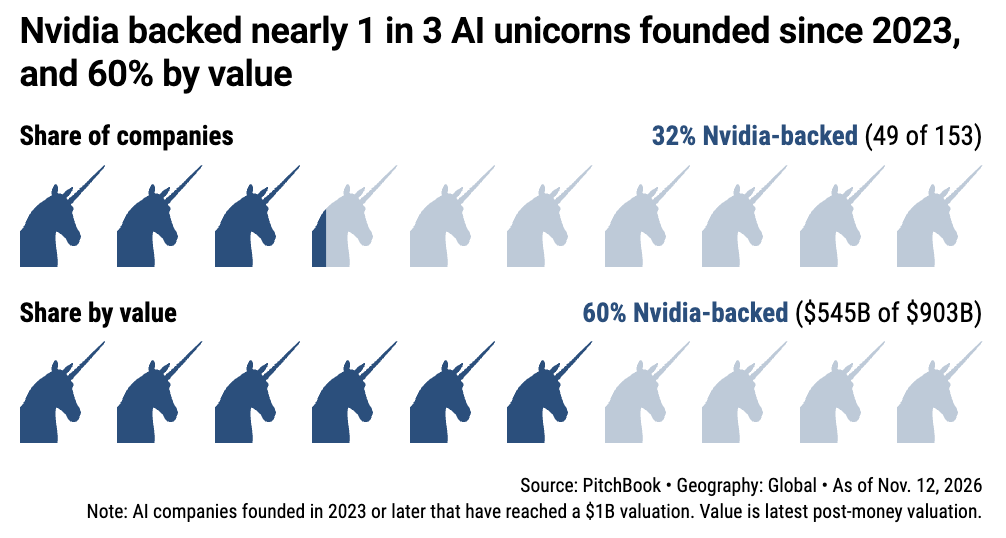
Nvidia’s role as AI’s chief financier is in question after Jensen Huang resigned as president, CEO, and director last Thursday under board pressure, following reports of an affair with a suspected Chinese spy and with multiple employees. CFO Colette Kress is interim CEO, and former Synopsys CEO Harvey Jones is the first-ever board chair. Nvidia has joined 296 VC deals since 2023, more than a third this year, and has backed 49 of 153 AI unicorns founded since 2023 (32%), representing 60% of their $903 billion in value, plus nearly $50 billion in frontier AI labs. The risk is that investigations and a succession fight leave it unable to keep financing the AI ecosystem
Kress leads Nvidia’s first earnings call without Huang on Tuesday, Nov. 17, which could signal any change in strategy, though as CFO she is unlikely to turn bearish on its financing approach
Kress has called the roughly $50 billion in frontier-lab investments “a small fraction of our expected free cash flow over the same period”
Huang had about 60 direct reports by his own count, one sign of the governance cleanup facing new leadership
Supreme Court agrees to hear Robinhood challenge to IPO information omission lawsuit (CNBC, 3 minute read)
The Supreme Court agreed to hear Robinhood’s appeal seeking to block a class-action lawsuit over interim financial data omitted from its July 2021 IPO. Robinhood wants the Court to overturn a 9th Circuit ruling that revived the investor suit, which also names firms involved in the IPO, including Goldman Sachs and J.P. Morgan Securities, after a San Francisco federal judge had dismissed it. The investors allege the registration statement omitted material information it was legally required to disclose: it contained only limited information about Robinhood’s performance in the second quarter of 2021, and the stock dropped after the company reported those results. The Trump administration and the SEC had urged the Court to take the case
A Robinhood spokesperson said the company is “pleased” the Court will hear its case
The IPO followed a surge in retail interest during the pandemic in meme stocks and dogecoin
8alpha.ai is an AI fintech transforming cash-generating businesses into scalable, AI-powered companies. We provide revenue-based financing and hands-on AI transformation, delivering no zeros with unlimited upside. We’re the architects building financial infrastructure for the next generation of investors and startups.
Become part of our revolution.
Happy reading,
8alpha.ai’s Research & Investment Team