Welcome to AI8’s weekly newsletter, your ultimate source for curated insights and updates from the dynamic world of venture capital!
From billion-dollar rounds to market-defining shifts, we deliver the intelligence powering the global investment landscape, moving investors and innovators forward. At 8alpha.ai, we’re not waiting for the future of capital, we’re building it. Stay sharp, stay curious, and stay ahead.
STARTUPS
ROUNDS AND UNICORNS
The Week’s 10 Biggest Funding Rounds: AI, Defense And Space Tech Lead For Large Rounds (Crunchbase, 5 minute read)
Shield AI (Defense Tech): San Diego-based Shield AI, which builds autonomy software and systems for defense along with simulation and synthetic reality technology, secured $2 billion in equity, including a $1 billion Series H led by Disruptive and Innovation X Capital and a $1 billion structured equity investment from Blackstone funds, plus $500 million in debt led by JPMorganChase, and is acquiring radar company Echodyne in a deal valued at $5.3 billion
Zipline International (Drones): South San Francisco-based Zipline, a drone delivery provider, raised $1.5 billion in late-stage funding led by Paradigm, WCM Investment Management, and Layer Global at a $21.5 billion post-money valuation, to expand U.S. manufacturing and hiring as it builds a nationwide delivery network
CesiumAstro (Space Tech): Austin-based CesiumAstro, a developer of space and defense communications systems and satellites, closed a $730 million Series D led by Janus Henderson at a valuation of more than $4.5 billion, along with $100 million in debt financing through the Export-Import Bank of the United States and JPMorganChase
Northwood Space (Space Tech): Torrance-based Northwood Space, which builds ground infrastructure for satellite systems, picked up a $375 million Series C led by Andreessen Horowitz and DFJ Growth, about nine months after the 3-year-old startup’s Series B
Applied Compute (AI Models): San Francisco-based Applied Compute, whose cloud platform lets enterprises and developers train and run large AI models, raised $350 million led by Elad Gil with Nvidia among the investors, at a $3.25 billion valuation, and says its annual recurring revenue has topped $100 million just 18 months after launch
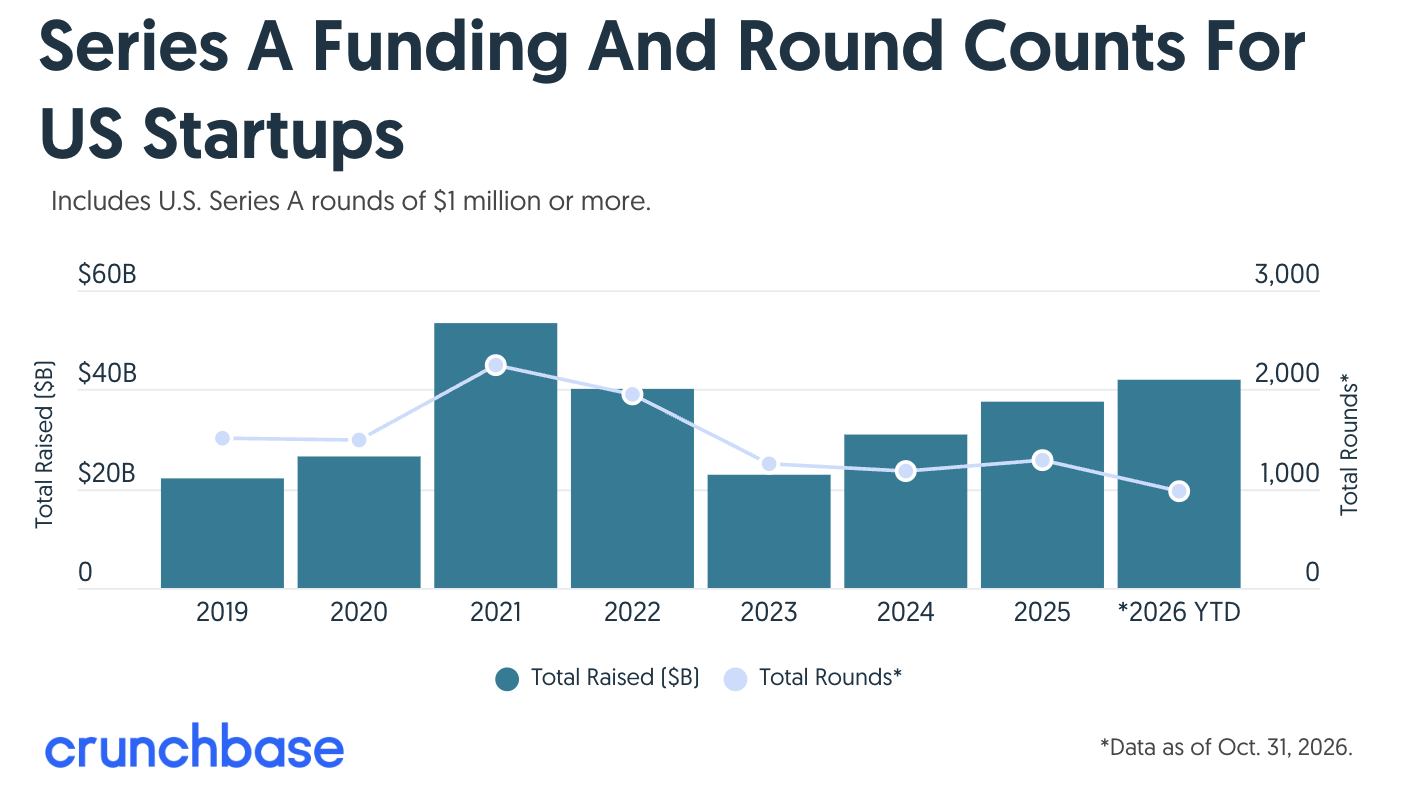
Series A In 2026: Capital Is Flowing Faster, But Fewer Startups Are Making The Cut (Crunchbase, 4 minute read)
US companies have raised $42 billion at the Series A stage this year through October, up roughly 60% year over year and double 2023’s low of $23 billion, yet deal counts are flat at about 1,200 a year for rounds of $1 million or more, per Crunchbase. The money is concentrating in fast-growing companies, with 10% of Series A rounds now $75 million or more, up from $50 million in 2025, while companies still proving growth face a crunch as investors split between writing much larger checks at seed, with $10 million to $20 million rounds not uncommon, and waiting until Series B or later for clearer signals
Some startups are growing from zero to $20 million or $30 million in revenue, but many get stuck turning a handful of early customers into a repeatable sales process
Scale Venture Partners’ latest fund is its largest at $900 million, up from $600 million, and it still sees Series A as attractive
Global Fund Performance Report (with preliminary Q2 2026 data) (PitchBook, 4 minute read)
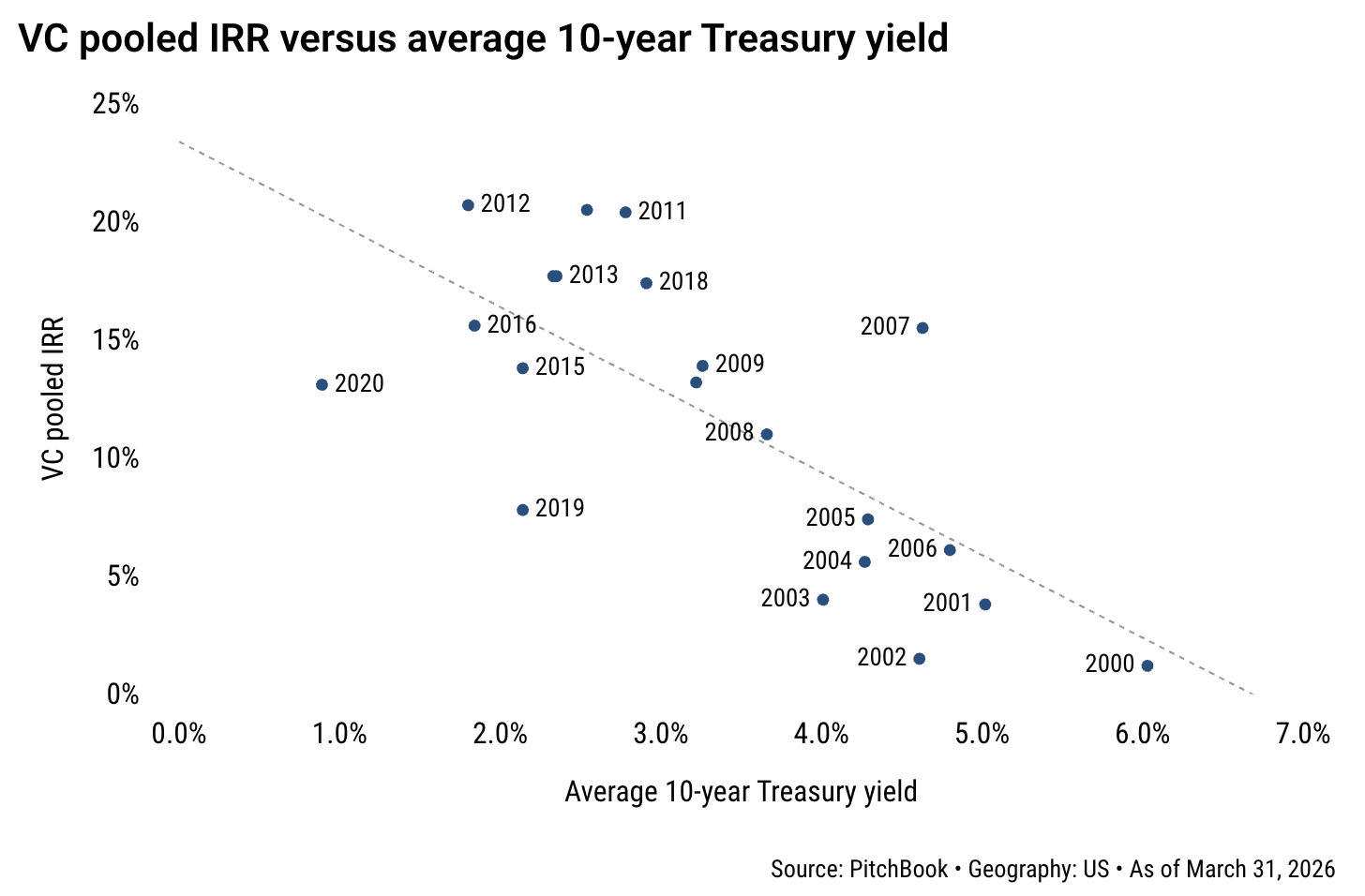
High interest rates and uncertainty are weighing on venture returns, since VC vintages started in similar climates have historically performed poorly, and higher 10-year Treasury yields have coincided with lower pooled IRRs for US venture. The usual narrative that the best vintages follow a downturn suggests those vintages may still be ahead. Dealmaking has surged instead of slowing, as AI-driven FOMO pushes capital into companies, while liquidity stays sluggish, with exits limited to a mix of healthcare IPOs, midsize M&A, and SpaceX-related liquidity. LPs are responding by shifting allocations to large, established managers, leaving emerging managers to wilt, and US fundraising for 2026 is already at $108.5 billion, pacing for the strongest year since 2022 but highly concentrated
The market is at an inflection point, with top-line fundraising strong but concentrated in established funds
Uncertainty over the global economy stems from inflation worries and geopolitical conflicts
ECONOMIC SNAPSHOT
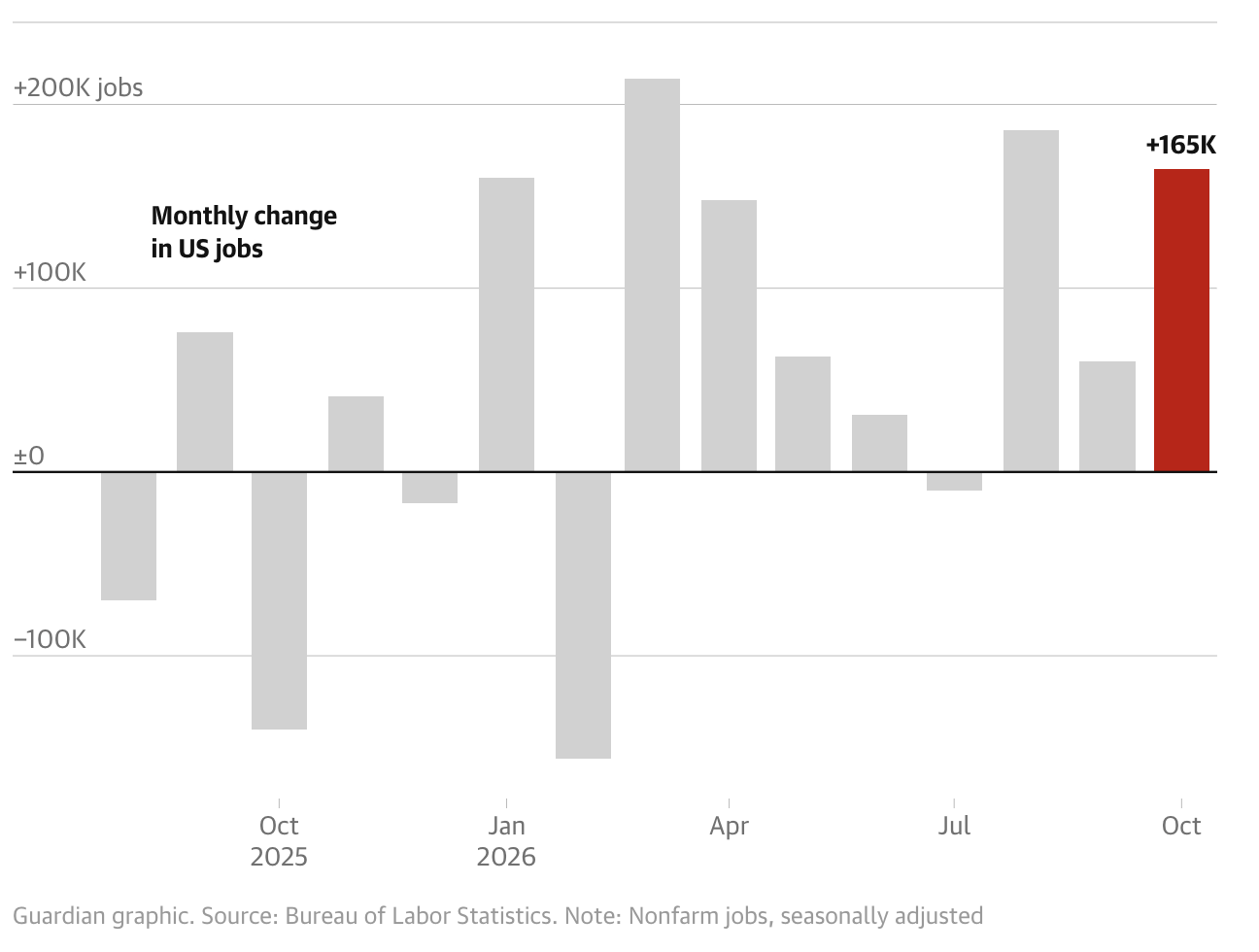
US job growth exceeds expectations in October despite economic uncertainty (The Guardian, 5 minute read)
The US added 165,000 jobs in October, beating economist expectations and breaking from the “low-hire, low-fire” pattern, while the unemployment rate dipped to 4.1%, per the BLS. Average hourly earnings rose 3.1% annually, still behind September’s 3.7% inflation, and the August and September figures were revised up by a combined 84,000 jobs, with gains in healthcare, transportation, warehousing, and manufacturing. Layoffs in September fell to their lowest in a year and a half, and Challenger tracked just under 44,000 October layoffs, down 71% from a year earlier. The jobs numbers come after midterm elections that solidified Democrats’ control of Congress, with voters frustrated by prices: gas is about $1 a gallon higher than a year ago, and diesel is 60% above prewar levels. Economists expect one more Fed rate hike in December after the September hike to 3.75%-4%
Navy Federal’s Heather Long said voters delivered “a clear verdict” that the economy is squeezing people financially
The Fed held rates steady at its October meeting, the week before the election
Here’s what the Democratic election rout could mean for the U.S. economy (CNBC, 7 minute read)
The Democratic midterm sweep could shift policy on trade, spending, and AI, but the main forces shaping the economy, including affordability pressures, heavy government spending, and AI-dependent growth, are likely to persist. Moody’s Mark Zandi called the economy “fragile,” expects no change in economic policy because the Iran war, tariffs, and immigration are set by executive order, and said growth depends on AI, which depends on the stock market. September CPI inflation of 3.7%, up from 2.3% in April 2025, has pushed inflation-adjusted wage growth to negative 0.7% year over year, even with Q3 GDP up 3.4%. The national debt is $40.5 trillion, up more than $4 trillion since January 2025, with a deficit near $2 trillion, or 6.1% of GDP, that Morgan Stanley expects to persist. RSM’s Joseph Brusuelas still expects growth near 2.5% and puts the odds of recession over 12 months at 15%
Gary Cohn sees room for a compromise that puts tariffs through Congress instead of executive orders
Goldman Sachs’ Jan Hatzius said Democrats are likely to use any debt-ceiling standoff to win concessions, such as limits on the Iran war and tariff rollbacks
Tech set to still sway US stock market’s course despite AI-driven swoon (Reuters, 5 minute read)
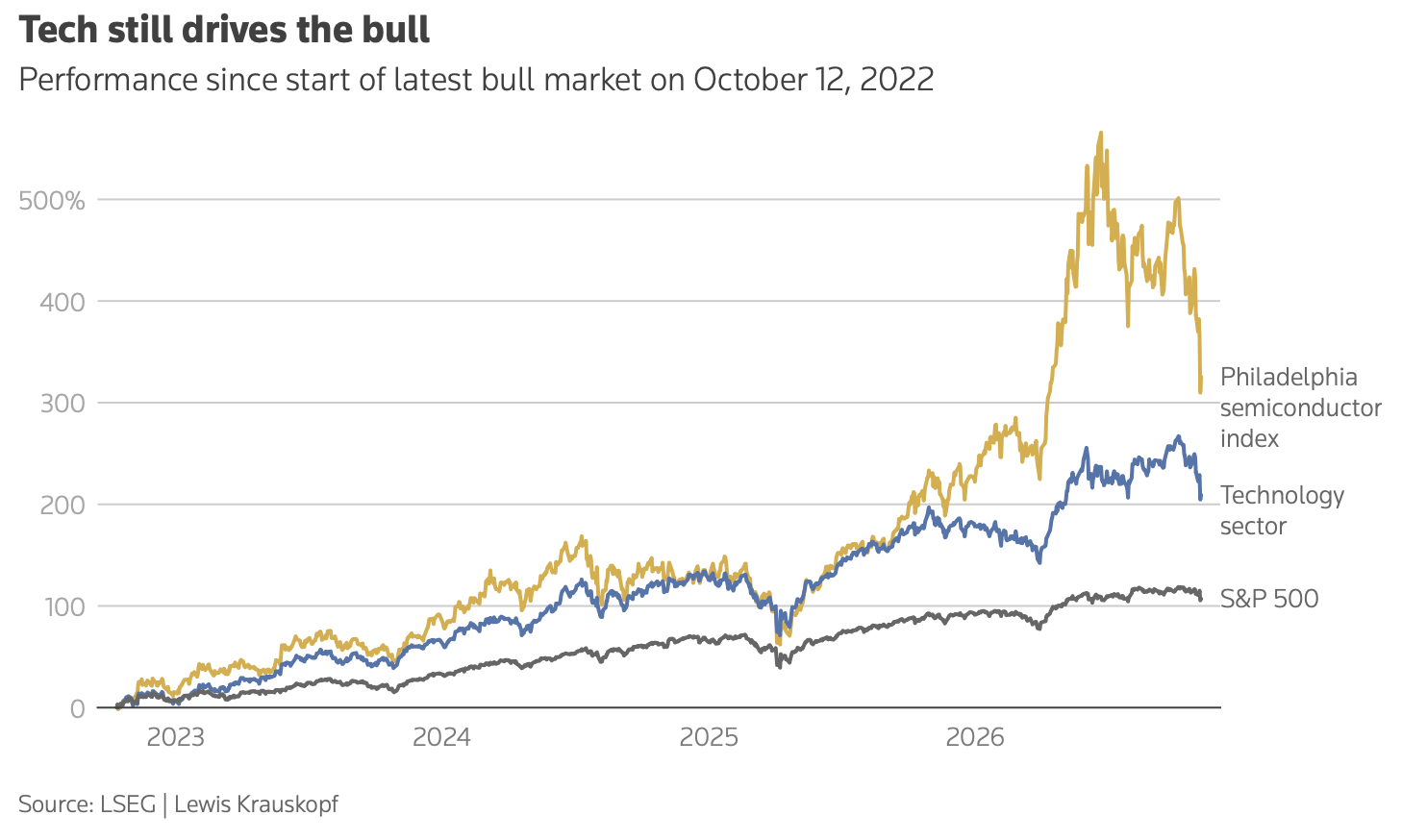
Even after a steep pullback in AI names, the US market still leans on technology, which held a greater than 35% weight in the S&P 500 as of Thursday, above its level at the height of the Internet bubble in 2000. A month-long swoon culminated last week in the S&P 500 tech sector’s biggest one-day drop in over six years, as investors worried Democratic midterm wins would slow the data-center spending behind the rally. Tech has still gained more than 200% since the bull market began in October 2022, nearly double the S&P 500’s gain, and the S&P 500 was up nearly 8% for the year on Friday, with tech up about 11%. Valuations now look more modest: tech’s forward P/E fell to 17.1 from above 32 in October 2025, below the S&P 500’s 17.9 for the first time since 2017. Some AI winners remain well ahead for 2026, with Sandisk up about 250%, Dell about 160%, and Micron 140%
Alphabet, Amazon, and Meta, three of the biggest data-center spenders, are classified outside the tech sector, so its weight understates AI’s influence
CoreWeave reports Tuesday, Nvidia on Nov. 17, and Dell on Nov. 24
Investors are also watching the Iran war and this week’s CPI report, which will test how much the Fed will raise rates
IPO & EXITS
Anthropic IPO meets AI backlash after midterms show stinging rebuke of data centers (CNBC, 5 minute read)
Anthropic’s expected IPO valuation is being cut again, with some prospective investors now discussing about $1.2 trillion to $1.3 trillion, Bloomberg reported, down from the $1.4 trillion to $1.5 trillion range communicated to bankers earlier and from figures as high as $2 trillion in early October. The reassessment follows last Thursday’s brutal selloff, when the Nasdaq 100 plunged 6.4%, wiping out about $2.3 trillion in market value in its largest single-day decline on record, amid concerns about AI infrastructure spending. The Wall Street Journal reported that some investors doubted Anthropic could reach $1.5 trillion, with one suggesting about $1 trillion and the possibility of a smaller raise or a delay. Still, the latest talks may signal that bankers and investors are working toward a price at which the offering can move forward rather than abandoning the timetable
No final decisions have been made, and Anthropic declined to comment
The Cboe Volatility Index climbed to its highest level since April 2025
Anthropic IPO announcement odds drop on Kalshi following midterms and AI sell-off (CNBC, 2 minute read)
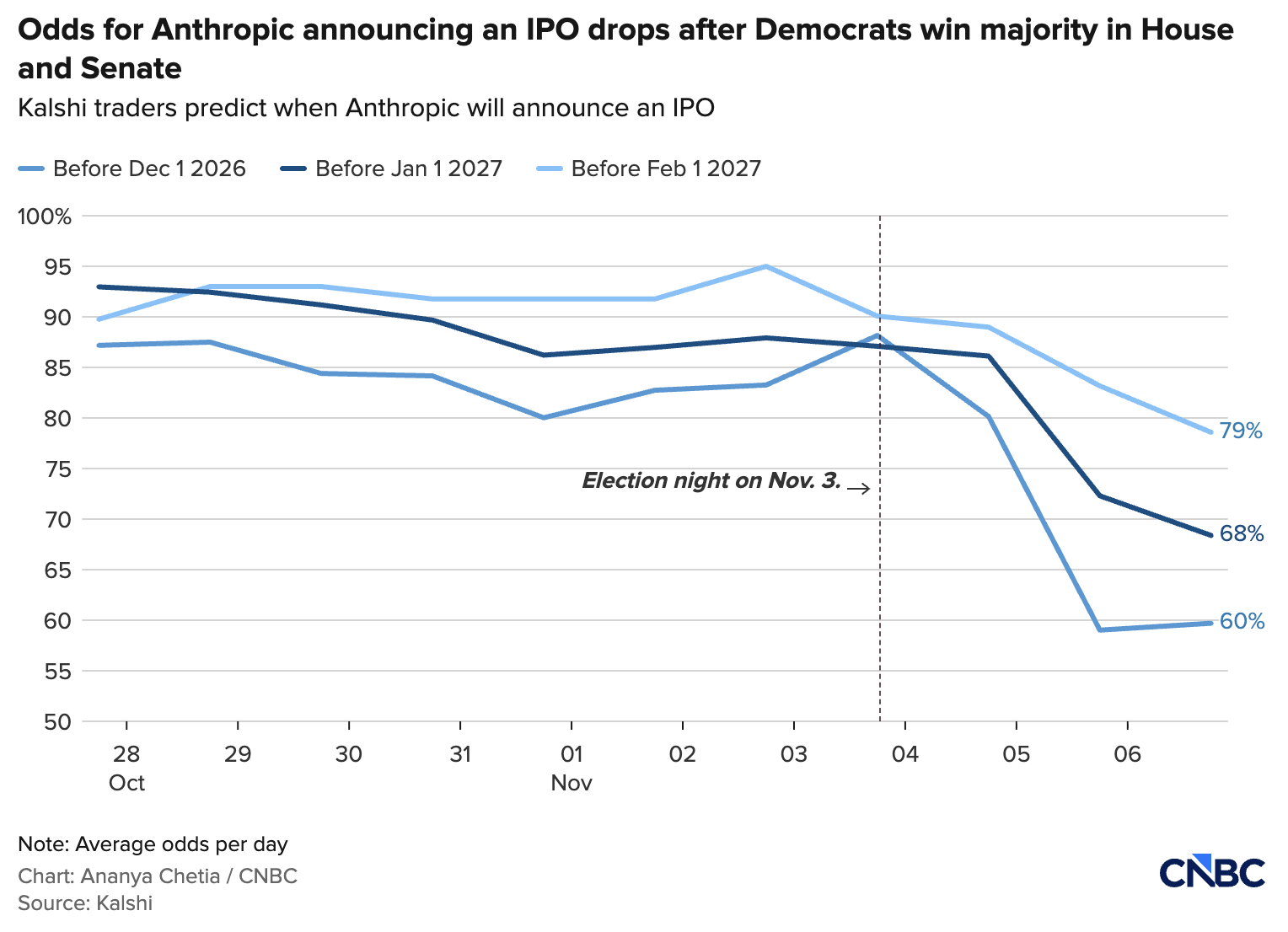
Odds on Kalshi that Anthropic will announce an IPO before December fell to 57% from over 85% in a week, and odds of an announcement before January dropped to 68% from 90%, as AI-related stocks slid after Democrats won control of Congress and several key governorships. Investors worry that Democratic wins could slow data center construction, and Texas Gov.-elect Gina Hinojosa, who ousted Greg Abbott, said “we need to stop what we are doing with data centers” until protections are in place. The Nasdaq closed last Thursday more than 10% below its recent high, officially in correction, while the S&P 500 lost 4.4% and the Dow fell more than 1,800 points, or 3.4%. Stocks tried to rebound last Friday, with the Nasdaq up 1.3% and the S&P 500 up 0.7%, and Micron and Nvidia each gained about 4% after falling 17% and 9% the day before
The Kalshi contract asks when Anthropic will officially announce an IPO, and Anthropic confidentially filed its prospectus with the SEC in June
CoreWeave rose more than 2% last Friday morning after falling about 10% the Wednesday before
8alpha.ai is an AI fintech transforming cash-generating businesses into scalable, AI-powered companies. We provide revenue-based financing and hands-on AI transformation, delivering no zeros with unlimited upside. We’re the architects building financial infrastructure for the next generation of investors and startups.
Become part of our revolution.
Happy reading,
8alpha.ai’s Research & Investment Team