Welcome to AI8’s weekly newsletter, your ultimate source for curated insights and updates from the dynamic world of venture capital!
From billion-dollar rounds to market-defining shifts, we deliver the intelligence powering the global investment landscape, moving investors and innovators forward. At 8alpha.ai, we’re not waiting for the future of capital, we’re building it. Stay sharp, stay curious, and stay ahead.
STARTUPS
ROUNDS AND UNICORNS
The Week’s 10 Biggest Funding Rounds: Physical AI And Predictions Lead The Lineup (Crunchbase, 5 minute read)
Re:Build (Manufacturing): Framingham, Massachusetts-based Re:Build, which partners with industrial companies from product design through large-scale production, secured $2.1 billion in new funding led by General Catalyst and JPMorganChase
Kalshi (Predictions Marketplace): New York-based Kalshi announced a $1 billion Series G led by Wellington Management and Sequoia Capital at a $40 billion post-money valuation, and says its annualized trading volume now exceeds $1 trillion
Bedrock Robotics (Construction Tech): San Francisco-based Bedrock Robotics, a developer of autonomous systems for heavy construction equipment, raised $600 million in Series C funding led by CapitalG and Emergence Capital at a $4.1 billion post-money valuation, bringing total funding to nearly $1 billion
Dren Bio (Biotech): San Carlos-based Dren Bio, a developer of antibody therapeutics for cancer and autoimmune diseases, closed $350 million in a round led by Juvia Group and Lightspeed Venture Partners to support advanced trials for its blood cancer therapies
Group 14 Technologies (Battery Tech): Woodinville, Washington-based Group 14, a supplier of advanced silicon battery materials, picked up $169 million in Series D extension funding and plans a production facility in Sagunto, Spain
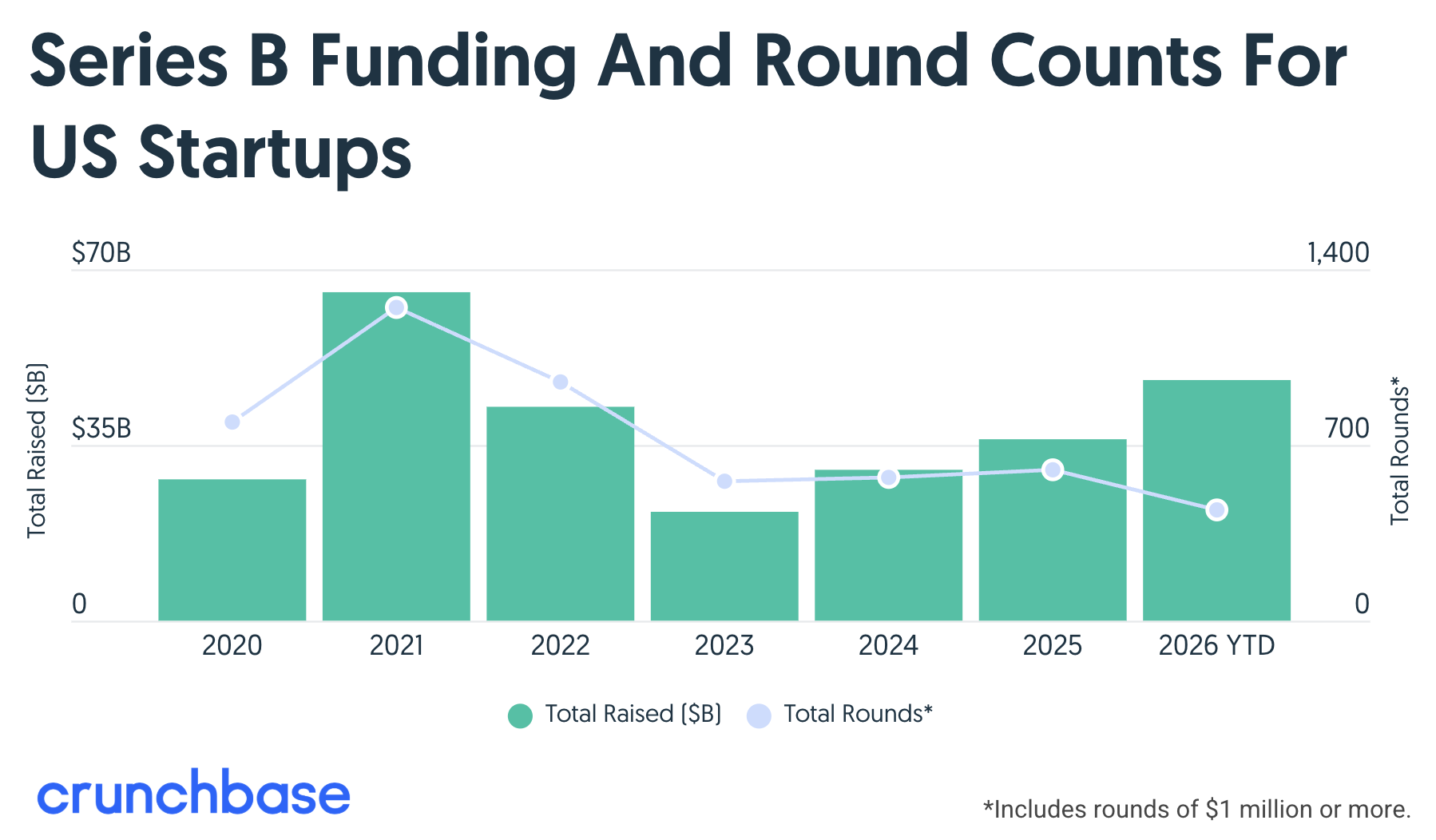
Series B Funding Is Up, But Fewer Deals Are Getting Done (Crunchbase, 5 minute read)
US Series B funding is at its highest in years, with investors pouring around $48 billion into Series B-stage financings so far in 2026, yet round counts are below year-ago levels and on track for a multiyear low. Small and mid-sized rounds are disappearing: less than a third of deals were under $30 million, versus about half from 2021 to 2025, and just 26 rounds were under $10 million. Big rounds are thriving, with at least 110 companies raising $100 million or more, roughly a quarter of all deals, led by a $12 billion round for Jeff Bezos' Prometheus. AI is the driver, taking about two-thirds of Series B funding, up from about half in 2025, and more than half of all Series B deals
World Labs and Valar Atomics each raised $1 billion, the next largest Series B rounds after Prometheus
The climate favors AI startups with proven traction, especially those that already raised large Series A and seed rounds
Investors are increasingly focused on big checks for high-valuation companies, which makes smaller Series B rounds harder to get
More Money, Fewer Checks: These 3 Charts Show The Divide Behind VC’s Record Funding Year (Crunchbase, 3 minute read)
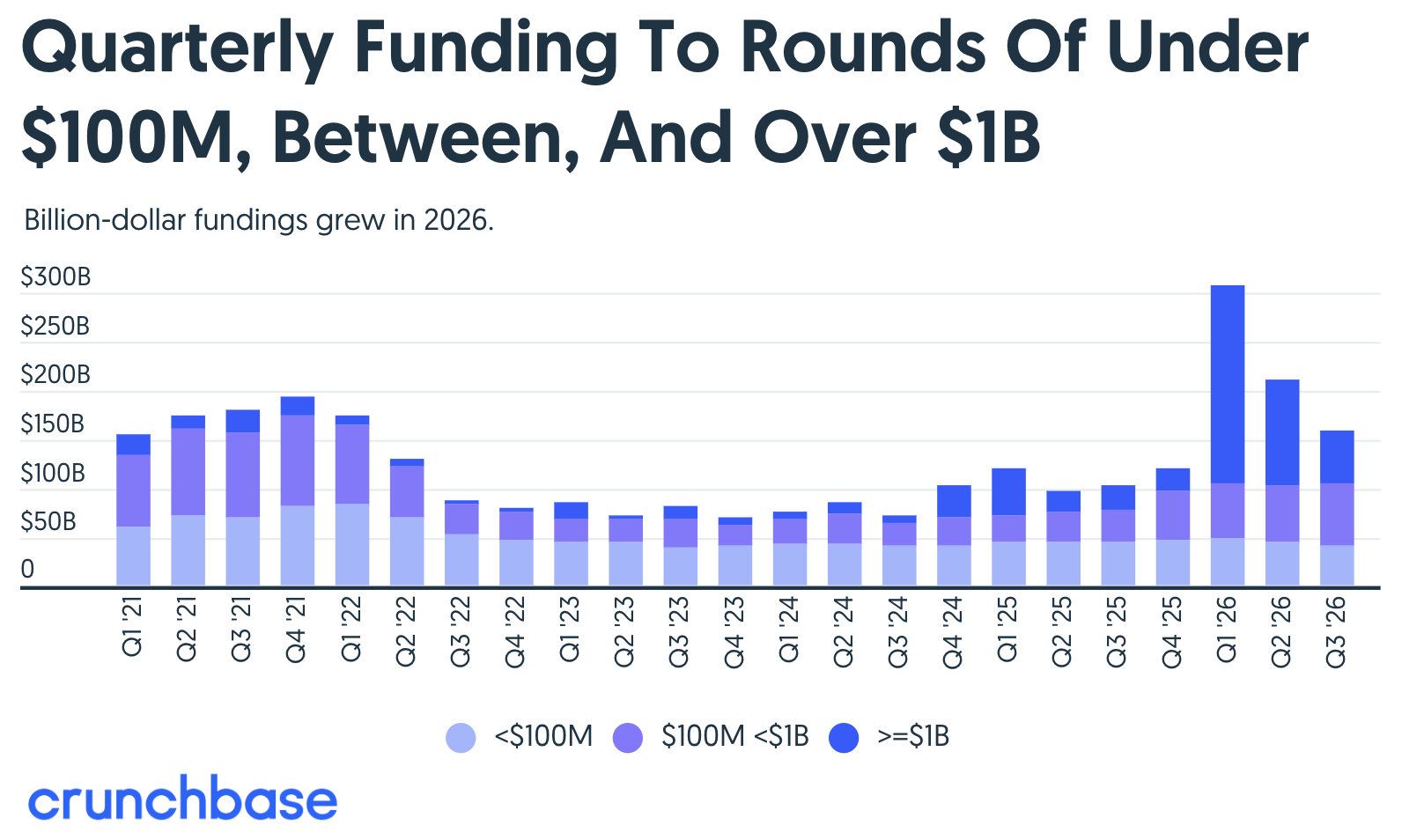
Venture capital is both more abundant and scarcer in 2026, with a record nearly $680 billion invested through Q3 but investors writing fewer checks to seed and early-stage companies. The surge is concentrated in the largest rounds, while funding in smaller rounds has essentially flatlined since 2023, and about one-third of Q3 funding went to just 27 companies raising rounds of $1 billion or more. In North America, Q3 deal counts fell 16% year over year and 14% from Q2 to the lowest quarterly total since 2023, even as funding jumped 50% year over year to $92 billion, with the contraction concentrated in seed and early stage while late-stage counts rose. Series B shows the divide: dollars hit a multiyear high this year, but deal count is on track for a multiyear low
Seed and Series A show the same pattern, with money concentrating in larger rounds as deal counts dip
Anthropic is expected to go public this month in an IPO valued at $1.5 trillion to $2 trillion, a test of public appetite for the companies driving the boom
OpenAI slashes funding target by $10 billion amid tech rout, FT reports (Oct. 30) (Reuters, 5 minute read)
OpenAI has cut the target for its latest funding round by $10 billion to about $20 billion, and its desired valuation has dropped to $1.25 trillion from $1.4 trillion, amid a selloff in tech stocks driven by AI worries. The first close is expected to raise less than $20 billion after some investors reduced their allocations, and the deadline for commitments was last Friday. A consortium of UAE investors including MGX is expected to be the largest participant, and OpenAI would gain the option to lease newly developed computing capacity in the region. Wealthy individuals would also be able to invest in a later retail offering at the $1.25 trillion valuation
Founders Fund, Coatue, Sequoia, and Andreessen Horowitz are also expected to participate
OpenAI wanted to close the round before Anthropic's imminent listing, since the two are tapping a similar investor base
OpenAI is pursuing a listing in 2027
ECONOMIC SNAPSHOT
Last snapshot of the US economy before midterms shows stronger growth but higher inflation (CNN, 4 minute read)
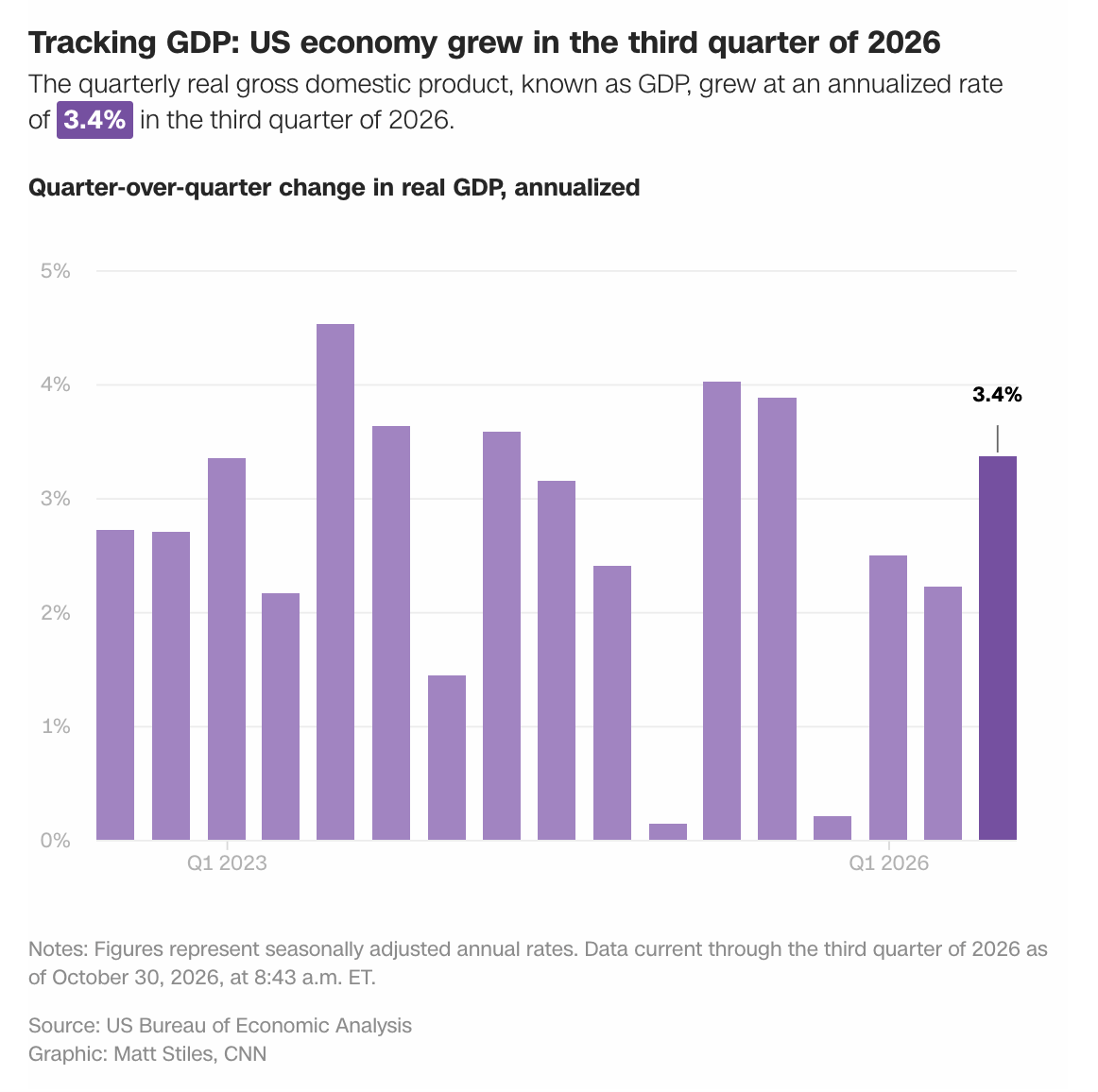
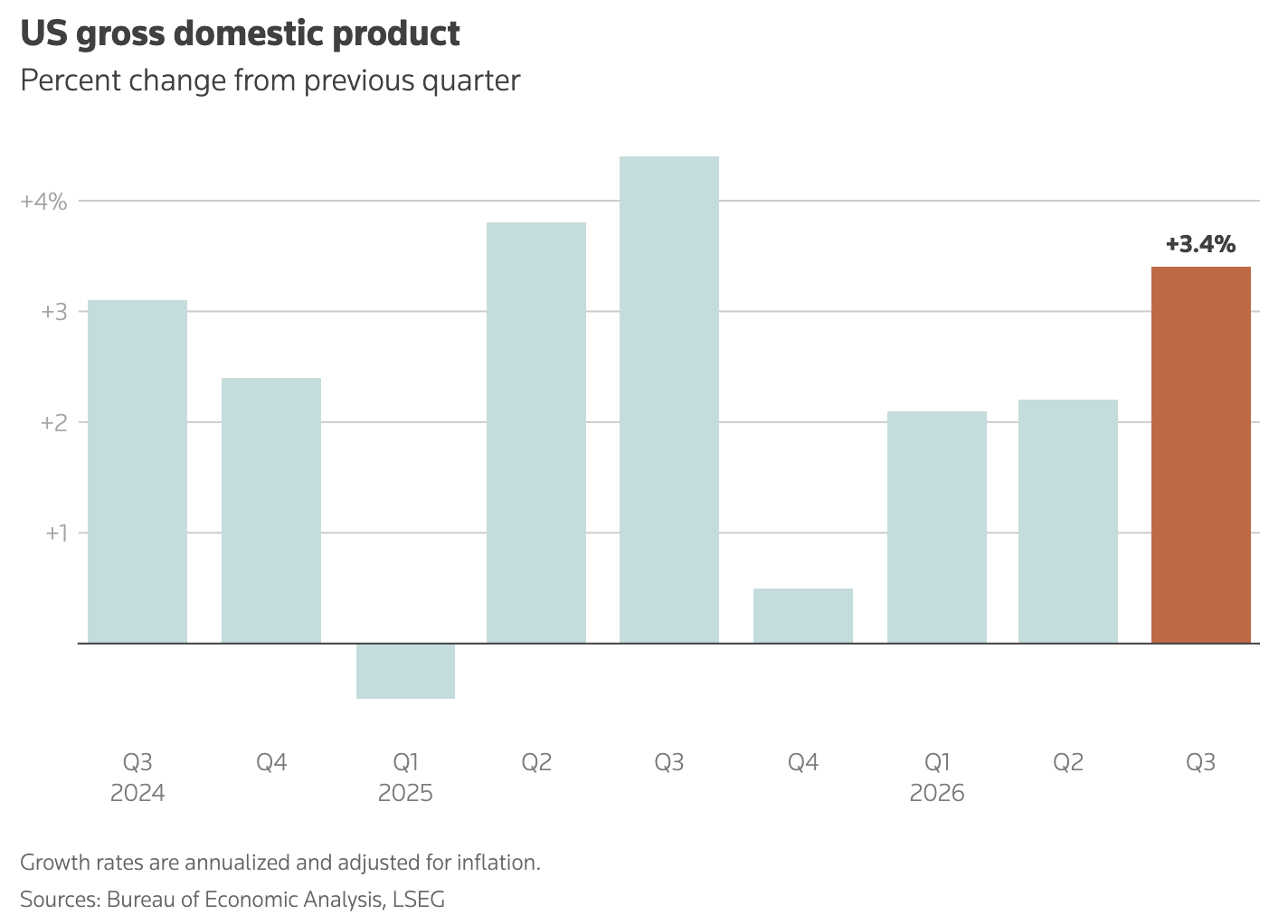
US economic growth accelerated to a 3.4% annualized pace in the third quarter, its fastest in a year and above expectations, while inflation hit a four-month high. The PCE price index rose 0.5% in September, lifting the annual rate to 3.6% from 3.4%, and core PCE rose 0.3% for the month, lifting its annual rate to 3.1% from 3%. Business investment surged at a 12.7% annualized pace from 9% in Q2, driven by AI infrastructure, and consumer spending held at a 3.8% pace. Exports fell 5.7% while imports surged at nearly a 20% pace, likely reflecting stockpiling ahead of Canadian tariffs plus data center purchases. Households are feeling strain: monthly spending slowed to 0.5% from 0.9% and was flat after inflation, the savings rate fell to 3.8%, its lowest in nearly four years, and inflation-adjusted after-tax income fell 0.3%
The Fed left rates unchanged on Wednesday, and Fitch's Olu Sonola said the report gives it "another reason to hike in December"
Personal income grew 0.2% in September, slowing from 0.3%
Robust consumer spending, AI-related investment power US economy in third quarter (Reuters, 5 minute read)
Spending on services drove Q3’s consumer strength, led by healthcare, restaurants, bars, and hotels, while purchases of goods like motor vehicles and household furniture pulled back. Higher-income households, whose wealth has been lifted by AI-driven stock gains, are driving much of the spending, with historically low layoffs and moderate hiring helping others keep pace. The AI investment boom shows up in equipment spending, which surged at a 20.9% rate, the fastest since Q3 2020, adding 1.16 percentage points to growth, the most in six years, mostly from computers and peripheral equipment, while software and R&D spending grew 8.4%. Domestic demand, which excludes inventories, trade, and government, accelerated at a 4.9% rate, the strongest since Q2 2021, a pace economists see as unsustainable
Inventory rebuilding added 1.61 percentage points to growth after five straight quarters of drawdowns
Residential investment contracted again as mortgage rates rose, and government spending grew at a 5.3% rate
Century Foundation’s Kyle Moore said the growth is lopsided toward the AI buildout, with wages for typical workers still lagging prices
In China, the AI bubble has already burst (Reuters, 6 minute read)
China's AI and semiconductor stocks have already crashed, with the STAR50 index down 40% in under four months, wiping out about $480 billion in market value, as lofty valuations collapse under worries about AI demand and curbs on Chinese exports. The broader CSI300 is down about 20% from its June high, versus a 7.8% Nasdaq drawdown from its Oct. 6 record. AI stocks make up 42% of China's market capitalization and 57% of turnover, per Goldman Sachs, so few investors in a retail-dominated market have escaped. Retail favorites have been hit hard: Unitree, which was 8,000 times oversubscribed at listing, has halved since August, and MetaX and Moore Threads have halved since July after leaping 700% and 400% on debut. The STAR50 still trades at about 100 times trailing earnings, down from nearly 250, versus 30 for the Nasdaq 100
No obvious selling trigger emerged, though traders cited high prices, tax bills, and the threat of US bans on Chinese equipment in data centers
Lotus Asset Management's Hong Hao said the selloff will "put a stop" to many companies trying to list
Goldman Sachs and BNP Paribas still see buying opportunities, and Asia funds remain overweight China
The real question we should all be asking about AI (CNN, 5 minute read)
Big Tech stocks sold off last week, with Google posting its worst day ever, Intel its biggest drop since the Nixon administration, and the Nasdaq sliding toward a correction, as AI infrastructure spending outruns profits. The bond market, which finances the buildout, has mostly shrugged. AI spending has reached $1.6 trillion since 2023, and about a third of hyperscaler capex this year, roughly $250 billion in bonds, is expected to be debt-financed. Goldman Sachs estimates the market could absorb about $510 billion of investment-grade hyperscaler debt, more than double what they are expected to borrow by year-end. The real question is how much longer the bond market will fund the spending. Indebted neoclouds like CoreWeave, whose bond yields surged to 15% in October, look most exposed, while hyperscalers, whose cloud revenue grew 50% in Q2, look like winners
Monetization comes three months to two years after a data center is switched on, per Goldman Sachs, so hyperscalers must borrow upfront and repay later
Requests from AI agents consume 15 times as many tokens as human-initiated ones, per OpenRouter
Warning signs would be a downshift in business AI usage, cheaper pricing, or fewer customer commitments, and none have appeared yet
IPO & EXITS
Anthropic's new IPO filing puts its computing bill near $900 billion (Yahoo Finance, 3 minute read)
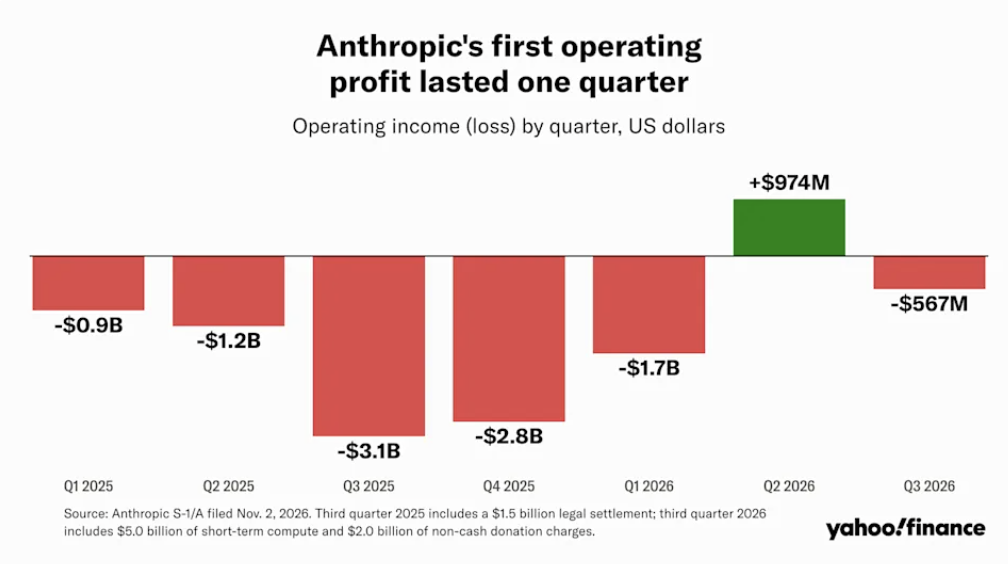
Anthropic's first operating profit lasted one quarter, and its amended IPO filing puts its computing bill at about $895 billion of commitments, with about $70 billion due within a year and nearly $450 billion by the end of 2030, almost seven times the roughly $132 billion in cash and short-term investments it held at the end of September. Q3 revenue jumped to about $17 billion from $11.6 billion in Q2, but Anthropic posted a $567 million operating loss after a $974 million profit in Q2, as demand outran capacity and it bought $5 billion of short-term computing that "currently costs significantly more" than its long-term deals. Broadcom tops the commitments list with about $161 billion, followed by Google at about $121 billion, SpaceX's AI unit at up to $120.5 billion, and Amazon at $110 billion
Anthropic estimates that 5% to 7% of revenue in the first nine months came from customers breaking its usage policy, and warned the crackdown may reduce revenue and growth rates
Shares will be offered through Schwab, Fidelity, Robinhood, SoFi, and E*Trade, with 1.77 billion stock options outstanding that could dilute buyers
Inside the make-or-break AI mega-project behind Nscale’s $35bn IPO (Financial Times, 6 minute read)
Nscale, the Nvidia-backed UK neocloud planning a $35 billion IPO, faces mounting setbacks on its West Virginia "Monarch Compute Campus," its main future revenue driver. Anthropic's $45 billion rental deal for the first building accounts for more than 40% of Nscale's $103 billion revenue backlog, but Nscale hasn't secured financing for it and Anthropic can walk away if it isn't secured by a deadline. An EY report puts the first phase at $69.2 billion, and only about 400 of the site's 2,250 acres are under development. Regulators have issued 10 notices of violation and a cease-and-desist order after runoff flooded neighboring homes, and the site's 864 gas engines would be permitted to emit 10 million tonnes of greenhouse gases a year. Nscale lost $1 billion on $141 million of revenue in the first half of 2026, and Microsoft pulled out of a roughly $3 billion Essex deal
A 2025 West Virginia law, pushed by developer Fidelis, lets data centers self-power off the grid and bars local governments from blocking them
Nscale was valued at $14.6 billion in March, and one source said the recent sector sell-off could “reset valuations” for its IPO
8alpha.ai is an AI fintech transforming cash-generating businesses into scalable, AI-powered companies. We provide revenue-based financing and hands-on AI transformation, delivering no zeros with unlimited upside. We’re the architects building financial infrastructure for the next generation of investors and startups.
Become part of our revolution.
Happy reading,
8alpha.ai’s Research & Investment Team