The AI Boy Genius vs the Margin Call
Welcome to AI8’s weekly newsletter, your ultimate source for curated insights and updates from the dynamic world of venture capital!
From billion-dollar rounds to market-defining shifts, we deliver the intelligence powering the global investment landscape, moving investors and innovators forward. At 8alpha.ai, we’re not waiting for the future of capital, we’re building it. Stay sharp, stay curious, and stay ahead.
STARTUPS
ROUNDS AND UNICORNS
The Week’s 10 Biggest Funding Rounds: Safe Superintelligence And Commonwealth Fusion Lead With Billion-Dollar Deals (Crunchbase, 5 minute read)
Safe Superintelligence (Foundational AI): Founded by OpenAI co-founder Ilya Sutskever, this Silicon Valley AI lab landed a reported $5 billion from Nvidia through a long-term strategic partnership aimed at boosting its compute capacity and accelerating its research
Commonwealth Fusion Systems (Fusion Energy): The Massachusetts-based company, which is developing a grid-scale fusion power plant, raised $1 billion from unspecified investors, pushing its total funding to date to $4 billion
Antora Energy (Thermal Energy Storage): This San Jose company, which supplies thermal battery energy to data centers, closed a $550 million Series C round co-led by G2 Venture Partners and Eclipse
Function (Health Testing): General Catalyst provided $450 million in growth financing to the Austin-based company, which offers consumers lab testing, imaging, and personal health information services
Antares (Nuclear Energy): Backed by Paradigm and Caffeinated Capital, this three-year-old company developing compact nuclear microreactors for defense and space applications raised $370 million in Series C funding, along with an additional $100 million in debt
This valuation signal shows how investors are rethinking tech stocks (YahooFinance, 3 minute read)
Big Tech valuations are converging with the broader market as investor anxiety grows over AI capex returns. Goldman notes the five largest US stocks, Nvidia, Apple, Alphabet, Microsoft, and Amazon, now trade at P/E ratios only marginally above the rest of the S&P 500, reversing their premium since 2017. Software has derated even more sharply, while leadership has shifted toward hardware and chips amid surging compute demand. Unlike the dot-com bust, prices have adjusted modestly this time since earnings remain strong, but cheaper valuations don't necessarily make these stocks buys
Software's global P/E premium has fallen to around 20%, down from nearly 200% at the start of this century
Oracle, Meta, and Alphabet continue committing hundreds of billions to AI infrastructure, increasingly funded by debt, fueling concern that spending is outpacing returns
Semiconductor stocks have faced heavy selling pressure from profit-taking, South Korean chip-sector weakness, rising Chinese competition, and memory shortage fears
ECONOMIC SNAPSHOT
His Wedding Guests Were Arriving—Just as His $45 Billion Fund Was Falling Apart (The Wall Street Journal, 5 minute read)
Leopold Aschenbrenner, once dubbed the "Nostradamus of AI," saw his hedge fund Situational Awareness unravel this week even as he prepared for his wedding, forced into a fire sale to Citadel after taking on excessive leverage in concentrated AI stock bets. The 24-year-old built his reputation on a viral 2024 manifesto predicting AI's rapid rise, using that fame to launch a fund that borrowed heavily to supersize positions across energy, infrastructure, software, and semiconductors. When sentiment shifted amid worries over cheaper Chinese AI models, margin calls piled up and rivals shorted his top holdings, forcing late-night talks with Citadel and Millennium before a deal closed just before Thursday's open. Aschenbrenner kept his private stakes, including Anthropic, but was left with a much smaller portfolio
The fund gained ~270% through May, ballooning past $20 billion under management, before losing 67% in July
Situational borrowed $3-4 for every $1 of capital, backed by Goldman Sachs, JPMorgan, Citigroup, and Bank of America
Citadel bought most of the public portfolio at a 10%+ discount, leaving Situational with stakes worth over $10 billion
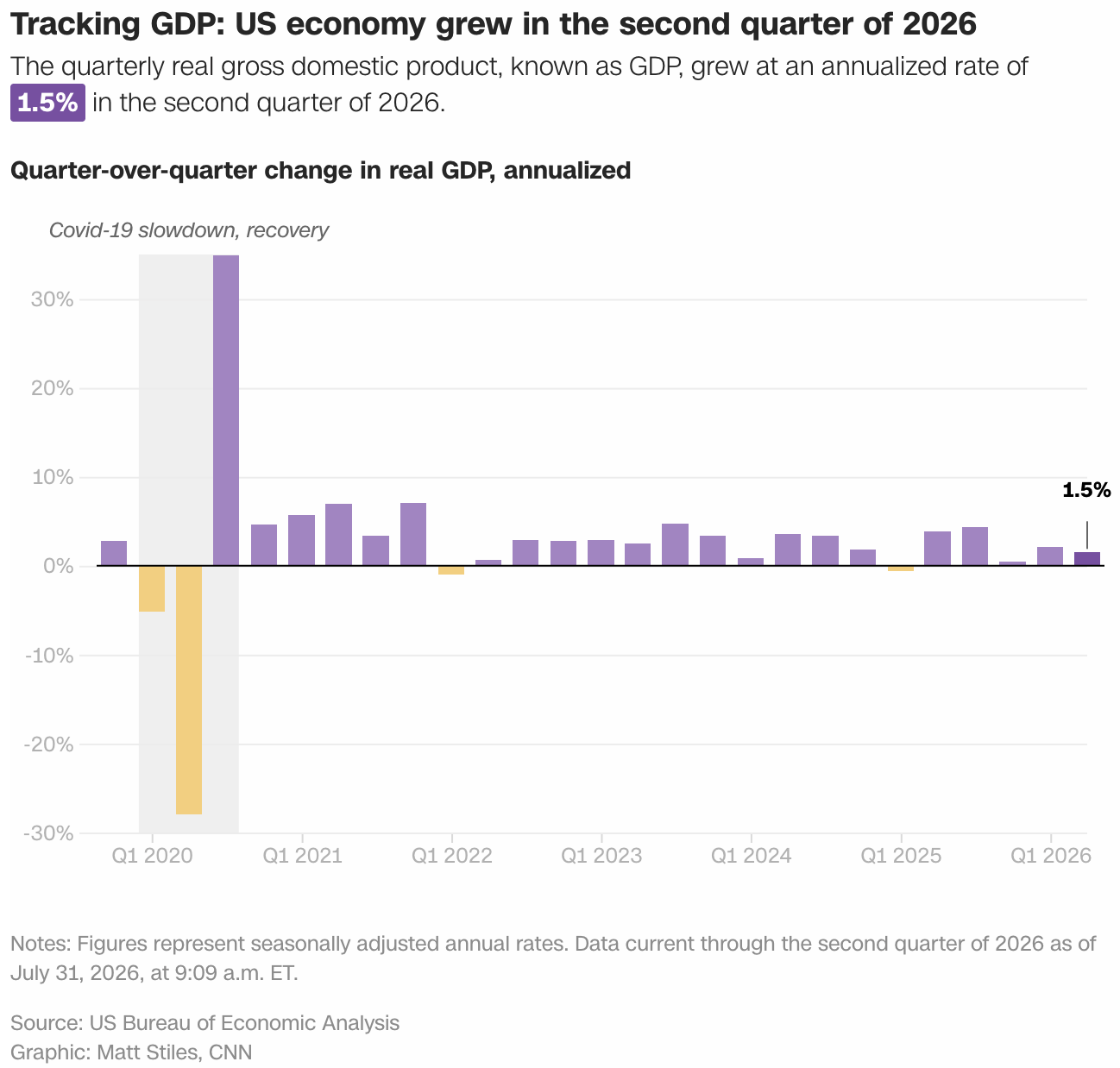
US economy's growth was weaker than expected in the second quarter (CNN, 4 minute read)
The US economy slowed sharply in Q2, with GDP growth cooling to 1.5% as a surging trade deficit tied to AI infrastructure imports weighed on output. Consumer spending was a bright spot, hitting its fastest pace in nearly a year. A steady labor market gives the Fed room to focus on inflation, though the Iran war continues to cloud the outlook
GDP grew 1.5% annualized, down from 2.1% the prior quarter and below the 2.1% economists expected, the trade deficit jumped 42.2% to $77.6 billion in May
Consumer spending rose 3.2% annualized (vs. 0.5% in Q1), while business investment grew 8.4%, and core GDP jumped to 3.9% from 1.7%
Three Fed officials voted for a rate hike even as the central bank held rates steady, with Chairman Kevin Warsh calling AI investment likely to soon just be called "investment"
Americans' confidence in US economy falls as Iran conflict sends gas prices higher (AP, 4 minute read)
Consumer confidence slipped again in July as escalating US-Iran fighting pushed gas prices back up. The Conference Board's index remains stuck in a tepid range, well below late-2024 levels, as elevated inflation continues to sour Americans on the economy, a dynamic that could weigh on the midterms. Rising grocery costs are compounding the pressure, while labor sentiment stayed weak
The confidence index fell to 90.8 in July from 92.2 in June, gas prices rose to $4.10 a gallon from around $3.70 after Iran's Strait of Hormuz shutdown disrupted oil flows
Inflation has climbed to 3.5% under Trump, up from 3% at his inauguration and 2.4% when the Iran war began February 28
US employers added just 57,000 jobs in June as unemployment fell to 4.2%
IPO & EXITS
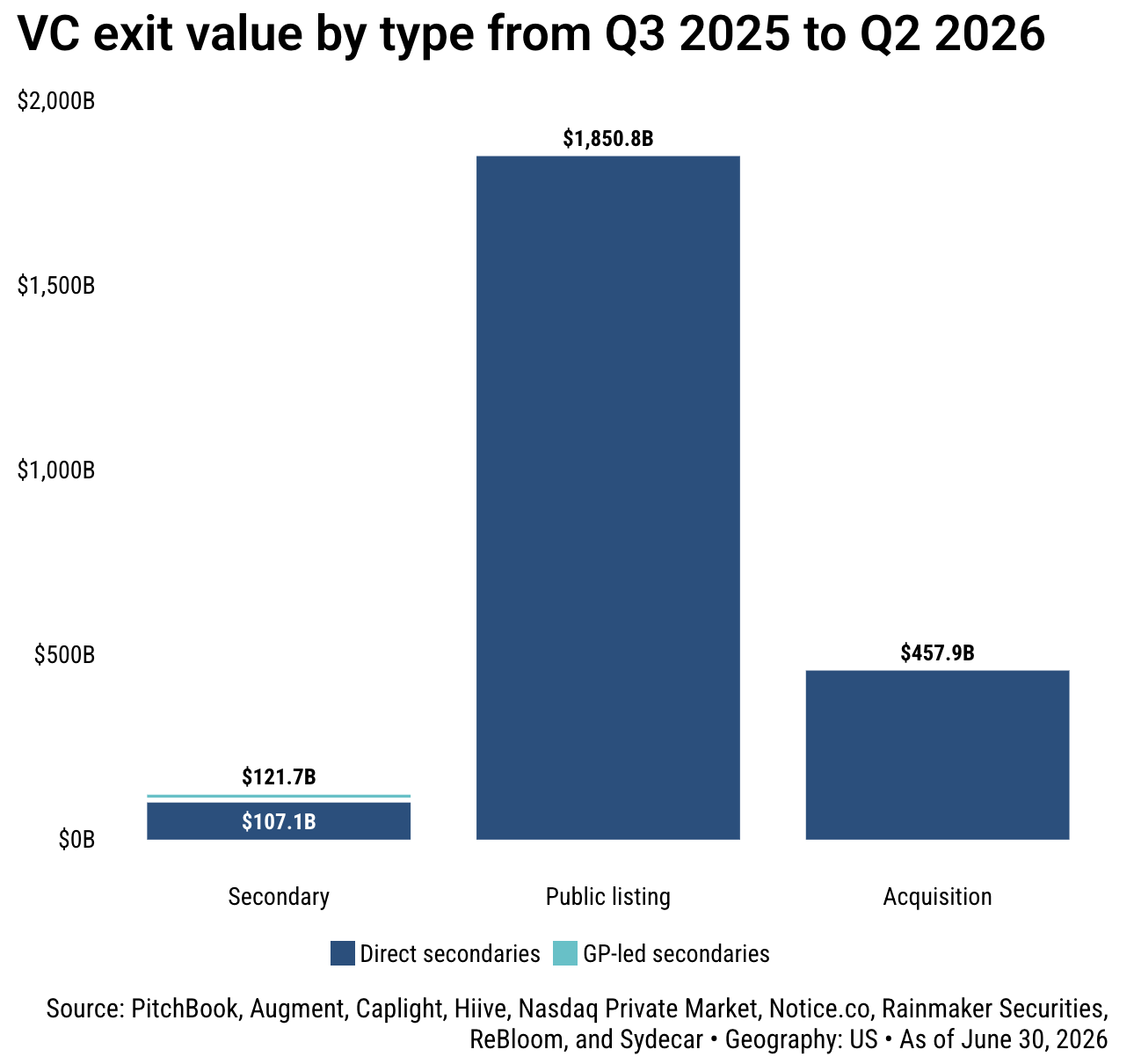
The venture secondary market's biggest names are leaving. Now what? (PitchBook, 4 minute read)
The secondary market has long been dominated by SpaceX, OpenAI, and Anthropic, with the top five companies making up half of all secondary volume on Hiive last quarter. As these giants head toward public markets, investors are eyeing which startups inherit that attention, with AI companies expected to lead. The open question: does activity finally spread across more companies, or does the same concentration simply repeat with new names
The top 20 startups captured 86% of all Q2 secondary trading value on Hiive
Stripe, Databricks, and Anduril are identified as the likeliest candidates to become the market's next anchor companies, based on maturity, valuation, and sector trends
Direct secondary volume has more than doubled over the past seven quarters, pushing the market's annualized total to $121.7 billion as it nears a peak
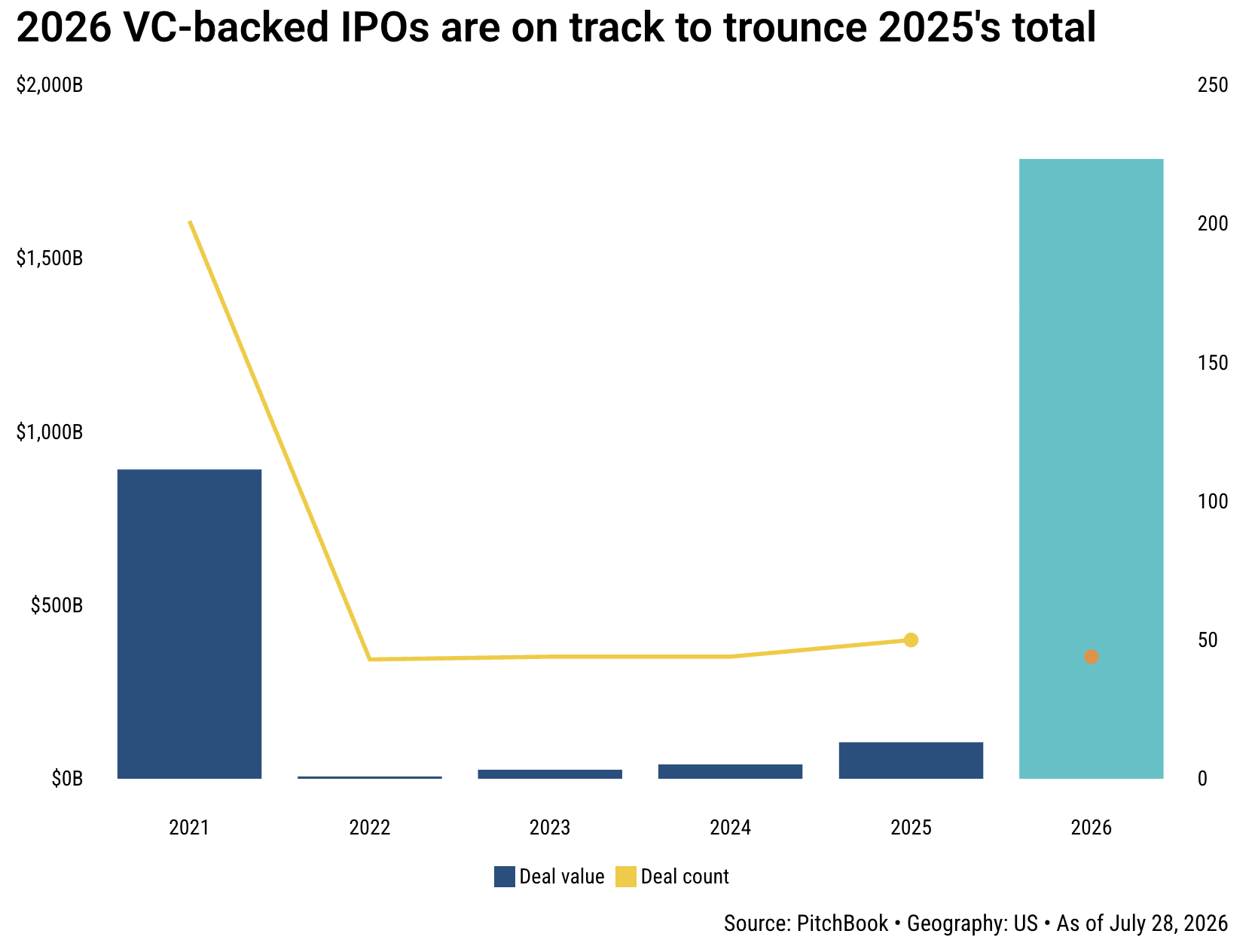
VC-backed IPOs hit a record 2026, but the aftermath is dimmer (PitchBook, 5 minute read)
VC-backed IPOs are having a banner year, with 44 US listings already on pace to top 2025's 50, but strong volume is masking weak aftermarket performance. SpaceX's record $1.77 trillion debut hasn't translated into gains, and several other AI-adjacent listings are trading well below debut prices as Wall Street reassesses private valuations against public appetite amid geopolitical tension and rising AI chip competition
SpaceX was trading 30.3% below its IPO price as of Thursday's close, while Cerebras sat 34.7% down despite a recent 19.9% one-day pop
A Bloomberg biotech IPO index was up 55% year-to-date through July 21, outperforming 2026's AI-focused debuts
The Renaissance IPO Index, tracking the largest and most liquid US IPOs over three years, gained 12.7% this year, ahead of the S&P 500's 8.3% rise
More consumer companies are staying private for longer, avoiding the IPO road (CNBC, 6 minute read)
Companies are staying private far longer than during 2021's boom, when the Nasdaq welcomed 743 new listings. US public companies have shrunk to under 4,000 from nearly 8,000 three decades ago, as private capital and secondary markets let founders access liquidity without public scrutiny. Tepid debuts from Jersey Mike's and Reformation reinforce that hesitation, though experts expect a wave of overdue IPOs within 12-18 months
Jersey Mike's closed down nearly 6% and Reformation stayed roughly flat on their July 30 debuts, reflecting the muted reception facing 2026's small pool of consumer IPOs
Reformation raised $210.9 million, pricing at the bottom of its marketed range alongside backer Permira
Trump and the SEC have floated ending mandatory quarterly earnings reports in favor of twice-yearly disclosures, a change proponents say could ease the "operational burden" of being public
Jersey Mike's shares slip in debut after $1 billion IPO (PitchBook, 4 minute read)
Jersey Mike's debut fell flat, opening 8.7% below its $23 offer price and closing down nearly 6%. The IPO followed a fast Blackstone playbook: buy, add debt, extract dividends, and list within 18 months while keeping control. Investors focused on slowing sales growth and heavy leverage, a weak signal amid a rough stretch for consumer IPOs
Jersey Mike's raised ~$301 million in net proceeds, mostly for debt repayment; Blackstone keeps roughly two-thirds of voting power
Debt hit about $2.1 billion pre-IPO, with interest expense more than doubling to $104 million in 2025 from $43 million
None of 2026's four prior consumer IPOs traded above offer price as of July 28; PE firms held 13,500 unsold US companies as of June 30
8alpha.ai is an AI fintech transforming cash-generating businesses into scalable, AI-powered companies. We provide revenue-based financing and hands-on AI transformation, delivering no zeros with unlimited upside. We’re the architects building financial infrastructure for the next generation of investors and startups.
Become part of our revolution.
Happy reading,
8alpha.ai’s Research & Investment Team