The AI Distortion
Welcome to AI8’s weekly newsletter, your ultimate source for curated insights and updates from the dynamic world of venture capital!
From billion-dollar rounds to market-defining shifts, we deliver the intelligence powering the global investment landscape, moving investors and innovators forward. At 8alpha.ai, we’re not waiting for the future of capital, we’re building it. Stay sharp, stay curious, and stay ahead.
STARTUPS
ROUNDS AND UNICORNS
The Week’s 10 Biggest Funding Rounds: Enterprise AI, Space Tech And Biotech Top The Ranks (Crunchbase, 5 minute read)
Sierra (Customer Experience AI): Raised $950M at a $15B valuation in a round led by Google Ventures and Tiger Global to expand its AI-powered customer experience platform
Astranis (Space Tech): Secured $455M in equity and debt financing, including a $300M Series E, to scale advanced high-orbit satellite systems
Anagram Therapeutics (Biotech): Received $250M from Blackstone Life Sciences to advance treatments for pancreatic insufficiency and related diseases
Blitzy (AI Software Development): Raised $200M at a $1.4B valuation in a Northzone-led round for its autonomous software development platform
Corgi Insurance (AI Insurance): Secured $160M Series B funding at a $1.3B valuation to expand its AI-native insurance platform for startups
US VC Valuations and Returns Report (PitchBook, 7 minute read)
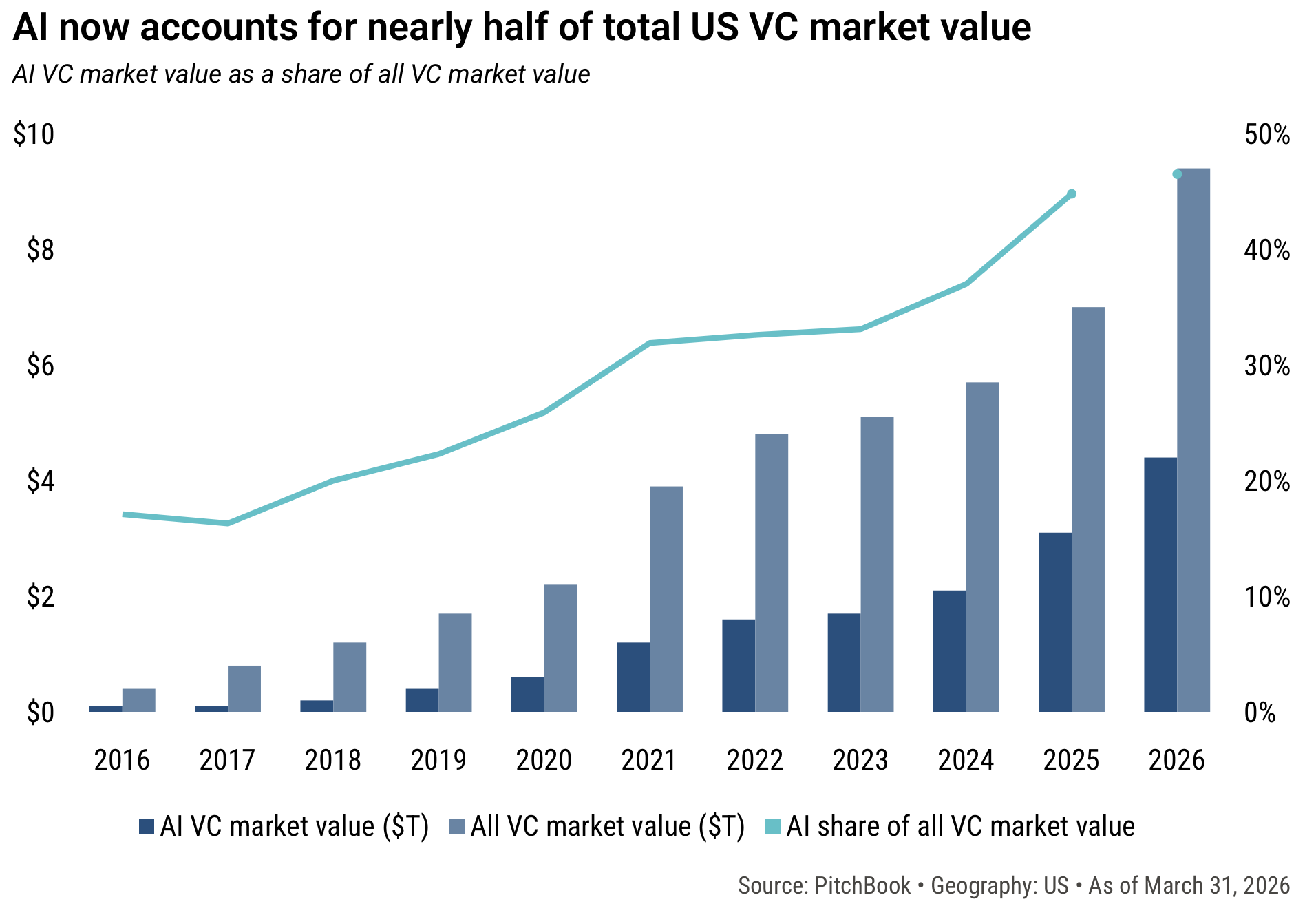
The U.S. venture market reached a record $9.4T valuation, including $5.8T in unicorn value, but liquidity remains weak as paper valuations continue outpacing realized returns. AI is driving a growing divide in the market: median Series A AI valuations carried an 84% premium over non-AI startups in Q1 2026, while strategic buyers aggressively pursued AI assets, exemplified by Google paying nearly 3x Wiz’s last private valuation. At the same time, much of the broader venture market remains frozen
About 86.8% of acquisitions disclosed no valuation, signaling muted exits and markdowns, while IPOs achieved only a 1.1x median step-up over prior private valuations
Venture funds also posted -$46.2B in net cash flows through the first three quarters of 2025, highlighting weak distributions
Investors see potential IPOs from SpaceX, OpenAI, and Anthropic as either a market revival catalyst or a further concentration of capital into a few dominant companies

ECONOMIC SNAPSHOT
AI Is Distorting Practically Everything About the Economy (The Wall Street Journal, 5 minute read)
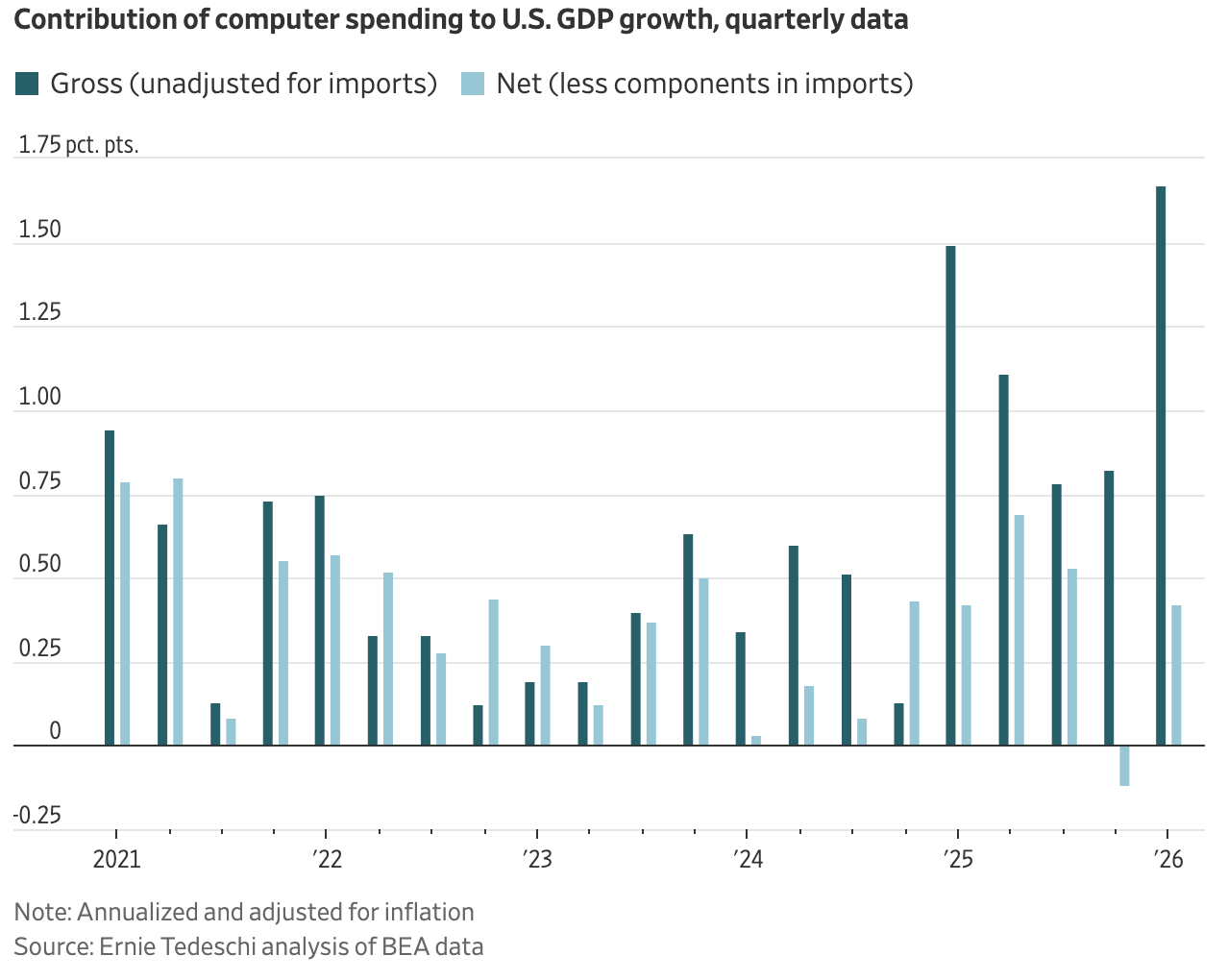
AI is no longer just supporting the U.S. economy, it is increasingly reshaping and distorting it. Hyperscaler AI spending is projected to exceed $800B in 2026 and $1.1T in 2027, reaching ~3.3% of GDP, more than projected U.S. defense spending. While headline GDP grew 2% in Q1 2026, the underlying economy appears split: AI-related sectors surged, with investment rising 43% in tech equipment, 23% in software, and 22% in data centers, while much of the rest of the economy remained weak
AI spending is reshaping trade, markets, profits, and the broader economy, boosting imports and concentrating stock market gains in AI-linked companies
The "Magnificent Seven" are expected to grow profits 61% vs. 16% for the rest of the S&P 500, while labor's share of output hit its lowest level since 1947
Concerns about AI replacing jobs are weighing on worker sentiment, even though large-scale layoffs remain limited
The stock market has only done this 3 times since the Gulf War. It’s not a good sign (CNBC, 3 minute read)
The S&P 500 reached record highs above 7,400, rising more than 17% since March, driven mainly by AI and semiconductor stocks. Shares of Micron are up roughly 140%, while the new Roundhill Memory ETF (DRAM) has doubled and gathered about $6B in assets. However, investors are increasingly worried that the rally is too concentrated in a small group of AI-related companies. The “Magnificent Seven” now make up more than one-third of the S&P 500’s value and are up over 25% since March, while much of the broader market continues to lag
On Friday, the S&P 500 closed 7% above its 50-day average, but only 52% of stocks traded above theirs versus a historical average of 86%
Analysts noted this was only the third time since 1990 that the index hit a record high while more stocks made new lows than new highs
Similar patterns appeared before the 1929 crash, the 1973 bear market, and the 2000 dot-com collapse, raising concerns that AI gains may be masking broader weakness
Trump tariff refunds are happening – and businesses should pay attention (The Guardian, 5 minute read)
After the Supreme Court struck down Trump-era tariffs imposed under the IEEPA, the U.S. government quietly launched a refund process. Roughly 330,000 importers paid more than $166B in tariff fees, and affected companies can now seek refunds through their original customs brokers using the government’s ACE portal system. Early reports suggest the process, while bureaucratic, is operating relatively smoothly, with refunds expected within 60–90 days
The refunds could provide meaningful cash relief for small businesses that absorbed higher import costs over the past several years
The process still involves broker fees, paperwork, and possible tax costs, since refunds may count as taxable income in 2026
FedEx, UPS, and DHL said they will return refunds to customers, while many large retailers have not yet confirmed whether they will do the same
April hiring beat expectations, but economists warn the labor market is ‘frozen’ (CNN, 6 minute read)
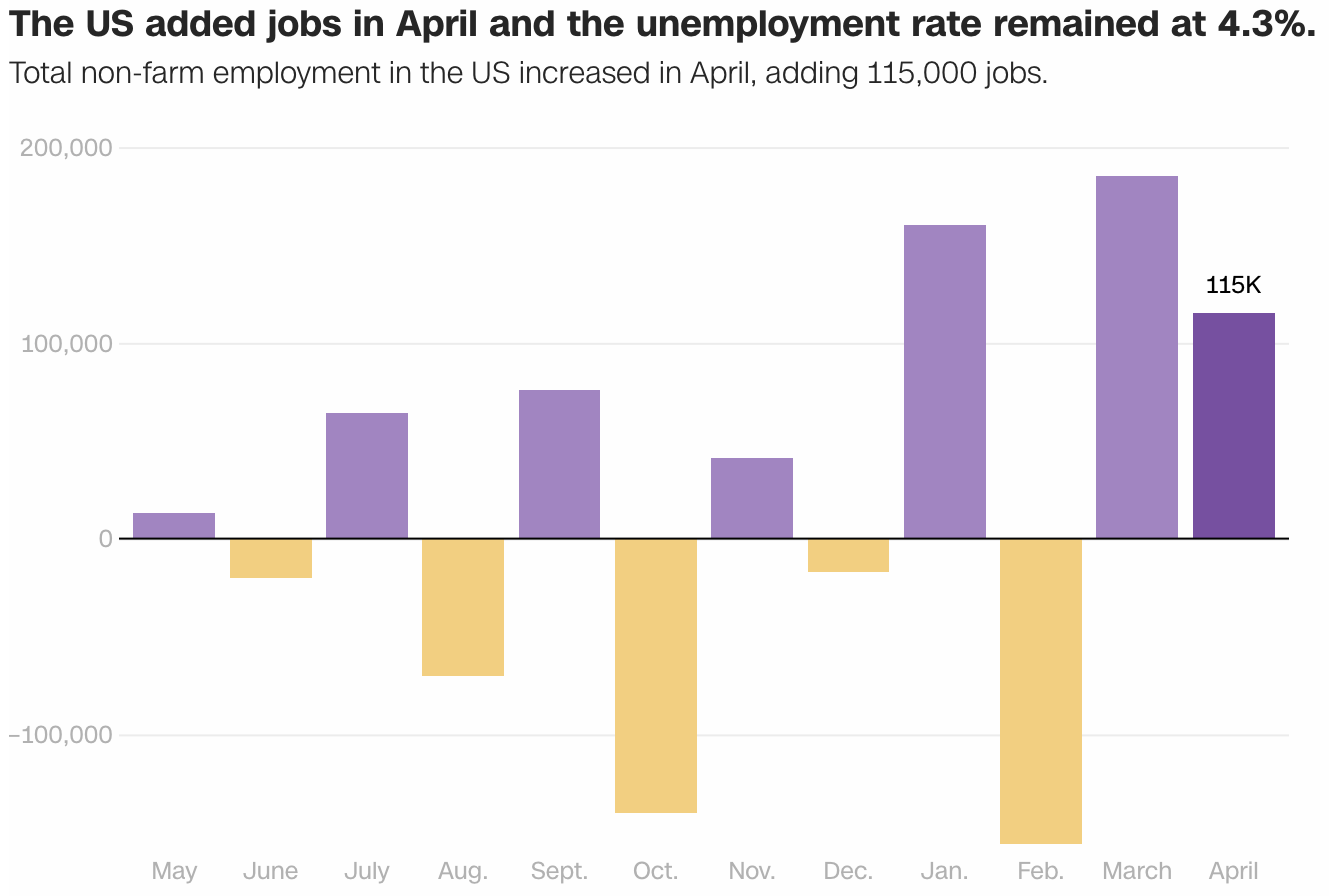
The U.S. labor market showed mixed signals in April 2026. The economy added a stronger-than-expected 115,000 jobs, above forecasts of 65,000, while unemployment held steady at 4.3%, suggesting continued resilience despite higher energy prices and geopolitical uncertainty. Healthcare led hiring with 53,900 new jobs, while transportation, warehousing, and retail also contributed gains. Beneath the headline numbers, economists pointed to a softer labor market
However, job losses appeared in tech (-13,000 jobs), financial services (-11,000), government, and manufacturing, reflecting weaker momentum in several sectors
Hiring remains in a “low-hire, low-fire” environment, with weak labor-force participation (61.8%) and rising underemployment
The broader U-6 unemployment measure climbed to 8.2%, while wage growth slowed to 3.6% annually, just slightly above inflation
US Treasury weighs repo role for cash, liquidity management (Reuters, 4 minute read)
The Treasury Borrowing Advisory Committee (TBAC) discussed a proposal for the U.S. Treasury to place part of its large cash balances into the overnight repo market to support liquidity in short-term funding markets. The Treasury currently holds about $879B at the Federal Reserve earning no interest. By lending some of that cash into repo markets, the Treasury could help ease funding pressure and return reserves back into the banking system during periods of high demand
The discussion comes as Treasury borrowing needs remain elevated and policymakers monitor tighter liquidity conditions
The overnight repo rate currently sits around 3.62%, compared to the Fed’s 3.65% interest paid on bank reserves, leaving only a narrow 3 basis point spread
The proposal highlights growing focus on how Treasury and Fed policy affect liquidity and short-term funding markets
Private Credit’s Hot Streak Is Over (The Wall Street Journal, 5 minute read)
Private credit firms are entering a weaker performance cycle after several years of exceptionally strong returns. Major firms including Apollo, Blackstone, Blue Owl, Ares, and Golub reported lower returns, declining loan valuations, and rising concerns around software and AI-related lending. Apollo’s direct origination funds generated just 0.5% gross returns, down from 2.6% a year earlier, while funds such as Ares Capital, Golub Capital, and Sixth Street marked down net asset values
Several funds also reduced dividends as investor concerns around defaults, AI disruption risk, and redemption pressure intensified
Institutional demand remains strong, with Blackstone and Apollo growing credit AUM by 18% and 30% YoY, respectively
Executives say private credit still outperforms public loan markets, despite growing pressure for tighter underwriting and greater transparency
IPO & EXITS
SpaceX IPO gives Musk sweeping power and curbs shareholder rights (Reuters, 5 minute read)
SpaceX’s upcoming IPO is expected to become one of the largest in history, targeting up to $75B in proceeds at a potential $1.75T valuation. Filings show the company is adopting an unusually restrictive governance structure that gives Elon Musk near-total control through supervoting shares and Texas corporate law protections. Musk currently controls 42.5% of SpaceX’s equity and 83.8% of voting power, and is expected to retain majority control after the IPO through Class B shares carrying 10 votes per share
Shareholders will face strict limits on lawsuits, governance proposals, and voting rights, including a $1M or 3% ownership threshold to force a vote
The structure shows investors are increasingly willing to give up shareholder protections for access to dominant AI and tech companies
Investor demand remains strong, driven partly by Tesla's rise from $17 at IPO to nearly $398, delivering ~42% annualized returns
Lime, the Uber-backed micromobility company, files for IPO (TechCrunch, 4 minute read)
Lime, the Uber-backed electric scooter and bike rental company, officially filed for an IPO on Nasdaq under the ticker “LIME” after years of preparing to go public. The company has shown strong revenue growth, increasing from $521M in 2023 to $687M in 2024 and $887M in 2025. Net losses also improved significantly, narrowing from -$122M in 2023 to -$34M in 2024, though losses widened slightly to -$59M in 2025. Lime generated $104M in free cash flow in 2025 and now operates across 230 cities in 29 countries
Lime faces heavy debt pressure, with ~$1B in liabilities versus $261M in cash as of March 2026
The company warned it may need IPO proceeds or new financing to continue operating
Uber remains an important partner, contributing roughly 14.3% of Lime’s revenue through integration inside the Uber app
Geothermal startup Fervo Energy to raise up to $1.3B in IPO (TechCrunch, 3 minute read)
Geothermal startup Fervo Energy is seeking to raise up to $1.3B in its Nasdaq IPO under the ticker FRVO, targeting a valuation of up to $6.5B. The valuation is more than double what the company was reportedly targeting earlier this year, reflecting strong investor demand for energy infrastructure tied to the AI boom. Fervo follows the successful IPO of nuclear startup X-energy, which raised $1B and now has a market capitalization above $8B
Rising electricity demand from AI data centers is driving investor interest across next-generation energy companies
Fervo said its first large-scale geothermal project aims to cut power costs from ~$7,000 to ~$3,000 per kilowatt to compete with natural gas
Meanwhile, prices for new natural gas power plants have risen roughly 66% over the past two years as tech companies race to secure power for AI infrastructure
8alpha.ai is an AI fintech transforming cash-generating businesses into scalable, AI-powered companies. We provide revenue-based financing and hands-on AI transformation, delivering no zeros with unlimited upside. We’re the architects building financial infrastructure for the next generation of investors and startups.
Become part of our revolution.
Happy reading,
8alpha.ai’s Research & Investment Team