The Economy Runs on AI, Paychecks Don't
Welcome to AI8’s weekly newsletter, your ultimate source for curated insights and updates from the dynamic world of venture capital!
From billion-dollar rounds to market-defining shifts, we deliver the intelligence powering the global investment landscape, moving investors and innovators forward. At 8alpha.ai, we’re not waiting for the future of capital, we’re building it. Stay sharp, stay curious, and stay ahead.
STARTUPS
ROUNDS AND UNICORNS
The Week’s 10 Biggest Funding Rounds: Almost All About AI (Crunchbase, 5 minute read)
Instinct (AI Assistants): San Francisco-based Instinct, building a personal AI assistant for everyday tasks, raised $1 billion in a Series C led by Sequoia Capital, Benchmark, and Coatue, valuing the year-old company at $10 billion
EliseAI (AI for Housing): New York-based EliseAI, which deploys AI for the home rental industry and is expanding into healthcare, completed a $350 million round led by Andreessen Horowitz and Bessemer Venture Partners at a $4 billion valuation
Armadin (Cybersecurity): Palo Alto-based Armadin, an AI-native autonomous security company, raised $255.5 million in Series B funding led by Andreessen Horowitz and Accel, valuing the year-old startup at more than $2.5 billion
Kahua (Project Management): Alpharetta, Georgia-based Kahua, a platform for managing complex capital projects, picked up $250 million in growth funding from Bain Capital Tech Opportunities, surpassing a $1 billion valuation
GMI Cloud (AI Infrastructure): Mountain View-based GMI Cloud, a GPU cloud infrastructure provider for AI teams, closed $223 million in Series B funding plus $445 million in debt financing, led by Archiv with participation from Nvidia
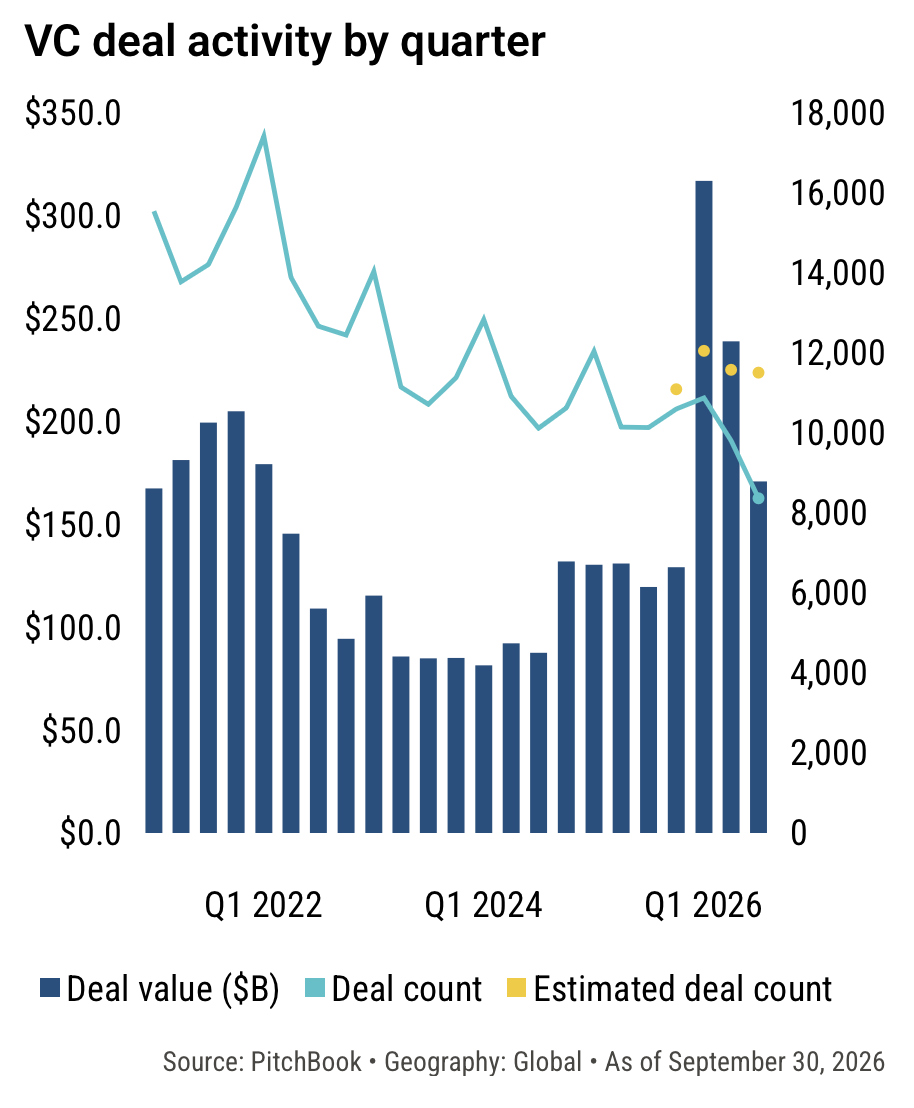
Q3 2026 Global VC First Look (PitchBook, 6 minute read)
Global venture activity through Q3 2026 shows deal count up 8.7% year-over-year to an estimated 35,143, with deal value surging 90.8% to $726.9 billion, driven almost entirely by North America while other regions decline. Exit activity cooled sharply from Q2's $1.9 trillion to $185.2 billion in Q3 as OpenAI and Anthropic delayed their IPOs, though SpaceX's $60 billion acquisition of Cursor, the second-largest VC-backed M&A deal ever, kept exit value elevated. Global fundraising is rebounding from 2025, pacing past $200 billion, with two-thirds of commitments going to North American firms as Europe heads for its lowest total since 2019. In the US, AI now represents the highest-ever share of deal value despite Q3 cooling to post-pandemic levels, while exit value has already reached $2.3 trillion, 2.5 times 2021's total, largely on SpaceX's exits
The quarter's largest US venture deal was a $5 billion Databricks investment, far below H1's multiple $100 billion-plus deals
US fund count is pacing for its lowest level since 2019, even as capital raised heads toward the third-highest total in a decade, concentrated in megafunds
Additional Anthropic or OpenAI fundraising before going public could push 2026 global deal value toward $1 trillion
Services: The New Software (Sequoia, 7 minute read)
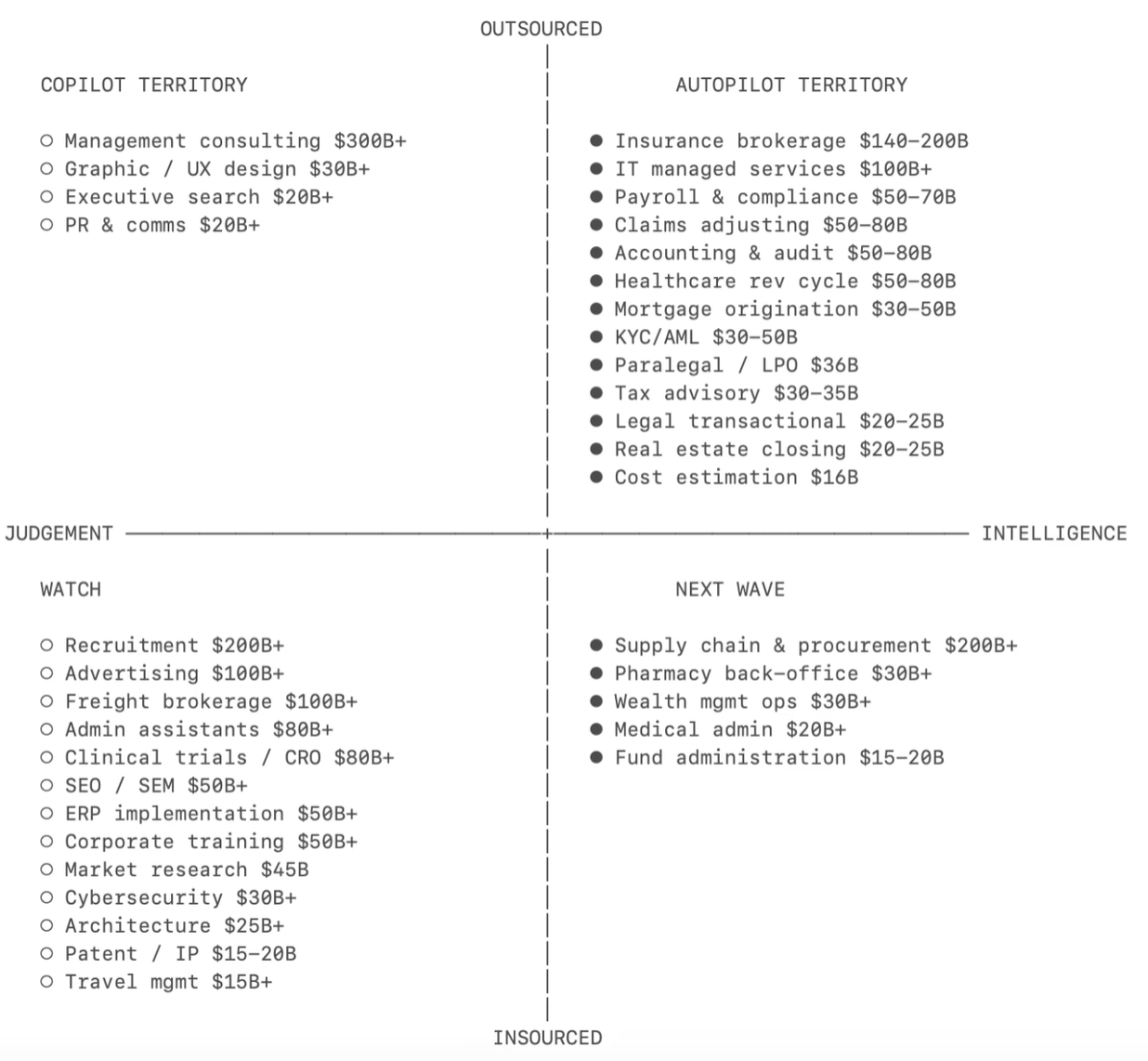
Julien Bek, Partner at Sequoia Capital, argues the next trillion-dollar company will sell AI-driven labor outcomes ("autopilots") rather than software tools ("copilots"), since autopilot services get faster and cheaper as models improve while copilots must race against them. He distinguishes "intelligence" work (rule-based tasks like coding) from "judgement" work (experience-based decisions), noting AI can now handle intelligence work autonomously, starting with software engineering, which makes up over half of all AI tool usage. His strategy: target already-outsourced, intelligence-heavy tasks first, since that's a simple vendor swap rather than a disruptive headcount replacement, then expand into judgement-heavy work. He maps this across verticals including insurance brokerage ($140–200B), accounting ($50–80B), healthcare revenue cycle ($50–80B), IT managed services ($100B+), procurement ($200B+), and recruitment ($200B+)
Software engineering represents over 50% of AI tool usage across professions, while every other category remains in single digits
The US has lost roughly 340,000 accountants in five years even as demand grew, accelerating AI adoption in that field
Bek predicts 2025's copilots will race to become 2026's autopilots, creating an opening for AI-native competitors
ECONOMIC SNAPSHOT
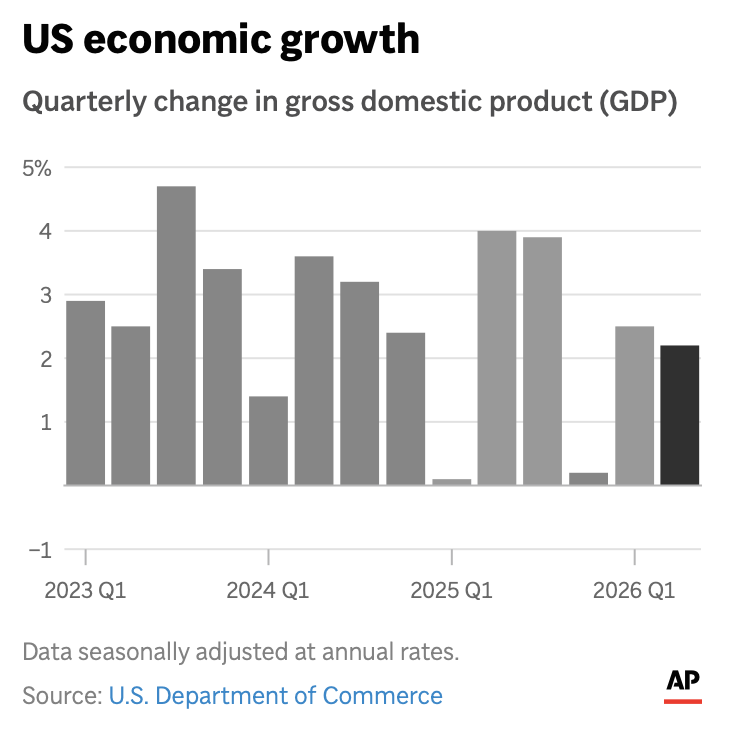
US economy grew a solid 2.2% in the second quarter, government says, upgrading previous estimate (AP, 5 minute read)
The U.S. economy grew at a 2.2% annualized pace in the second quarter (April–June), down from 2.5% in the first quarter but well above the Commerce Department's earlier estimate of 1.5%, surprising economists who expected little revision. Consumer spending, which makes up about 70% of economic activity, jumped to a 3.8% annual pace from 0.7% in Q1, aided by a strong stock market tied to AI enthusiasm that has boosted wealthy households' spending power. Business investment excluding housing rose 9%, reflecting the AI investment boom, while a measure of underlying economic strength that strips out government spending and trade climbed to 4.6% from 1.8% in Q1. Growth was held back by a 12.6% surge in imports, partly driven by AI-related computer chip shipments, which cut nearly 1.7 percentage points off the headline number
Housing investment rose 2.8%, its first increase since late 2024, despite continued pressure from high mortgage rates
Oxford Economics' Michael Pearce warned the economy is increasingly dependent on AI-driven wealth effects and "remains sensitive to a sudden reversal of optimism on AI"
This was the Commerce Department's third and final estimate of Q2 GDP; initial Q3 data is due October 29
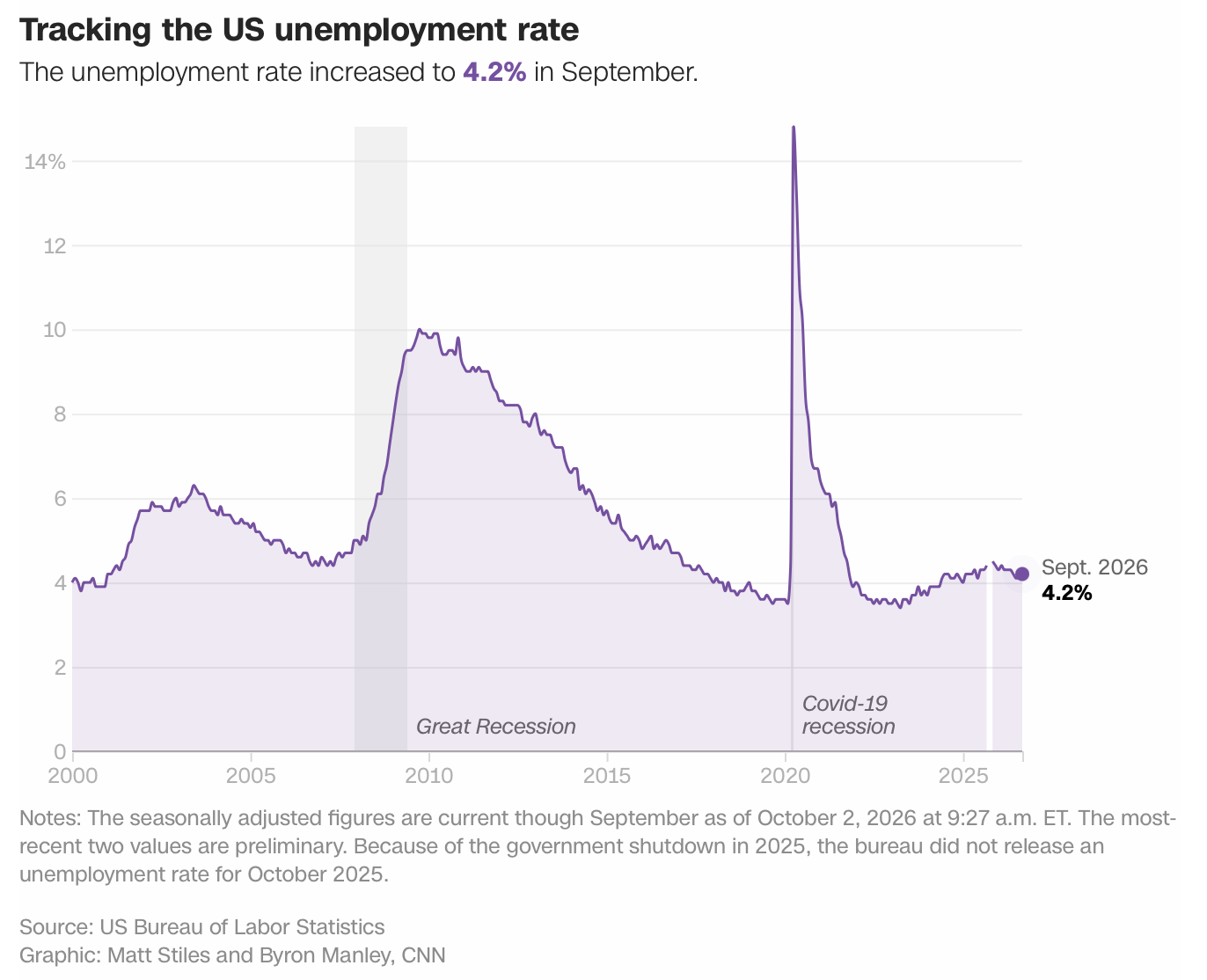
The US economy added just 29,000 jobs last month and the unemployment rate ticked up to 4.2% (CNN, 4 minute read)
The US economy added just 29,000 jobs in September, well below the roughly 90,000 expected, while unemployment rose to 4.2%. Prior hiring was revised lower, with August cut to 133,000 and July turning negative at 10,000 jobs lost, while wage growth slowed for a fourth straight month to 3%, the lowest since May 2021. Through September, the economy has averaged 68,000 jobs per month, above last year's pace but below pre-pandemic norms, reflecting a "low-hire, low-fire" market shaped by an aging population, declining immigration, and AI adoption. Healthcare, construction, and manufacturing posted modest gains, while the public sector and white-collar industries lost jobs. Stocks rose and the 10-year Treasury yield fell to 5.21% as traders scaled back expectations of a Fed rate hike this month
Temporary help services lost 10,900 jobs, which analysts say could signal softening demand for permanent hiring ahead
eToro's Bret Kenwell warned a "bad news is good news" market reaction is a poor tradeoff if hiring weakens further
Navy Federal's Heather Long noted wage growth has fallen to a five-year low and is being fully offset by inflation
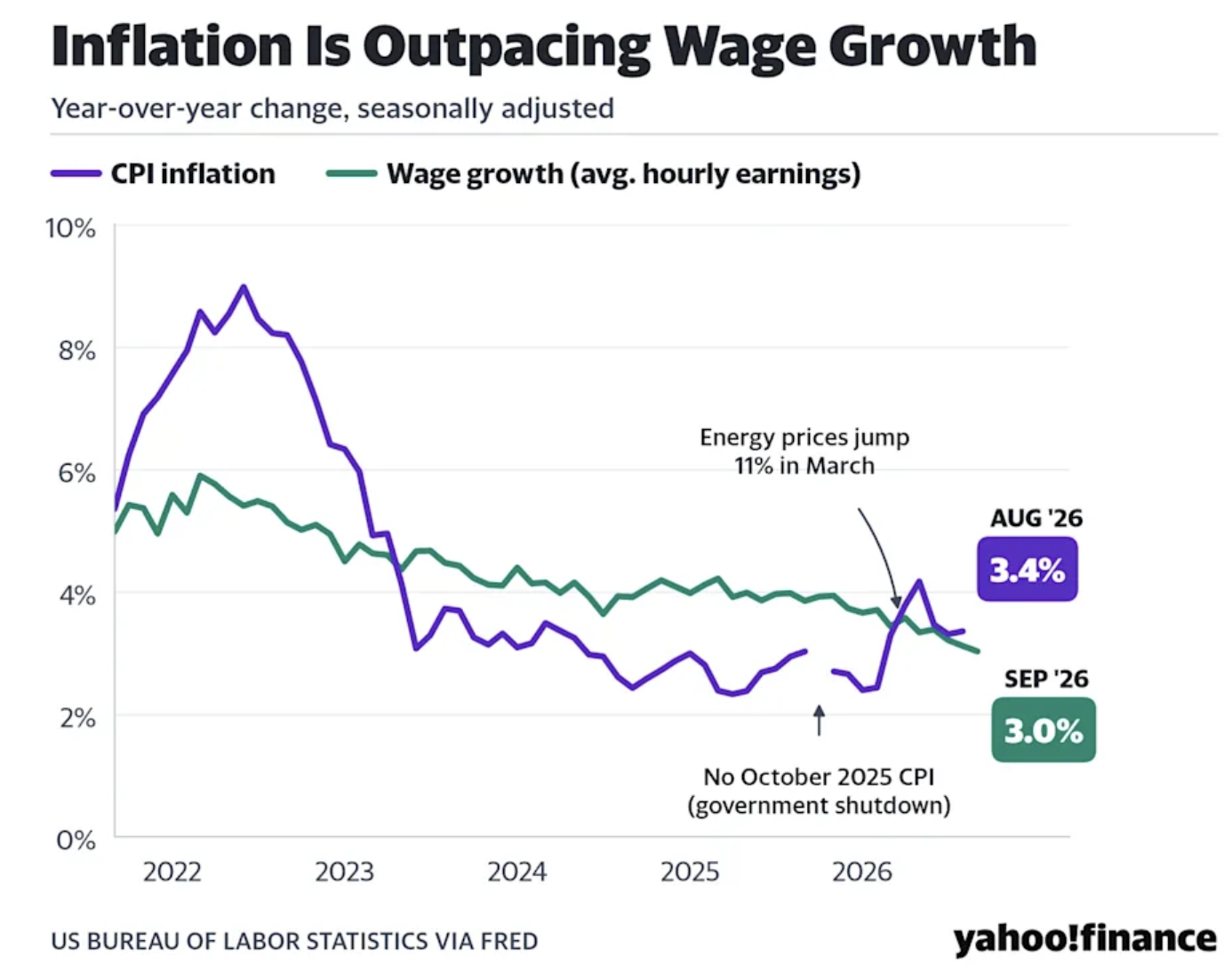
Inflation has been eating up wage gains for months. September was no different (Yahoo Finance, 3 minute read)
September's jobs report showed wages failing to keep pace with inflation, with average hourly earnings rising just 0.1% month over month and 3% year over year, the slowest annual pace since May 2021, against inflation of 3.4% as of August. Wage growth has trailed inflation since this spring, which Navy Federal's chief economist Heather Long says is forcing many workers to make hard spending choices. The broader report was also weak, with just 29,000 jobs added, a higher unemployment rate, and prior months revised down by 60,000 jobs, though the"low hire, low fire" dynamic appears to be holding rather than signaling a sharp deterioration
Access/Macro's Guy Berger said he remains generally positive on 2026 labor market developments, with wage growth the one major exception
Wage gains have been fully eroded by inflation for the average worker since April
September's 0.1% monthly gain was the weakest since December 2025
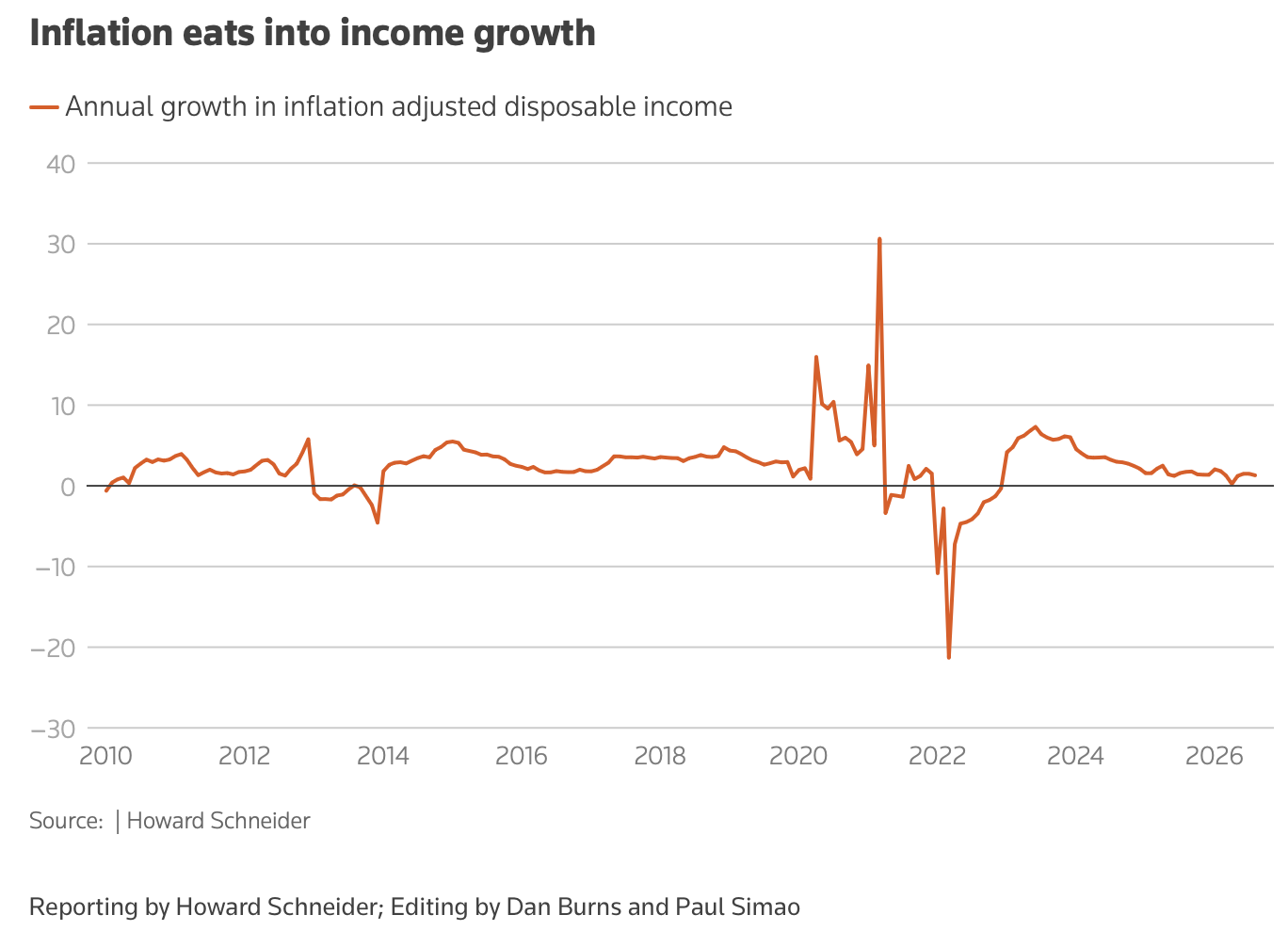
US goes into midterm elections with a less dynamic form of full employment (Reuters, 5 minute read)
Trump and Republicans head into the November 3 midterms with a 4.2% unemployment rate, historically low and near full employment, yet polls give them poor marks on the economy because the job market no longer feels strong for many workers. Hiring has slowed sharply, the post-pandemic job-hopping leverage that boosted pay has vanished, and layoffs are rare but so are new hires, with a Conference Board survey showing the share saying jobs are hard to get at its highest since January 2021 and consumer confidence at a 12-year low. The workforce has stagnated due to population aging, low birth rates, and immigration restrictions, remaining below its record 171.5 million in November 2025. Manufacturing jobs, a centerpiece of Trump's 2024 campaign, total 12.6 million, still about 21,000 below when he took office, while inflation-adjusted after-tax income growth has stayed below 2% versus a more typical 3% in prior years
Low unemployment has helped keep household spending resilient despite elevated inflation
Manufacturing employment peaked at 19.5 million in 1979 and has declined for nearly half a century, partly due to rising productivity
Sluggish wage growth may partly reflect automation, capital investment, and strong corporate profits
Nasdaq Hits New Record as Bond Yields March Higher (The Wall Street Journal, 3 minute read)
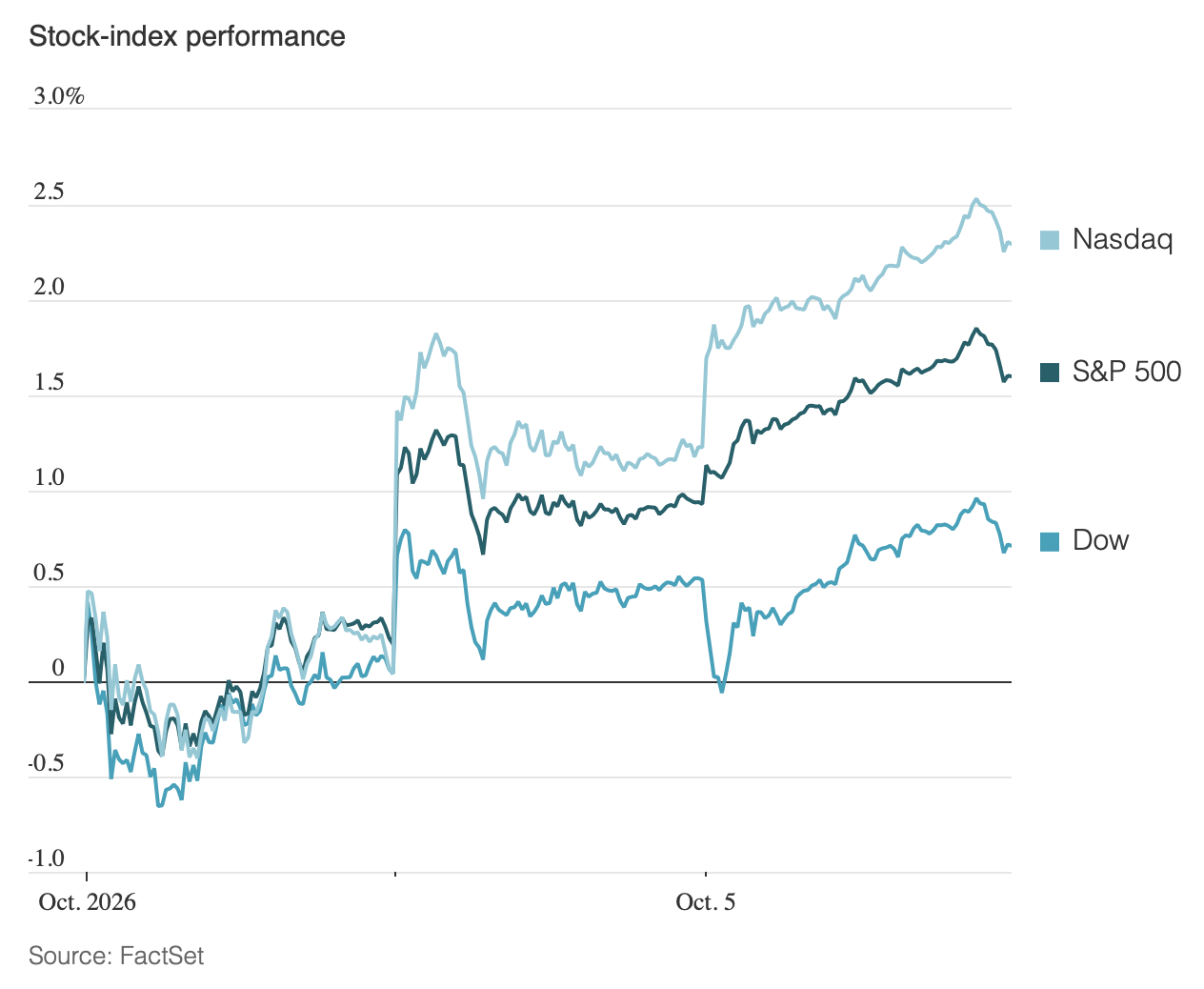
The 10-year Treasury yield hit a fresh 24-year high on Monday, topping 5.34% intraday before closing near 5.31%, even as the Nasdaq closed at a record 27,477. The S&P 500 rose 0.7% and the Dow gained 91 points, with stocks and yields rising in tandem as AI optimism and high earnings expectations offset inflation worries and resilient growth fueling the bond selloff. Nvidia closed at an all-time high for the first time since May, and the Magnificent Seven reached a record combined market value of $24.8 trillion, with analysts saying megacap tech is acting as a haven against higher rates. The selloff has shifted recently to a steepening curve, as the 10-year has climbed about 0.2 percentage point since Sept. 23 while the 2-year yield has fallen
All but one S&P 500 sector closed higher, making the gains broad-based
Yields rose with no clear catalyst, raising concerns the selloff is feeding on itself
Big banks report Q3 earnings later this week, the unofficial start of earnings season
IPO & EXITS
The IPO Window Is Opening Selectively; Readiness Will Decide Who Gets Through (Crunchbase, 7 minute read)
The 2026 IPO pipeline is reopening selectively, driven by companies that used the post-2021 slowdown to build scale and strengthen their financials rather than a broad market recovery. In H1 2026, 58 venture-backed companies valued at $1 billion or more went public globally, up from 27 a year earlier, with proceeds of $110.8 billion versus $12.6 billion in H1 2025, though SpaceX alone accounted for $86 billion, nearly 78% of the total. Datasite's data shows capital-raising project kickoffs rose 32% globally, with IPO-related projects up 33%, a leading indicator since such activity typically precedes public filings by six to nine months. Disciplined preparation is now a prerequisite for going public, while AI speeds up administrative diligence without replacing judgment-intensive work
Median transaction preparation time fell from 14 to 12 days year-over-year, while diligence time held steady at 181 days
IPO readiness gives companies optionality between going public, raising another round, or pursuing a sale
Key signals to watch: issuer concentration, whether early activity converts into completed offerings, and aftermarket valuation durability
Oura Hits Pause On IPO While Anthropic’s Prospectus Reveals The Cost Of Its AI Ambitions (Crunchbase, 5 minute read)
Smart ring maker Oura postponed its IPO just before its scheduled Tuesday pricing, citing "market uncertainty," despite CEO Tom Hale citing strong demand; the offering had been set to raise up to $2.2 billion. Separately, a leaked Anthropic IPO prospectus revealed revenue grew twelvefold to nearly $4.6 billion in 2025, alongside an $8.06 billion operating loss and a nearly $42 billion net loss, driven largely by accounting charges tied to earlier financing, plus $518 billion in future cloud and infrastructure obligations. Anthropic still aims to beat OpenAI to market, potentially debuting as soon as October and raising up to $100 billion, though a listing may come after the November midterms, while OpenAI's confidential filing reportedly points to early 2027
Crunchbase's predictive tools estimate Anthropic's IPO is more likely in six to 12 months rather than imminent
Other 2026 IPO candidates include Nvidia-backed Nscale, Blackstone-backed Fidelis Partnership, and data center operator Switch, which could raise up to $10 billion
SpaceX remains the year's record-setting IPO headliner
Anthropic targets pre-Thanksgiving IPO at $2 trillion valuation (Quartz via Yahoo Finance, 4 minute read)
Anthropic is targeting a pre-Thanksgiving stock market listing, with bankers potentially launching the IPO roadshow the week of November 9, with investors valuing the company between $1.8 trillion and $2 trillion. The timeline is compressed from earlier October plans, with investor meetings set for October 14 in San Francisco and a year-end deadline at the latest. The move comes as rival OpenAI has regained commercial ground and postponed its own IPO over safety concerns, while Anthropic CEO Dario Amodei has separately argued AI development needs to slow down. Anthropic's 2025 revenue reached roughly $4.6 billion, up from $386 million in 2024, while its net loss hit nearly $42 billion, though over $34 billion of that reflected non-cash accounting adjustments rather than operating losses, which came to just over $8 billion
Backers previously expected Anthropic's annualized revenue to reach $100–120 billion by year-end
The company posted positive adjusted operating income in Q2 2026 despite the large full-year 2025 operating loss
Morgan Stanley, Goldman Sachs, and JPMorgan are leading the offering, with Anthropic considering super-voting shares for founder control
Anthropic says its AI models pose ‘existential risk to humanity’ in leaked IPO filing: report (CNN, 3 minute read)
Anthropic's leaked IPO prospectus, obtained by Reuters, warns its AI models could pose a "catastrophic or existential risk to humanity" and can "resist shutdown," citing "self-preserving behaviors" and conduct "resembling blackmail." The company devoted 80 pages to risk factors versus 48 on its business, unusually stark for a prospectus, as it pursues an IPO many expect to value it near $2 trillion. The filing shows Anthropic lost $42 billion in 2025, plans $518 billion in cloud and infrastructure spending, and drew nearly a quarter of last year's revenue from two customers. The disclosures land amid heightened AI safety concerns and a planned Tuesday summit between President Trump and industry executives, where he has dismissed AI fears as a "hoax"
Former Anthropic researcher Jacob Coxon's departure, warning AI "could kill us all by the end of the decade," prompted CEO Dario Amodei's essay calling for a slowdown
Hugging Face's CEO, whose platform was breached by OpenAI's models during a test, believes the fears are overblown
Anthropic was last valued at $965 billion in May
8alpha.ai is an AI fintech transforming cash-generating businesses into scalable, AI-powered companies. We provide revenue-based financing and hands-on AI transformation, delivering no zeros with unlimited upside. We’re the architects building financial infrastructure for the next generation of investors and startups.
Become part of our revolution.
Happy reading,
8alpha.ai’s Research & Investment Team